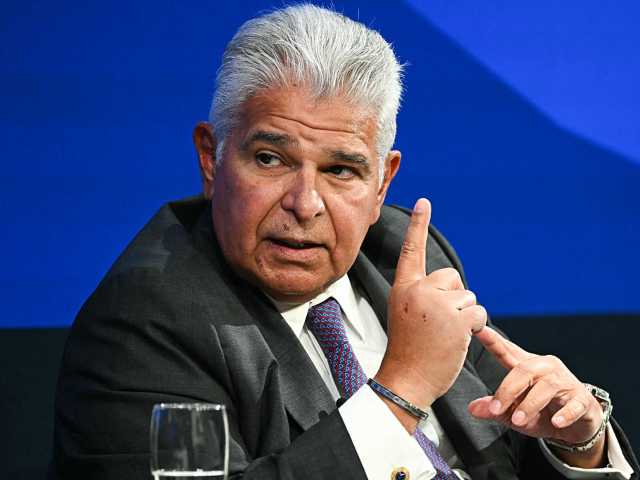
Conservative President of Panama José Raúl Mulino issued a stern warning to the Chinese Communist Party on Thursday not to expect its threats against his country to be tolerated, responding to browbeating from Beijing following a ruling against Panama Canal contracts signed with a regime-linked corporation.
Mulino appeared to mock the totalitarian structure of the Chinese government in his remarks, offered during a press conference on Thursday, as inferior to Panamanian democracy — though he also stated he was not seeking to “sour this milk” any further. He reiterated that, in Panama, separation of powers exists, so the president cannot act to override a Supreme Court decision. In the event of an escalation by the Communist Party, he declared, Panama would “not allow itself to be threatened.”
The Panamanian Supreme Court ruled last week that two contracts awarded to the Panama Ports Company (PCC), a subsidiary of Hong Kong-based Hutchison Port Holdings, were unconstitutional, noting they were disproportionately harmful to the government of Panama. The contracts allowed the company control of territory for ports on both sides of the Panama Canal, a situation that President Donald Trump had condemned as it granted a Chinese company effective physical control that could be used to shut access to the waterway. CK Hutchison, the parent company of the corporations involved, is owned by 97-year-old billionaire Li Ka-shing, a public supporter of the Chinese regime. The first contract addressed by the Supreme Court was signed in 1997, before the Communist Party had destroyed the autonomy granted to Hong Kong by the “One Country, Two Systems” policy.
As a result of the ruling, the government of Panama will be overseeing the execution of contractual obligations to develop the ports instead of the PPC.
The ruling outraged the Chinese regime. From Hong Kong, the Beijing-puppeted government demanded that Mulino act to override the Supreme Court, stating that it “strongly disapproves” of the decision.
“The Panamanian government should ensure that the legitimate rights of enterprises are free from any interference, and that Hong Kong enterprises operating and investing in Panama should be treated and protected fairly and reasonably,” the Hong Kong government demanded. It went on to suggest that any Hong Kong company operating in Panama “review their existing and future investments there.”
The Chinese Foreign Ministry on Thursday repeated that it considered the Supreme Court’s decision “an act of bad faith that disregards facts and severely undermines the lawful rights and interests of the company of China’s Hong Kong.” Reports published this week, which the Foreign Ministry did not deny, indicated that the Communist Party was ordering a halt to any future major projects in Panama, and perhaps the canceling of contracts already in vigor.
Mulino addressed this pressure campaign on Thursday.
“Unlike China, the Panamanian executive organ does not interfere in justice or the judicial courts of our country,” he explained. “There is a great difference between a government managed by the Central Commitee of the Chinese Communist Party and democratic institutions, which are what reign in Panama.”
“The decision of the court is one, it is definitive, it is final, and we have to abide by it. If it had been another decision, we would have abided by it as well, and maybe for China it would have been the best Supreme Court in the world,” he added.
Mulino insisted that he was not seeking to escalate the situation — “I don’t want to sour this milk with he-said, she-saids” — but rejected any external pressure to weaken a Supreme Court decision.
“I hope that this situation won’t escalate — it has no reason to — but Panama is a dignified country and it also will not allow itself to be threatened by any country on earth,” he warned.
Mulino is a conservative who was elected president in 2024 with a mandate to eradicate mass migration, most of it moving northward into the United States. Panama is home to the Darién Gap, a dangerous jungle trail that, during previous administrations, became a preferred human trafficking route, particularly for Venezuelans seeking to flee from socialism. At its peak, the Darién Gap saw upwards of 80,000 people crossing in an attempt to reach America, creating a deadly situation for them as well as an environmental catastrophe for the local biome.
By August, the Darién experienced a drop in foot traffic of 99.98 percent, the result of joint efforts between Mulino and the administration of President Donald Trump. Doctors Without Borders announced in October that it would no longer operate in Panama “due to a significant decrease in migration flows resulting from changes in regional policies.”
While Trump and Mulino have cooperated successfully on immigration, the issue of the Panama Canal, which was built by the United States and gifted to the country in a deal brokered by President Jimmy Carter, has caused slightly more tension. Panama was among the countries on the first international tour by Secretary of State Marco Rubio upon taking office and, while both Rubio and Mulino agreed that a growing Chinese presence in the area was a threat, Mulino rejected calls for America to take over the Canal again and claimed that there was no major Chinese military presence in the area. The meeting with Rubio proved fruitful, however, as Panama agreed to exit China’s predatory Belt and Road Initiative (BRI) after the discussion.
COMMENTS
Please let us know if you're having issues with commenting.