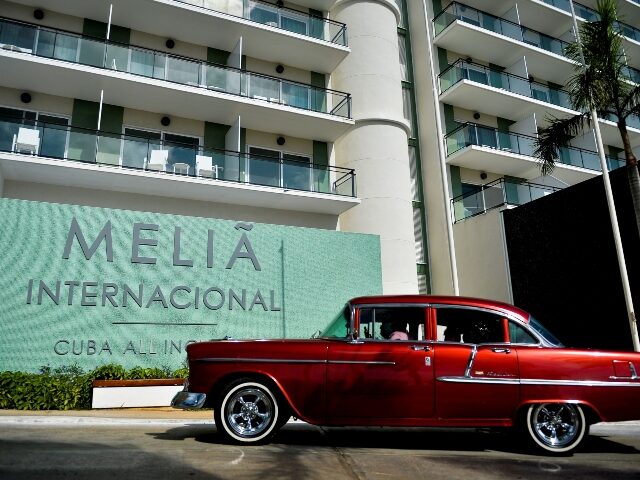

The massive international hotel chain Meliá, based in Spain, announced on Wednesday that it would stop operating 15 of the 34 hotels it currently administers in Cuba.
In a statement made public on Wednesday and shared with the relevant Spanish government economic authority, Meliá explained that it was partially exiting the Cuban market “from a profound sense of corporate responsibility” and “in response to and as a consequence of a combination of unforeseen circumstances beyond the capacity of the management or actions of Ilha Bela,” the Portuguese arm of Meliá. The independent Cuban outlet 14 y Medio reported on Wednesday that Meliá had made the announcement to the authority on May 26 and had previously alerted the Cuban Communist Party of its plans that month, but only made the decision public on Wednesday.
While the statement made public on Wednesday was brief, 14 y Medio noted that a top officer within Meliá had complained at a recent event that the situation in Cuba was “difficult” and “unsustainable” for the company. Meliá will nonetheless maintain 19 properties on the island after no longer administering the 15 announced on Wednesday, three of them in the capital, Havana. The withdrawal from the 15 will mean the corporation no longer manages the hotels nor retains the marketing name and branding of them. Reports indicate that among those Meliá is abandoning is the Gran Hotel Bristol Habana, which locals identified as the luxury destination for international leftists who participated in the “Nuestra América” convoy in March, a coalition of wealthy and famous Marxist activists who visited the island to create propaganda in favor of the communist regime.
Meliá is reportedly the fourth international hotel chain announcing that it is reducing its presence in Cuba, following Canadian company Blue Diamond, Asian company Aston, and the fellow Spanish company Iberostar.
“In total, some 60 luxury hotels (four and five stars) will stop being administered by foreign corporations,” 14 y Medio reported.
Cuba has been experiencing over a half a century of abject poverty, extreme political repression, and widespread human rights abuses as a result of the 1959 coup d’etat by late mass murderer Fidel Castro. While the heinous abuse of the Cuban people had for decades done little to deter European luxury tourism companies from profiting off the situation, in the past year, companies such as Meliá have been reconsidering their presence in the country as a result of two major changes in 2026: Cuba losing access to nearly free fuel from Venezuela after former dictator Nicolás Maduro’s arrest in January, and the government of President Donald Trump imposing sanctions in May targeting Grupo de Administración Empresarial S.A. (GAESA), the Cuban tourism conglomerate.
Towards the end of his life, Fidel Castro navigated Cuba out of the “special period” of the 1990s – following the Soviet Union collapse – by ensuring a parasitic relationship with Venezuela through the ideological bond with then-dictator Hugo Chávez. Cuba for over two decades provided security, espionage training, and international support to Venezuela in exchange for free or low-priced oil, which allowed it to maintain a tourism sector for Europeans and Canadians comfortable with the exploitation of the Cuban people. Following Maduro’s arrest by the U.S. government on January 3, 2026 – an incident during which 32 Cuban regime agents died trying to defend Maduro – Cuba has effectively run out of fuel. In February, the Cuban government alerted airlines that it had no jet fuel, so any stops at its airports would require refueling in neighboring countries, a situation that devastated the tourism industry. While Cuba enjoys alliances with other oil-rich nations, most prominently Russia, these have not intervened to fill the void left by Maduro’s largess.
The updated U.S. sanctions have also caused strife for the Communist Party. Any involvement in the tourism sector in Cuba requires cooperation with GAESA, which is run through the Cuban Revolutionary Armed Forces (FAR) and serves as a cash cow for the small number of elite communist families running the country. In early May, the Trump administration announced personal sanctions on the president of GAESA, Ania Guillermina Lastres Morera, and the corporate entity itself, due to its outsized roll in funding the repression of the Cuban people.
“Cuba is actually not controlled by the government. Cuba is controlled by a military holding company named GAESA,” Secretary of State Marco Rubio explained during a Congressional hearing on Wednesday. “GAESA virtually owns everything: they own the tourist sector, they own the mining, they own the gas stations, they own everything.”
“About 70 percent of Cuba’s GDP is under the control of this military company and they’re sitting on between 14 and 17 billion dollars in assets so you have people literally starving, literally — power grid that hasn’t been maintained in ten years, and you have this holding military company sitting on these assets,” Rubio continued.
The Castro regime appears to be attempting to court the Russian government once more to help it escape the current financial situation. In an article published by Granma, the official newspaper of the Cuban Communist Party, on Thursday, it highlighted that Russian First Vice-Prime Minister Dmitri Chernishenko expressed interest in investing in Cuba during a forum this week.
“Despite external pressure, Russian companies continue to expand their presence in Cuba and are willing to invest in long-term projects,” he claimed, including in the tourism sector.
COMMENTS
Please let us know if you're having issues with commenting.