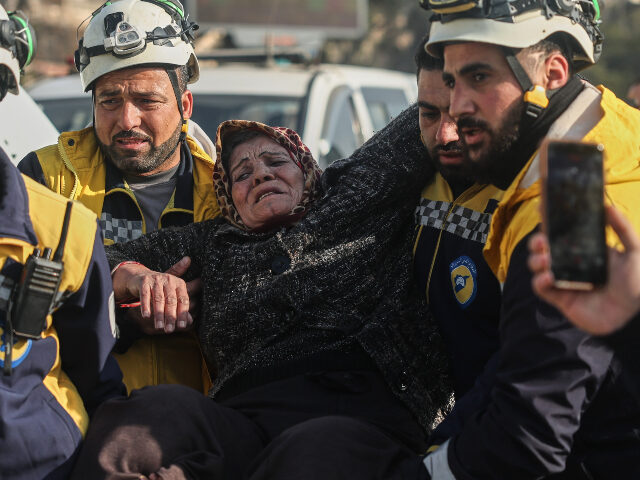
The Syrian Army on Thursday told residents of Kurdish neighborhoods in the city of Aleppo to evacuate in the face of airstrikes, even as the Kurdish-led Syrian Democratic Forces (SDF) said it was winning the intensifying battle for control of the city.
Aleppo has been restless since mid-December, when tensions between the Kurds and the military government headed by former al-Qaeda lieutenant Ahmed al-Sharaa boiled over into a skirmish at a security checkpoint.
The SDF was a major U.S. ally during the war against the Islamic State and it has been pushing for a degree of autonomy from Sharaa’s government, which took control after seizing Damascus and ousting dictator Bashar Assad in December 2024.
The autonomous zone claimed by the SDF includes a swath of northeastern territory and portions of Aleppo, the most important city in the region. The SDF has its own internal police force, known as the Asayish, which operates in the Kurdish-majority districts of the divided city. The checkpoint where fighting broke out in December was jointly manned by the Syrian Army and the Asayish. Each blames the other for shooting first and triggering the conflict.
The situation in Aleppo seemed to stabilize after a few days in December, but on Tuesday a fresh round of even more intense fighting broke out, displacing thousands of civilians and killing at least four. Tens of thousands of Kurdish civilians were seen fleeing Aleppo for the presumably safer ethnic enclave of Afrin.
As before, the Syrian Army and the SDF blamed each other for renewing the conflict. The Syrian Army accused the SDF of using civilians as human shields, while the SDF posted videos that appeared to show the Syrian Army deliberately shelling civilian homes and a hospital in Aleppo.
Unlike the previous flare-ups, Tuesday’s skirmish intensified instead of subsiding. The Syrian Army said on Thursday it intends to drive all Kurdish armed forces out of Aleppo, while SDF and Asayish officials claimed they were beginning to push government troops back and secure their control of the Kurdish quarter in Aleppo after three days of fighting.
The Asayish said on Thursday that at least 12 people were killed and 64 injured in “indiscriminate and brutal attacks” by government military and paramilitary forces on two Kurdish neighborhoods in Aleppo, and many civilians remained “trapped under the rubble of buildings” destroyed in “continuous and intense bombardment by tanks, artillery, and drones.”
The Syrian Army responded by claiming the positions it bombed in Aleppo were “legitimate military targets,” and an even larger operation would commence soon. The military opened several “humanitarian corridors” to evacuate civilians from the areas that were coming under attack.
U.S. Ambassador to Turkey Tom Barrack, who also serves as President Donald Trump’s special envoy to Syria, said on Thursday that the United States is “closely following developments” in Aleppo with “deep concern.”
“We urge all parties to exercise the utmost restraint and to place the protection of civilian lives and property above all other considerations,” Barrack said.
He hailed the “historic strides” Syria has made toward “stability, national reconciliation, and reconstruction” after the long and brutal Syrian civil war ended with the fall of Assad, but he noted “the deep scars of prolonged conflict require time to heal.”
The ambassador offered the assistance of the United States, its allies, and “responsible regional partners” with de-escalation, and urgently appealed to “the leadership of the Syrian government, SDF, local authorities in Kurdish-administered areas, and all armed actors on the ground” to cease hostilities.
“At this critical juncture, the region must stand united against disruptive external forces and their proxies that seek to undermine the remarkable progress achieved in the past year, and to erode the enduring legacy of President Donald Trump’s Middle East peace initiatives,” he said.
It was not immediately clear if Turkey sat on the “responsible regional partner” or “disruptive external forces” side of that equation. Turkey regards armed Kurdish factions in Syria as a threat to its national security, and strongly supports efforts by the new government in Damascus to absorb the SDF.
On Thursday, the Turkish Defense Ministry offered to assist the Syrian Army with “counter-terrorism” operations in Aleppo, although it stressed that all of the fighting to date was “carried out entirely by the Syrian Army.”
“If Syria requests assistance, Turkey will provide the necessary support,” the Turkish Defense Ministry said.
“We are ready to provide all kinds of support for the immediate end of the clashes in Aleppo and the establishment of peace and stability,” added Turkish Parliament Speaker Numan Kurtulmus.
Turkish Kurds held a massive protest in the southeastern city of Diyarbakir on Thursday, and a smaller one in Istanbul, to protest the operation by Syrian government forces in Aleppo.
The Istanbul march was broken up by riot police, with about 25 arrests, apparently because the protesters unfurled a huge banner of Abdullah Ocalan – the jailed leader of the Kurdistan Workers Party (PKK), which is banned as a terrorist organization in Turkey.
In the Turkish capital of Ankara, lawmakers from Turkey’s pro-Kurdish DEM party protested in front of parliamentary headquarters and denounced the attacks on Aleppo’s Kurds as a crime against humanity. The party also slammed the police action against protesters in Istanbul as “unacceptable” and “brutal.”
COMMENTS
Please let us know if you're having issues with commenting.