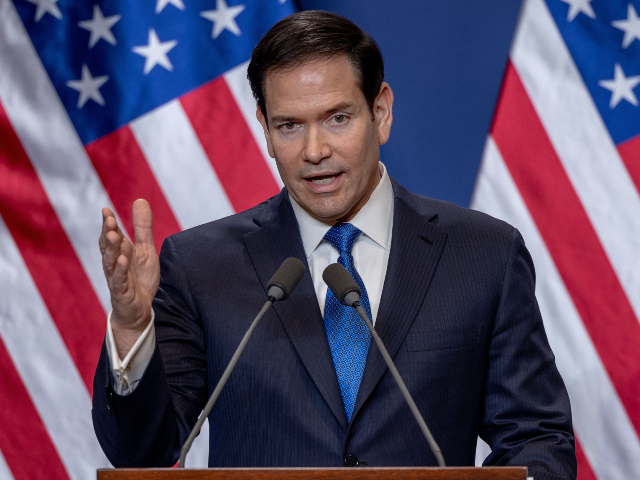
Secretary of State Marco Rubio said on Sunday that President Donald Trump “engaged personally” with Syrian President Ahmed al-Sharaa and Syrian Democratic Forces (SDF) command Mazloum Abdi to halt clashes between the Syrian army and the Kurdish-led SDF in late January.
“The President engaged personally not once but twice with al-Sharaa, and he said stop the fighting so that we can move the ISIS prisoners that are there,” Rubio said at a press conference with Slovakian Prime Minister Robert Fico in Bratislava on Sunday.
“He said, ‘Stop the fighting so that we can move these ISIS prisoners and so that you can — we have more time to work on this reintegration, the integration of the Kurds into the national Syrian forces,’” Rubio said.
Rubio was referring to the massive prison camps holding Islamic State fighters and their families, which have been administered by the SDF for the better part of a decade. The SDF began withdrawing its forces from the camps under attack from the Syrian national army last month, raising fears that prisoners might escape.
The U.S. has been simultaneously pressing al-Sharaa to secure the camps and transferring as many ISIS prisoners as possible to secure facilities in Iraq. On Thursday, the U.S. Central Command (CENTCOM) announced that 5,700 adult male ISIS fighters have been successfully transferred to Iraqi custody.
Rubio said the U.S. missed a “Ukraine meeting” with four European powers at the Munich Security Conference on Friday because “we were meeting with Syria and the Kurds.”
The meeting in question included Abdi, Syrian Foreign Minister Assad al-Shaibani, and Ilham Ahmed, who is co-chairman of foreign relations for the Democratic Autonomous Administration of North and East Syria (DAANES), essentially the political wing of the SDF.
Rubio said the meeting was “historic” and would help to solidify the ceasefire agreement between Damascus and the SDF that was brokered by the United States in late January.
“Now, let me say that no one here has ever disputed that the challenge of Syria was going to be a very significant one, a very significant one,” Rubio continued.
“We are dealing with elements that, as we’ve said in the past, you know, we have, you know, concerns about things that they have done in the past,” he noted.
Rubio addressed complaints that the U.S. did not stand firmly enough behind the SDF, which was a major American ally during the brutal war against the Islamic State, by arguing that unifying the country after the fall of dictator Bashar Assad was a vital security objective.
“The bottom line was we had two choices in Syria. Choice number one was to let the place fall apart into 18 different pieces: long-term civil war, instability, mass migration, a playground for terrorists, ISIS running all over the place, Iran getting back in — that was choice number one. Choice number two is to try to see if it was possible to work with these interim authorities and President Al-Sharaa and with his team,” he explained.
“Guess what? We chose number two because it’s what made sense,” he said.
“The truth is when the recent events in northeast Syria occurred, President Trump himself got involved in the matter. Twice he told President Mazloum: stop the fighting. This way, we can transfer thousands of ISIS prisoners, some of whom had managed to escape from prison,” he said.
“We also needed more time to unify coordination within the Syrian army. Mazloum listened to President Trump and stopped the fighting. We were able to do that,” Rubio said.
Rubio said “we like the trajectory” of developments in northeastern Syria since the ceasefire deal, although he noted there is still work to be done, as other disaffected groups like the Druze, Bedouin nomads, and Alawite Muslims will want security guarantees like those given to the Kurds.
“We’ve got good agreements in place. The key now is implementation, and we’ll be very involved in that regard,” he said.
Reuters noted over the weekend that “preliminary steps have gone smoothly since the Jan. 29 agreement” as “small contingents of government forces have deployed into two Kurdish-run cities, fighters have withdrawn from frontlines, and Damascus on Friday announced the appointment of a regional governor nominated by the Kurds.”
Lingering issues include how the SDF will be integrated into the Syrian national military — the SDF wants to keep its units together under their longtime commanders, while Damascus wants to disperse them across the military roster — and how much autonomy the SDF/DAANES will retain.
The SDF is also keen to maintain border transit routes into Iraq that have long served as supply lifelines for its forces. The central government took control of the SDF’s border crossing at al-Rabia in January. Damascus, meanwhile, is pressing the Kurds to relinquish control of two key oil fields and an airport near the city of Qamishli.
A key element of the arrangement praised by Rubio appears to be that the SDF will surrender much of the territory it once controlled, but internal security in the Kurdish region will be managed by their own trusted internal security force, known as the Asayish. This might prove unacceptable to Turkey, which strongly supports the Sharaa government and regards all armed Syrian Kurdish forces as security threats.
COMMENTS
Please let us know if you're having issues with commenting.