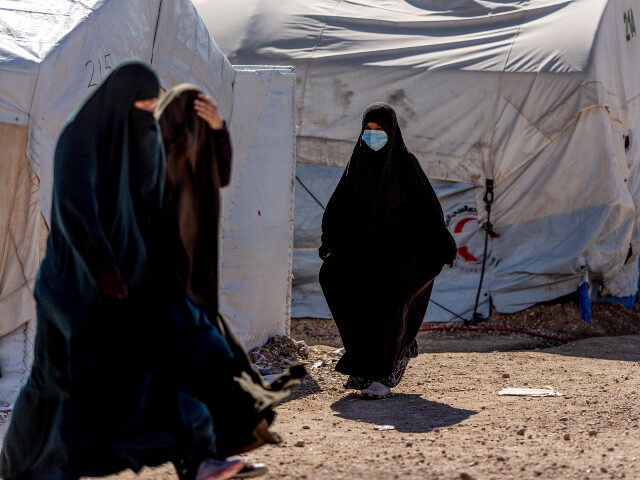
Australian Home Affairs Minister Tony Burke said on Wednesday that his office has issued a “temporary exclusion order” against one of the 34 Australian citizens who were linked to the Islamic State and have been held in Syrian camps for years.
The Syrian government is eager to repatriate as many of the long-imprisoned militants as possible, after taking custody of the camps from the Kurdish-led Syrian Democratic Forces (SDF).
The saga of the 34 Australian returnees began on Monday, when they were released from the Roj prison camp in Syria, a sprawling complex that has held over 2,000 ISIS prisoners from 40 different countries since 2019.
According to camp authorities, the people held at Roj were mostly the wives and children of ISIS fighters. Their ultimate fate has been uncertain since the collapse of the Islamic State “caliphate” in Syria and Iraq because their home countries have been reluctant to repatriate them, viewing many of them as enduring security risks.
The task of warehousing the ISIS wives fell to the SDF, the militia force of the semi-autonomous Kurdish region of Syria. The SDF was an important Western ally in the fight against the Islamic State, but after the fall of Syrian dictator Bashar Assad in late 2024, the Kurds found themselves at odds with the new United States-supported government in Damascus.
Those tensions erupted into violence in late 2025, as the SDF clashed with Syrian government troops in a conflict that spread from the divided city of Aleppo. A ceasefire was brokered by the United States in January, with an eye towards fully integrating the SDF into the central government and military.
The SDF was obliged to fall back from the ISIS prison camps it had long maintained, turning the prisoners into a political football that could no longer be punted. The U.S. oversaw a transfer of the most dangerous detainees into secure facilities in Iraq, while Damascus urged other governments to repatriate the lower-threat prisoners.
Australian Prime Minister Antony Albanese flatly refused to take back any of the Australian citizens held in Syria, but later his government suggested it might be willing to transfer some of them into Australian prisons.
“People in this cohort need to know that if they have committed a crime and if they return to Australia they will be met with the full force of the law. The safety of Australians and the protection of Australia’s national interests remain the overriding priority,” the Albanese administration said on Monday, when news that 34 Australian nationals had been released into the custody of family members from the Roj camp.
The detainees were quickly returned to the camp for unspecified “technical reasons,” even though they had already boarded buses for Damascus.
On Tuesday, Albanese reiterated his firm stance against “providing assistance or repatriation.” Opposition politicians agreed that people who embraced the extremist ideology of the Islamic State should never be allowed to return.
On Wednesday, the Australian government’s refusal to accept the “ISIS brides” appeared to soften – with one unnamed exception.
“I can confirm that one individual in this cohort has been issued a temporary exclusion order, which was made on advice from security agencies,” Home Affairs Minister Burke said in a statement on Wednesday.
Burke added that security services have “not yet advised” if any of the other 33 potential returnees should suffer a similar prohibition. The legal authority invoked for the ban was a relatively obscure clause of a 2019 law that has never been used before.
Albanese insisted that his government would not support the return of detainees aligned with a “brutal, reactionary ideology” that “seeks to undermine and destroy our way of life.”
“It’s unfortunate that children are caught up in this, that’s not their decision, but it’s the decision of their parents or their mother,” he said on Wednesday.
One of the unmentioned factors in Albanese’s wavering position appears to be the surging popularity of the populist, anti-migration One Nation party, which has been hammering his government for even thinking about accepting Islamic State prisoners from Syria.
On Tuesday, One Nation leader Pauline Hanson demanded an explicit and permanent ban on returning Islamic State militants, including the “ISIS brides.”
“They made their bed, now it’s time for them to lie in it,” she said. “These people travelled to a war torn country to support their husband-terrorists. They have no place in our society.”
“The government is claiming there’s nothing they can do to stop them returning. That’s nonsense,” she continued. “The government could issue a Temporary Exclusion Order, or even cancel their passports and refuse to issue travel documents. They haven’t done anything to stop these terrorist supporters returning.”
Hanson went on to accuse Burke of going soft on the ISIS brides because he was “caught receiving campaign help from the Muslim community leader who is allegedly coordinating the return from Australia.”
Hanson was referring to Burke’s close association with Dr. Jamal Rifi, a longtime friend and supporter. Rifi, a Lebanese Muslim, has been a leader in the effort to repatriate the detainees from Syria.
Interestingly, some of Albanese’s latest statements on the repatriation issue are identical to Hanson’s comments, even borrowing some of her exact words – he said “if you make your bed, you lie in it” in an ABC Radio interview on Tuesday – but the Sydney Morning Herald quoted the befuddled governor of the Roj prison camp insisting that the Albanese government has quietly “issued passports and the necessary documents” for all of the Australian citizens detained at the camp.
COMMENTS
Please let us know if you're having issues with commenting.