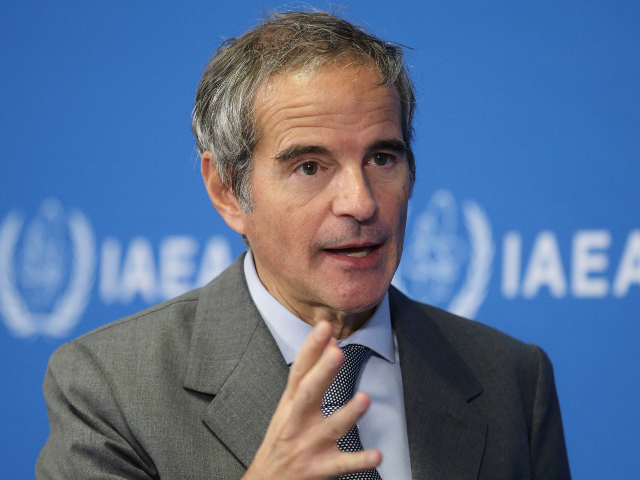

Rafael Grossi, the head of the International Atomic Energy Agency (IAEA) told an Italian newspaper on Wednesday that he believes the governments of Iran and the United States could hold talks to end their current conflict as recently as this weekend, mediated by Pakistan.
“I think there could be talks in Islamabad, Pakistan this weekend,” Grossi told Italy’s Corriere della Sera. Grossi predicted that any talks between Washington and Tehran would include a wide range of topics, from neutralizing Iran’s ability to promote international terrorism to limiting its illicit nuclear development, as well as Iran’s demands for the United States to lift sanctions on the rogue Islamist regime.
Grossi is the head of the United Nations agency tasked with ensuring that countries follow international law on nuclear development. As such, he has for years taken on a protagonist role in addressing the ongoing threat of Iran obtaining nuclear weapons. The Iranian regime insists that it is only interested in developing civilian nuclear energy production, but engages in activities such as uranium enrichment far above the threshold necessary to sustain civilian nuclear power plants.
The IAEA was instrumental in the eruption of hostilities between Iran and the West that began last year. During an update to the agency’s board in June, Grossi explained that Iran was not being transparent about its nuclear development and worked to “sanitize” nuclear sites before IAEA inspectors could reach them. As a result, the IAEA passed a resolution condemning Iran, shortly before President Donald Trump announced airstrikes to neutralize uranium enrichment at Iran’s Natanz, Fordow, and Isfahan nuclear sites.
Speaking to Corriere, Grossi stated that he believed the talks he predicted in Islamabad between the American and Iranian governments would “not only concern nuclear power … this time on the table will also be missiles, militias allied to the Islamic Republic, security guarantees for Iran.” He stated that he was not yet planning to go to these talks in Pakistan, but that he was “available” if necessary.
Asked about the potential for success in these talks, Grossi suggested that significant leverage exists to come to some agreement as there is currently an ongoing war – “Operation Epic Fury,” the Pentagon operation President Trump announced on February 28 that eliminated “supreme leader” Ali Khamenei. America and Israel have since announced the elimination of dozens of high-ranking Iranian government officials.
“Three weeks of war that have left their mark. Which caused a lot of damage, affected Iran’s economic, energy, and productive infrastructure,” Grossi observed. “This will make the conversation a little different.”
The IAEA chief suggested that American negotiators would no longer accept a deal in which Iran reduced its enrichment of uranium but, rather, “zero enrichment.” Grossi also repeated his assessment that concerns about Iranian enrichment were valid because Iran had processed, his agency estimated, 400 kilograms of uranium to 60 percent enrichment.
“60 percent is a quasi-military level. The Iranians say that those who have the right to do so can do so, and this cannot be denied, but it is a worrying development. No country in the world that does not possess nuclear weapons enriches at this level,” he asserted.
He nonetheless added his belief that “agreement on this point is possible” with a deal requiring, for example, that “there will be no more enrichment at the moment because the political, military, and confidence situation does not allow it; and, in principle, to reevaluate the issue in five or ten years.”
Grossi’s interview followed reports that Pakistan government officials had already begun fielding messages from America to Iran and back in indirect negotiations. On Wednesday, alleged Pakistan officials stated that Washington had drafted, and Pakistan had delivered, a 15-point peace plan to the Iranians.
Iranian officials have publicly insisted that no such negotiations have occurred, though President Trump has repeatedly stated that his team is in discussions with their Iranian counterparts. In an interview late on Wednesday, Iranian Foreign Minister Abbas Araghchi insisted that “no negotiations with the U.S. are underway,” according to the Iranian state outlet Mehr News.
“Speaking in a televised interview late on Wednesday, Iran’s top diplomat stressed that Iran’s current policy is to continue resistance in the face of ongoing unprovoked U.S. and Israeli aggression waged against Iran,” Mehr claimed.
“The fact that they are now talking about negotiations is itself an admission of defeat. Weren’t they the ones talking about ‘unconditional surrender’?” Araghchi claimed, recalling a comment on Truth Social by President Trump. “So why are they now mobilizing their highest-ranking officials to pursue negotiations?”
Contrary to Araghchi, Mehr published a report this week, citing an anonymous Iranian official, claiming that Tehran had “responded negatively to” an American peace proposal — an act that would be impossible without some level of negotiation between Iran and America. After rejecting the American terms, Mehr reported, the Iranians responded with their own peace plan, which would require the United States to pay Iran “reparations” and retain full control over the Strait of Hormuz.
COMMENTS
Please let us know if you're having issues with commenting.