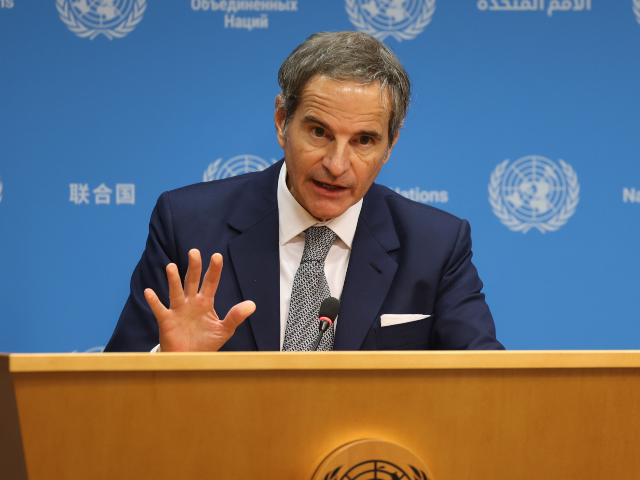

The U.N.’s top nuclear energy official dismissed the possibility of using the 2015 Joint Comprehensive Plan of Action (JCPOA), the Obama-era Iran nuclear deal, as a basis for any new agreement in comments at a press conference on Wednesday.
Rafael Grossi, the head of the International Atomic Energy Agency (IAEA) and a candidate to replace Antonio Guterres as the next U.N. secretary-general, addressed the press as reviews begin to assess whether signatories to the Treaty on the Non-Proliferation of Nuclear Weapons (NPT) are abiding by their responsibilities. Iran, a terrorist rogue state that has for over a decade invested in nuclear development incompatible with civilian uses, is a signatory to the NPT.
Grossi responded negatively to a question asking if attempts to draft a long-lasting agreement on Iran’s nuclear program should look to the JCPOA as a basic template.
“Iran in the past few years has had an exponential progress in its program. It has last generation centrifuges, it has different compounds in Esfahan, and we were talking about just new facilities,” Grossi said. “So, it’s a completely different ballgame, as one would say here in America. So JCPoA could not constitute a basis We need to look into something different.”
Elsewhere in his remarks, Grossi suggested that finding common ground on how to limit Iran’s nuclear development to ensure the safety of the world was especially difficult currently due to discord within the U.N., and especially the Security Council.
“In the past, we would have resolutions adopted without a vote at this United Nations Security Council on Iran,” he noted. “Many, several. And then, equally, when the JCPoA was adopted. That common denominator among the membership and in particular the five permanent members of the Security Council is no longer there.”
“It doesn’t mean, and we should strive for that maybe, it doesn’t mean that we cannot reconstruct some degree of consensus around what is happening there. But at the moment, unlike in the past, we don’t have it,” he added.
Iran has two powerful allies on the Security Council — Russia and China — that regularly vote to support the terror state’s interests. Russian officials have openly demanded that any future nuclear deal essentially be the same as the JCPOA.
President Donald Trump withdrew the United States from the JCPOA, brokered by former President Barack Obama, in 2018, citing Iran’s routine violations of its commitments. The deal technically still exists, as several other countries, including Iran, remain parties to it, but Grossi has publicly lamented that “nobody follows it” and it has no practical use currently. Iranian leaders have for years insisted that their prodigious uranium enrichment is not a threat to any outside party, despite the regime regularly organizing events in which chanting masses declare “death to America” and “death to Israel.”
“Nobody applies it, nobody follows it,” Grossi complained about the JCPOA in 2024. “There have been attempts to revive it here in Vienna. But unfortunately, although they were relatively close to success, they failed for reasons unknown to me, because I was not involved in the process.”
As a result of Iran’s violations of its nuclear responsibilities, President Trump announced airstrikes against the three largest known nuclear facilities in the country, located in the cities of Isfahan, Natanz, and Fordow in June 2025. Trump launched a separate military engagement known as Operation Epic Fury on February 28 that eliminated Iran’s “supreme leader” Ayatollah Ali Khamenei and, in conjunction with Israeli operations, dozens of senior Iranian officials. Iranian leaders responded by launching bombing campaigns against over a dozen unrelated neighboring countries, including the United Arab Emirates (UAE), Turkey, and Azerbaijan.
Hostilities between Washington and Tehran are currently on pause as part of an indefinite ceasefire announced by President Trump, which he has stated publicly is necessary to allow what remains of the Iranian government to regroup after many top leaders were killed.
Of top concern for the American government, and the IAEA, is the status of the enriched uranium believed to have been stored in the three facilities bombed in 2025. Reports suggest that nuclear officials believe that Iran currently possesses 972 pounds of highly enriched uranium. Grossi emphasized on Wednesday that the IAEA has not been allowed into the country to inspect sites and confirm the presence of this material in any given place, though he allowed for the fact that Iran has been engaged in a military conflict since February, complicating the possibility of a nuclear inspection.
“There is no peace. There is only a ceasefire,” he observed. “And there is probably this difficulty in accessing. Until my inspectors can go and verify that there is no access, we cannot confirm that this is the situation.”
Prior to the press conference, Grossi met with a top State Department official on Tuesday. According to a message and accompanying photo the IAEA chief posted on social media, the two discussed, among other issues, “the current situation in Iran.”
Grossi guessed that most of the known enriched uranium in Iran remains in Isfahan, describing it as a “best estimate” derived from the information the IAEA possessed shortly before the American airstrikes in 2025.
COMMENTS
Please let us know if you're having issues with commenting.