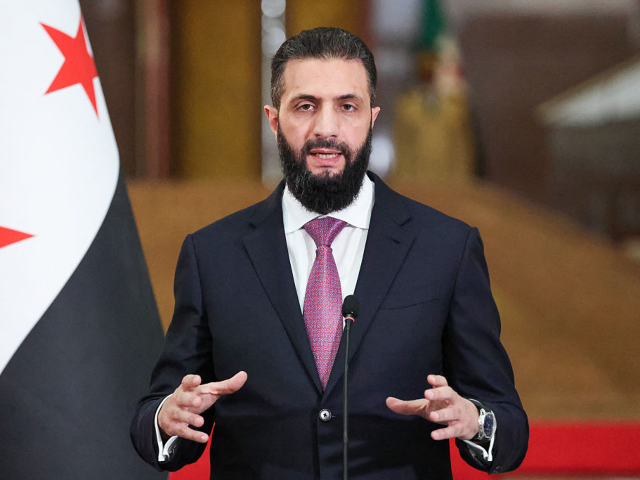

Syrian President Ahmed al-Sharaa paid for a coffee in Damascus using a Visa card on Wednesday, a common sight in most countries but unprecedented in the modern history of his country as it represented the first such transaction since Syria was removed from the U.S. State Sponsors of Terrorism (SST) list.
The State Department first announced in July that President Donald Trump had approved beginning the process of removing Syria from the SST, a designation reserved for the world’s most hostile and prolific terrorist powers. Syria was placed on the list in 1979, during the reign of dictator Hafez Assad, in recognition of the country’s ties to the world’s premier state sponsor of terrorism, Iran, as well as its links to a network of jihadist terrorist organizations around the world. More recently, during the tenure of Hafez’s son Bashar Assad, Syria was associated with Iranian proxy terrorism groups such as Hezbollah and maintained close ties to rogue states such as Cuba, Russia, and Venezuela.
The current Syrian government took power in December 2024, toppling the Assad regime and forcing Assad and his family to flee to Russia. Sharaa, an al-Qaeda associated jihadist previously known as “Abu Mohammed al-Jolani,” led his militia, Hayat Tahrir al-Sham (HTS), to victory in the Syrian civil war that began in 2011 when Assad responded to protests against his regime with outsized violence, prompting the nation’s descent into a chaotic war that at one point included as many as ten warring parties. After HTS took over the country, al-Sharaa began using his true name, wearing Western-style suits, and launched a global campaign urging friendly states to invest in the reconstruction of the country.
President Donald Trump first met Sharaa and the behest of the government of Saudi Arabia in May 2025 and left the encounter impressed, describing Sharaa as a “young, attractive guy” with “a real shot at pulling it together.” He has since met Sharaa at the White House and welcomed Syria into the global coalition against the Islamic State, reiterating his confidence in Sharaa’s leadership and vowing to lift Assad-era sanctions on the country.
Following the expiration of a 45-day waiting period, Syria exited the SST list this week.
The Syrian government made a spectacle of Sharaa visiting a cafe in Damascus with Syrian Central Bank governor Mohammed Safwat Raslan and buying a coffee with a Visa card, an action previously unthinkable in the country. The Syrian government’s rapid response social media page — also debuting this week as the SST list removal now allows the government’s presence on American-owned online platforms — noted that it had been over 15 years since a Visa card was used in Syria.
“For more than fifteen years, this simple transaction was impossible. Today, in the oldest continuously inhabited capital in the world, Syria’s return to the global financial system became a fact,” the page declared.
Visa explained in a press release that the “first live international transaction in Syria” was completed with the cooperation of the Lebanese bank Fransabank and the digital payment company Paymera.
“The test is the start of a historic step toward expanding digital payment capabilities in the market and providing international visitors with a familiar, secure, and convenient way to make payments,” Visa declared.
Visa’s regional vice president and group country manager, Leila Serhan, said in a separate statement that Visa had been working for “several months” in anticipation of the return of global digital banking to Syria, as the Trump administration had signaled that it would soon lift the sanctions preventing such actions.
“We are excited to have successfully tested live transactions today as we plan to enable international visitors to use their Visa cards while in Syria. This is an important milestone in the development of Syria’s payments ecosystem,” Serhan said.
Central Bank governor Raslan, who was present for the coffee purchase, also expressed enthusiasm at the development, which will make travel by foreigners into Syria, both tourists and businesspeople, significantly easier.
“For the first payment transaction using a Visa card to take place in the heart of Damascus the day after Syria’s name was removed from the list of state sponsors of terrorism, is — for me — a feeling that’s hard to sum up in words,” Raslan was quoted as saying.
The Emirati newspaper The National observed that Visa is far from the only actor preparing for large-scale financial operations returning to Syria. Mastercard announced on Thursday that it, too, had processed its first international card payment in Syria in over 15 years, alongside QNB group. Mastercard and QNB had announced in May that they were preparing to establish “a comprehensive international card payment acceptance in Syria including Point of Sale, e-Commerce, and SoftPOS” — services pivotal to restaurants and cafes in particular.
“Both parties are working together with the Central Bank of Syria, ensuring alignment with applicable regulatory, operational and risk management requirements and reflects a shared commitment to strengthening the payments ecosystem in the country,” the companies explained.
Secretary of State Marco Rubio confirmed on Monday that Syria was officially no longer a State Sponsor of Terrorism, opening the door to a host of previously banned economic activities. He credited al-Sharaa personally with changing the trajectory of the country to make such a shift possible.
“These actions were all taken in recognition of the positive actions taken and further commitments by the Syrian government under President Ahmed al-Sharaa to fully distance Syria from acts of international terrorism,” Rubio wrote in a statement. “In the past year, the Government of Syria has taken significant steps to counter terrorism, to include formally joining the Global Coalition to Defeat ISIS in November and conducting operations to disrupt the terror networks of ISIS, al-Qa’ida, Hizballah, and Iran-aligned groups.”
Sharaa confirmed the move in a national speech on Monday in which he congratulated Syrians for their part in the development and personally thanked Trump for his confidence.
The American president revealed in early July that he would approve the move off of the SST list, answering to a reporter asking about Syria’s status, “Why wouldn’t I?”
“Syria had one of the great cultures — the professors and lawyers and doctors — it had one of the great cultures of any country, not just the Middle East,” Trump said, “and then it went through this terrible period of time… They’re proud of the job he’s [Sharaa’s] done.”
COMMENTS
Please let us know if you're having issues with commenting.