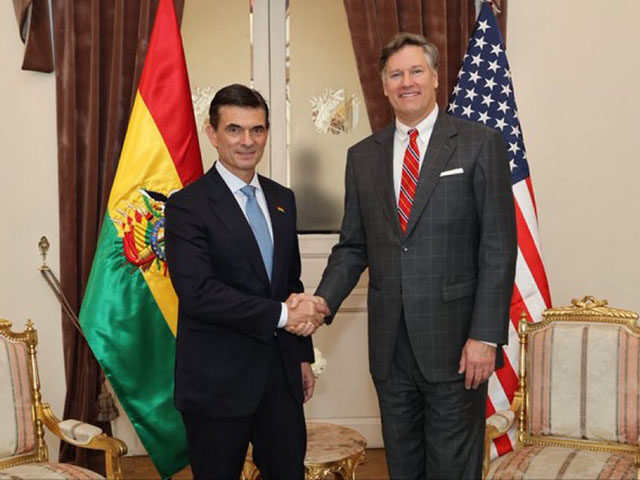

U.S. Deputy Secretary of State Christopher Landau on Monday said that America is willing to help the new government of Bolivia dismantle Iran’s terrorist influence in the country.
“Over the years, it has been very alarming that Bolivia has moved closer to Iran and that they have cooperated on military issues and in our hemisphere,” Landau told the Argentine news network Infobae. “Iran is not a good actor on the world stage, and I believe that the Iranian government’s extremism is always trying to export itself around the world. This presents a serious threat to all of us in the hemisphere. We will be in constant contact with the new Bolivian authorities.”
“The issue of Iran will be a matter of great mutual interest, and I suppose not only for the United States and Bolivia, but also for the governments of Argentina, Chile, Paraguay, and all of Bolivia’s neighboring countries, that no Iranian military equipment is being manufactured or distributed in Bolivia,” he continued. “I believe we will continue to work with the Bolivian authorities to better understand what has happened with cooperation with Iran, as well as with Nicaragua, Venezuela, and Cuba.”
Landau travelled to La Paz over the weekend to attend the inauguration of President Rodrigo Paz. The Bolivian president met with Landau in the first hours of his administration and restored Bolivia’s full diplomatic ties with the United States, ending 17 years of a unilaterally strained relationship caused by socialist former Presidents Evo Morales and Luis Arce.
On Monday, Landau held an international press conference in which he declared that Paz’s administration marked the death of so-called “Socialism of the 21st Century” in Bolivia and was a good omen for the rest of the region. Landau described his trip as the “most emotional” of his career due to the recent history between both countries.
For roughly two decades, Bolivia was ruled by the Movement Towards Socialism party (MAS), a notoriously anti-U.S. government that held a near-complete control of Bolivian institutions until it suffered an overwhelming defeat in August’s general elections that essentially wiped it out of power outside of two deputy seats in Congress.
MAS ruled Bolivia first through the multiple terms of Evo Morales — a failed wannabe dictator and fugitive of the law on pedophilia allegations — and then through Luis Arce’s disastrous socialist administration, which left Bolivia facing a severely complex economic crisis. In recent years, a power struggle between Morales and Arce over control of the socialist party caused a schism in MAS’s ranks, shattering its once-monolithic rule of the country.
Throughout its rule, MAS had Bolivia align itself with some of the world’s top anti-U.S. regimes such as China, Russia, Iran, Cuba, Nicaragua, and Venezuela. Thanks to Arce, Iran had virtually free rein to spread its influence in Bolivia, leading experts to declare Bolivia Iran’s “most successful” project in the region.
Most alarmingly, Arce had Bolivia sign a defense and security memorandum with Iran in 2023 that included an agreement for the purchase of Iranian made drones. The drone deal immediately raised alarm in other Latin American nations — particularly in Argentina, a country that suffered two deadly terrorist attacks attributed to Iran through its proxy Hezbollah against Jewish targets in the 1990s.
Landau said on Monday that it will be “very important” to see what secrets was MAS hiding over the past 20 years in Bolivia — including its military deal with Iran, as well as those involving Cuba, Venezuela, and Nicaragua.
Landau also told reporters that the Trump administration welcomed the idea of a possible return of the U.S. Drug Enforcement Administration (DEA) to the country — but stressed that it would be up to President Paz to decide. The DEA had a drug-fighting presence until 2008, when Morales banished the officials under dubious accusations that they were “spying” on him. Landau detailed that he did not discuss the subject with Paz during their encounter.
“For many years, Bolivia has been at the forefront of a group of countries that call themselves anti-imperialist or countries that have distanced themselves greatly from the United States, and which have ended up in total economic failure,” Landau said during the press conference.
“We are now prepared to work hand in hand, respecting the country’s sovereignty and seeking opportunities for economic development that can benefit the people of Bolivia. The United States is here as a good partner and friend of the Bolivian people,” he added.
Christian K. Caruzo is a Venezuelan writer and documents life under socialism. You can follow him on Twitter here.
COMMENTS
Please let us know if you're having issues with commenting.