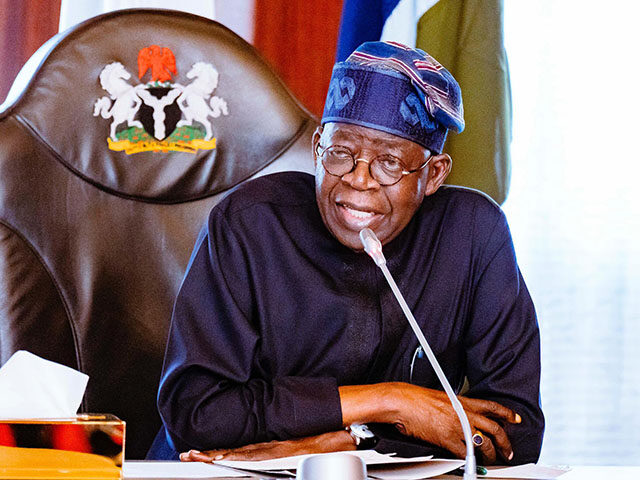

In his New Year’s Day address to the nation, Nigerian President Bola Tinubu celebrated “decisive” U.S. airstrikes against terrorist targets in northwestern Nigeria and promised that collaboration with international partners against “criminal and terrorist elements determined to disrupt our way of life” would continue.
“In collaboration with international partners, including the United States, decisive actions were taken against terrorist targets in parts of the Northwest on December 24. Our Armed Forces have since sustained operations against terror networks and criminal strongholds across the Northwest and Northeast,” Tinubu said.
“In 2026, our security and intelligence agencies will deepen cooperation with regional and global partners to eliminate all threats to national security. We remain committed to protecting lives, property, and the territorial integrity of our country,” he pledged.
The U.S. targeted Islamic State militants in the northwestern region of Sokoto with airstrikes last Thursday, in cooperation with Nigeria’s military and intelligence services.
President Donald Trump said on Truth Social that he authorized the “powerful and deadly strike against ISIS terrorist scum” who have been “targeting and viciously killing, primarily, innocent Christians at levels not seen for many years, and even centuries.”
“I have previously warned these terrorists that if they did not stop the slaughtering of Christians, there would be hell to pay, and tonight there was,” he said.
Trump later said in an interview with Politico that the strikes were originally planned for December 24, but decided to delay them by one day, to deliver them as a “Christmas present.”
“They didn’t think that was coming, but we hit them hard. Every camp got decimated,” he said.
In his New Year’s Day address, Tinubu said he believes “a decentralized policing system with appropriate safeguards, complemented by properly regulated forest guards, all anchored on accountability, is critical to effectively addressing terrorism, banditry, and related security challenges.”
Tinubu was alluding to a debate in Nigeria over whether it would be better to use a strong centralized military to guard against jihadi and bandit attacks, or if individual Nigerian states should have their own police and paramilitary units. Tinubu favors the latter approach.
Tinubu’s critics deride his emphasis on “decentralized security” as an effort to evade responsibility for the government’s failures, as murder, kidnapping, and terrorism have soared to appalling levels over the past few years. After a string of mass kidnappings in the fall, there was a scandal over how many of Nigeria’s police officers had been assigned to provide security for government officials and VIPs, leaving rural Nigerians vulnerable.
Nigeria’s Defense Headquarters said on Thursday that battle damage assessments from the U.S. airstrikes are still ongoing.
“We are still in that process, and I can assure you that once that is completed, we will communicate to the public all our observations. In due course, we will give you all the information that you require from the U.S. – Nigeria strikes,” said military spokesman Maj. Gen. Michael Onoja.
Onoja said Nigerian intelligence confirmed there were terrorist forces in the areas bombed by the U.S. military, but some of that intelligence had not previously been made public for security reasons.
“Of course, there is evidence to show that they are in the Sahel. So we can also take it further given the proximity of the Sahel to Sokoto. Intelligence reports have also confirmed their presence there before those strikes were conducted against them,” he said.
“As time goes on, you will hear about all the activities that we are doing. You know, it’s important that while we are acting, we keep it confidential. With time, I will call you here and brief you about all the things that we are doing,” he told reporters.
Onoja said it was important to mobilize the civilian population, “so that they will be vigilant and give information to the military and other security agencies, so that any issue of insecurity or any movement of these terrorists can be acted on quickly.”
“The truth is that security or insecurity can only be addressed through the cooperation of every member of society. It’s called the whole-of-society approach,” he said.
COMMENTS
Please let us know if you're having issues with commenting.