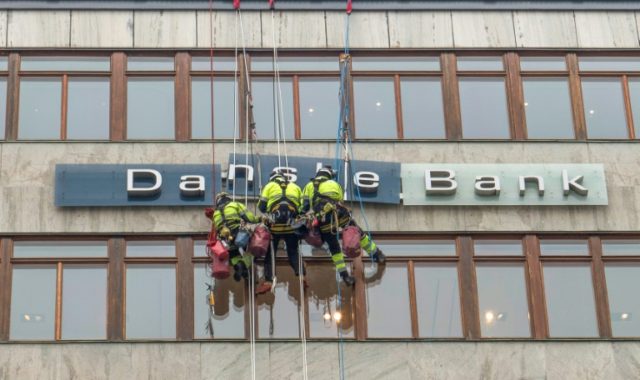

Copenhagen (AFP) – Shares in Denmark’s biggest bank, Danske Bank, took another tumble Friday as it was sucked into a reputational maelstrom whipped up by alleged laundering of up to 200 billion euros that could cost it dearly.
Investors and clients have headed for the exits amid growing fears of a possibly huge US fine for laundering funds for 15,000 mainly Russian clients.
Danske shares showed a drop of 6.24 percent at 148.70 kroner on a weaker Copenhagen stock exchange, a day after the bank said it was cooperating with a US investigation into suspicious transactions over seven years at its subsidiary in Estonia.
Since the start of the year, Danske Bank’s equity has lost almost 40 percent of its value.
“The prospect of a fine and the whiff of assisting money laundering has sent traders running from the stock,” said CMC Markets analyst David Madden.
On Friday the stock was hit by revelations in the Financial Times about “mirror trading” activitites at the Estonian unit.
“Mirror trading is actually remarkably simple,” explained Fiona Cincotta at City Index.
“It’s the buying of blue chip shares on one stock exchange, for example Moscow in rubles and requesting that the complicit bank then sells them on another stock exchange, in a different country and for a different currency.”
The practice is legal and lucrative but can alert investigators to potential money laundering schemes.
Danske Bank said it had identified the equivalent of 200 billion euros in “suspicious” transactions from 2007 – 2015 on behalf of 15,000 clients, including top Russian politicians and companies based in Denmark.
According to the FT, which cited an internal bank memo, Danske earned 10 million euros in 2013 through mirror trades that used Russian bonds, which the Danish lender acknowledged raised a “potential reputational risk in being seen to be assisting ‘capital flight’ from Russia”.
Such transactions reached 8.5 billion euros at the Estonian branch in 2013, according to the memo.
Denmark, like its Nordic neighbours, is considered a model of transparent governance, and the total amount of the suspicious transactions is 10 times Estonia’s national output in 2014.
– ‘Biggest money-laundering scandal in Europe’ –
The bank’s former chief executive, Thomas Borgen, resigned in September, and was replaced by Jesper Nielsen amid what one person close to the matter called “the biggest money-laundering scandal in Europe.”
Denmark’s financial market watchdog has ordered Danske to set aside 10 billion Danish kroner (1.5 billion euros, $1.3 billion) to cover potential fallout from the scandal.
Among those investigating the transactions are Copenhagen’s financial prosecutor, Danish and British market regulators and the US Department of Justice, because some of the transactions were done in dollars.
Meanwhile, Danske Bank clients including Copenhagen city hall are starting to look for alternatives.
Mayor Frank Jensen said on Twitter that it was mulling “legal possibilities of ending cooperation with Danske Bank – money laundering is unacceptable.”
The charity Oxfam has launched a Danish campaign to convince other towns and cities to do the same.
The allegations are linked to a fraud case exposed by Russian lawyer Sergei Magnitsky, who died in 2009 in a Russian jail after being denied medical care.
Magnitsky worked for the investment fund Hermitage Capital, whose chairman William Browder told AFP: “I think as we peel the onion of money laundering at Danske Bank the story will only get more and more sordid.”
COMMENTS
Please let us know if you're having issues with commenting.