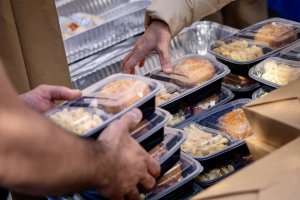
Nov. 13 (UPI) — The lapse in Supplemental Nutrition Assistance Program funding has created a surge in need at food banks across the United States while producers, restaurants, grocery stores and nonprofit organizations offer assistance.
The longest government shutdown in history came to an end on Wednesday as President Donald Trump signed a stopgap bill to fund the government.
More than 40 million SNAP recipients have gone without their monthly food assistance funds as the Trump administration has fought in court to deny releasing payments. Meanwhile food banks and pantries are stretched thin trying to meet the needs of their communities.
The effects of the lapse in SNAP payments have put a stress on the nation’s food bank systems that will not be quickly alleviated, Daniel Leckie, CEO of HATCH for Hunger, told UPI. HATCH for Hunger is a nonprofit organization that supports more than 100 food banks across the country by distributing animal proteins like meats, eggs and dairy.
“It’s going to create a ripple effect that is going to linger and last far beyond what we’re talking about today in November,” Leckie said. “There could be instances where by June food banks don’t have the budget left to purchase food.”
In March, the Trump administration cut $500 million in funding for the Local Food Purchase Assistance Cooperative Agreement program which food banks use to obtain local food items. The funding cut put a strain on the food bank infrastructure that was compounded by the government shutdown, Leckie said.
Food banks strained
The demand on the charitable food system has exceeded what was experienced during the COVID-19 pandemic, according to Leckie.
“The response that we’re getting from our food bank partners and community partners is that the demand and need is the highest they’ve ever seen,” Leckie said. “The number of people is exponentially higher than anybody could have imagined.”
HATCH for Hunger has delivered 2 million pounds of meat since the beginning of the month. According to Leckie it planned to deliver 7 million pounds of meat total for the year.
“The need is great,” he said. “We’re playing a small part in a much bigger issue and crisis when you look at a system that is already short of protein.”
Leckie added that food pantries have been short of the protein needed to meet the nutritional needs of communities by 500 million pounds prior to the SNAP lapse crisis.
“We’re meeting that call but it’s not enough,” he said.
Businesses lending a hand
HATCH for Hunger is doing a campaign called SNAP to Action, calling on companies and individuals to help support food banks by donating funds, food products and logistical support. The Happy Egg Co., Rose Acres Farms and MPS Egg Farms are among the companies that have responded, helping deliver about 1.5 million pounds of produce to food banks in the last two weeks.
Egg companies have also donated 45,000-dozens of eggs for the campaign.
Some restaurants and grocery stores are offering assistance to SNAP recipients in need of meals at the local level.
Hy-Vee grocery stores, a Midwest grocery chain based in West Des Moines, Iowa, is offering $3 meals for adults and free meals for children 12 and under through Friday. The program was originally set to end on Nov. 7 but was extended for an additional week.
Taco John’s, a fast food chain headquartered in St. Louis Park, Minn., gave away 20,000 meals with no questions asked in response to the government shutdown.
TGI Fridays restaurants are offering free meals for children to families that present a valid EBT card and purchase an adult entree costing $10 or more.
Some national chain restaurants are running campaigns to provide reduced-price meals at the local level.
Cyndi Kirkhart, CEO of Facing Hunger Foodbank in Huntington, W.V., told UPI that they are receiving more donations than usual, up by about 50%.
“[Monday] we had 216 pieces of mail that was direct mail or white mail donations,” Kirkhart said. “That’s a big day. We’re getting the story out about what this is really like on the ground and West Virginians want to take care of each other.”
‘Dramatic increase’
As donations have increased, the demand on Kirkhart’s food bank has spiked just as sharply.
“Never have we seen such a dramatic increase at basically one time,” Kirkhart said.
Facing Hunger Foodbank is operating mobile food pantries four times per week. Typically its mobile pantries are prepared to support about 250 households. Recently they have been seeing 800 to 900 households at each mobile pantry distribution.
Between 125 and 175 households coming to distributions are new to the food bank system, Kirkhart said.
“We were very challenged at the beginning of this,” she said. “Even on the first of October we started to see those quick upticks. We planned for 250 and had 325 show up so we bumped it up to 350. Then 350 became 500 very quickly.”
Demand increases in October were related to the government shutdown, Kirkhart said, as government employees and military families went without paychecks.
Families seeking emergency food boxes has increased as well. Facing Hunger Foodbank distributes emergency food boxes to an average of 50 families per month. Since the beginning of November they have seen about 60 families seeking emergency food boxes every day.
“If we hadn’t had the support of our governor, Patrick Morrisey, with funding we would have absolutely buckled under the demand,” Kirkhart said.
West Virginia’s governor released $1.1 million in emergency funding to food banks at the end of October in preparation of an interruption in SNAP benefits.
“The most compelling and difficult thing is when hope is built up. On Friday all the judges were saying that SNAP benefits would be released, then it was appealed, then it was ‘We’ll have the shutdown taken care of,'” Kirkhart said. “So this nonstop uncertainty, I feel like, is developing into a certain level of trauma. It feels like it’s never-ending and that’s very challenging.”
COMMENTS
Please let us know if you're having issues with commenting.