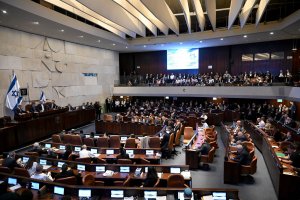

Oct. 30 (UPI) — The inconclusive outcome of Israel’s general election after the final vote count was released Friday means weeks of uncertainty in the country as various political blocs attempt to form a government — and ultimately another election if they are unsuccessful.
With the Central Election Committee results showing Prime Minister Benjamin Netanyahu’s Likud party and its ultra-nationalist and Jewish orthodox religious partners on 53 seats and Gadi Eisenkot’s opposition Yashar Party-led “change bloc” on 48, both remain well short of the 61-seat-minimum for a majority in the 120 seat Knesset.
Netanyahu’s Likud party accounted for 27 seats of the 53 total won by his coalition.
The other 19 seats were won by Arab parties that represent Israel’s Palestinian population.
Pending “minor corrections” over the next few days, the formal result will be submitted Wednesday to President Isaac Herzog, to whom the task falls of making the call on which bloc is most likely to be successful in putting together a coalition with a majority sufficient to govern.
Political parties have until Nov. 18 to file complaints and mount lawsuits challenging the final vote count.
Herzog pledged Thursday that he would consult with the leaders of all the political groups ahead of any decision he makes and urged all those involved to prioritize the best interests of the country.
The Israel Democracy Institute’s Assaf Shapira told The New York Times that he believed Herzog would most likely initially look to Eisenkot as his best option, in line with Israeli law and previous elections where the party leader for whom the most leaders have given their endorsement is usually given the first shot at forming a government.
However, Herzog’s invitation is only the beginning of what can be a rankerous process that can stretch out to weeks and weeks, if not months, as the initial 28-day window to form a governing majority can be extended by 14 days — and then repeated over again with up to two other leaders if the president’s first choice is unsuccessful.
Fresh elections will be called only after all options have been exhausted — Herzog has made it clear that another election must be avoided if at all possible. According to the IDI, in similar past situations, forming a new government has taken as long as 100 days, but has also been done in as little as three weeks.
Insisting Friday that the election result was a “win on points” for the anti-Netanyahu bloc, opposition leader and B’Yachad Party deputy leader Yair Lapid appealed to Israelis to give the coalition negotiations time and space.
The points win referred to by Lapid includes seats won by mostly Arab parties of the so-called Arab Joint List and Ra’am.
Joining forces with them would deliver parties who want Netanyahu out with a working majority of seven seats had B’Yachad, Eisenkot’s Yashar Party and Yisrael Beytenu, three of the four Jewish parties, not ruled out working with them in the Knesset under any circumstances.
COMMENTS
Please let us know if you're having issues with commenting.