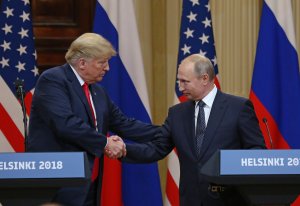

May 13 (UPI) — More than half a century ago, actors Jack Lemmon and Walter Matthau starred in the comedy hit, The Odd Couple, about two divorced roommates reacting to bachelor life.
Today, Vladimir Putin and Donald Trump, in the irony of all ironies, are the oddest couple. They are drawn together by classic strategic blunders and failures: Putin in Ukraine and Trump in Iran. And both need the other to extricate themselves from these self-imposed disasters.
The irony grows even greater. In Ukraine, the United States is actively advising and arming Kyiv in killing Russians by the many tens of thousands. In Iran, Russia is returning the favor by providing Tehran with targeting and other aid that is attacking Americans. Fortunately, U.S. casualties are a small, small fraction of Russian ones.
One reason why Putin and Trump have become embroiled in these quagmires — Putin for four years and Trump going on four months — is the failure to have sufficient knowledge and understanding of the enemies each is facing.
Putin took his generals’ assertion that Kyiv would be overrun in days. Then, Putin assumed that the overwhelming advantages Russia had in all forms of power would coerce Ukraine to capitulate. Now, Russia has taken over 1 million casualties and its economy, despite the hike in oil prices, is suffering.
Trump, probably empowered by the ease in which Venezuela’s president Nikolas Maduro was captured and Israeli Prime Minister Benyamin Netanyahu’s conviction that by decapitating Iran’s leadership, Tehran would collapse, ordered Operation Epic Fury.
Epic Fury is quickly becoming Epic Fuzzy in that the original aims for the attack, never clear, have become confused and conflicting. While Iran’s very modest air force and navy have been eliminated, the strategy of winning by not losing seems to be working. To some, Trump’s optimism over the progress of negotiations that so far have not been matched by Iranian actions, reinforces the prospect that Epic Fury has not and will not work.
Of course, Ukraine has the advantage of being actively supported by Europe and the non-U.S. members of NATO. These allies understood the danger posed by Putin should Ukraine fall.
Europe is doing its fair share to prevent that outcome, while suspecting that Trump remains so much more favorable to Putin than to Ukrainian president, Volodymyr Zelensky, that Kyiv could be sold down the U.S. river in exchange for better relations with Moscow.
Iran has no allies in the Gulf, although the Arab states are deeply ambivalent about their revolutionary neighbor. The Sunni-Shia conflict remains an issue. Some 700,000 Shias, some not far removed from their original home in Iran, and in Bahrain could form a “fifth column” for Tehran.
And Iran’s attacks against Gulf states infrastructure reflect a vulnerability that an expansion of the war would only grow worse. That includes the desalination facilities on which the Gulf states are dependent for virtually all their fresh water supplies.
How then might the mutual need for some reconciliation of the conflicts in Iran and Ukraine bring Putin and Trump closer? The quid pro quo is what can each do for the other?
Trump could indeed pressure Zelensky, as well as the NATO allies, to concede to Russian demands. The threat to leave NATO; reduce the presence of U.S. forces as Trump is doing in Germany and increase tariffs are coercive tools that could be applied.
Putin, likewise, could become the intermediary regarding the nuclear issues. Russia could offer to remove the enriched uranium, as well as spent fuel rods infused with plutonium-239 and be Iran’s future supplier. And Russia could give Iran some guarantees about restraining further U.S. military action.
Any visible signs of a joint Trump-Putin axis to work together for each other’s benefit would likely be disastrous given the perception of a deceitful collaboration no matter how much strategic sense this might make.
After all, Richard Nixon went to China and signed a nuclear arms agreement with the U.S.S.R., ushering in an era of detente. Of course, Trump is no Nixon. Whether Putin is a Mao Zedong or Leonid Brezhnev remains to be seen.
Still, the notion of an “odd couple” is appealing because it would be odd, indeed. Yet, desperation has drawn opposites together. As Ukraine continues to bleed Russia, Iran refuses to quit and gasoline and food prices rise, who knows how this may affect Putin, Trump and the possibility of a future partnership?
Harlan Ullman is senior adviser at Washington’s Atlantic Council, chairman of a private company and principal author of the doctrine of shock and awe. His next book, co-written with Field Marshal The Lord David Richards, former U.K. chief of defense and due out this fall, is Who Thinks Best Wins: How Decisive Strategic Thinking Will Prevent Global Chaos. The writer can be reached on X @harlankullman.
COMMENTS
Please let us know if you're having issues with commenting.