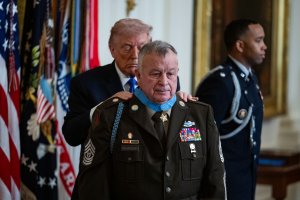

March 2 (UPI) — President Donald Trump awarded the Medal of Honor to three soldiers from three different wars — World War II, Vietnam and Afghanistan — during a White House ceremony Monday.
Those honored with the highest military award for valor were Master Sgt. Roderick “Roddie” Edmonds, retired Command Sgt. Maj. Terry Richardson and Staff Sgt. Michael Ollis. Edmunds and Ollis were given the award posthumously. Edmonds died in 1985 in Knoxville, Tenn., while Ollis died in 2013 in Afghanistan.
“Today, the President had the distinct honor of presenting three new Medals of Honor to members of the United States Army. This powerful moment once again made clear that honoring the bravest among us is not a partisan issue, but one that unites us through treasured American values,” said Cory Crowley, National Medal of Honor Museum Foundation executive vice president, in a statement. “Though their stories are different, all three of these men displayed remarkable selflessness that represents the very best of our nation. We are proud to be able to preserve their legacies at the National Medal of Honor Museum and inspire future generations with the power of their example.”
The three recipients each saved lives with their actions during war.
Edmonds was a prisoner in German prisoner-of-war camp Stalag IX-A after his capture during the Battle of the Bulge. On Jan. 27, 1945, camp officials told Edmonds, the highest-ranking non-commissioned officer, to order the 200 Jewish Americans in the camp to come forward during the morning roll call.
Edmonds, knowing it was a death sentence for the Jewish soldiers, had all 1,000 Americans stand in front of the barracks. The commandant angrily pulled his gun and put it against Edmonds’ head between his eyes and said that they can’t all be Jewish.
Edmonds defiantly said, “We are all Jews.” The commandant was frustrated, but gave up.
In March 1945, when the prisoners were ordered to evacuate the camp via forced march, Edmonds and the U.S. soldiers were ordered out, then they ran back to the barracks. The prison guards would order them out again, but they ran back to the barracks again and again, until the guards gave up and let them stay. A few days later, the prisoners were rescued by the 6th Armored Division.
Edmonds never told anyone what he had done, but his son Christopher Edmonds, who accepted the medal for his father, researched what had happened with the help of the Jewish Foundation for the Righteous to bring his father’s heroism to light.
On Sept. 14, 1968, Richardson and his platoon came under heavy fire from the North Vietnamese near Loc Ninh, Vietnam. He knew that the only way to avoid being overrun was to call in airstrikes. He went to the top of hill 222, where he could get reception, and lay in a shallow irrigation ditch, injured, calling in airstrikes.
He helped guide the pilots in 32 strikes for 7 hours from the ditch enduring napalm attacks.
After that, “they broke contact with us,” Dave Himmer, one of the soldiers saved by Richardson, told Military Times. “There were six of us that [decided] to go up and find his body because we just knew that, how do you survive that?”
They found him sitting on the hill with blood running from his ears from the blasts.
“There’s just no words to me personally in the English language that describe this man’s bravery,” said Peter Sasko, another soldier from Richardson’s unit. “There’s just, 85 of us were able to survive.”
Ollis was serving in Forward Operating Base Ghazi in Afghanistan Aug. 28, 2013, when a car bomb breached the base. That allowed 10 enemy fighters with suicide vests to come through the outer wall. Other attackers pelted the base with grenades and mortars.
Ollis, who was also awarded the Distinguished Cross, checked for casualties then ran toward the attack. He and Polish soldier Karol Cierpica moved toward the attackers and began fighting.
An “insurgent came around a corner and immediately engaged them with small arms fire,” Ollis’ citation said. “With complete disregard for his own safety, Staff Sergeant Ollis positioned himself between the insurgent and [Cierpica] who had been wounded in both legs and was unable to walk. Staff Sergeant Ollis fired on the insurgent and incapacitated him, but as he approached the insurgent, the insurgent’s suicide vest detonated, mortally wounding [Ollis].”
Cierpica attended the ceremony and called the Ollis family his “second family from Staten Island” and called America his “second homeland.”
“My greatest gift is to cultivate the memory of a true heroic act of courage I witnessed performed by your beloved son Michael.”
Cierpica’s wife and children were in attendance, and Trump pointed out that one of his sons was named Michael in honor of Ollis.
Ollis’ father, Vietnam veteran Robert Ollis, told Military Times that he felt great pride and joy, but, “Of course, I’d rather have Michael back.”
COMMENTS
Please let us know if you're having issues with commenting.