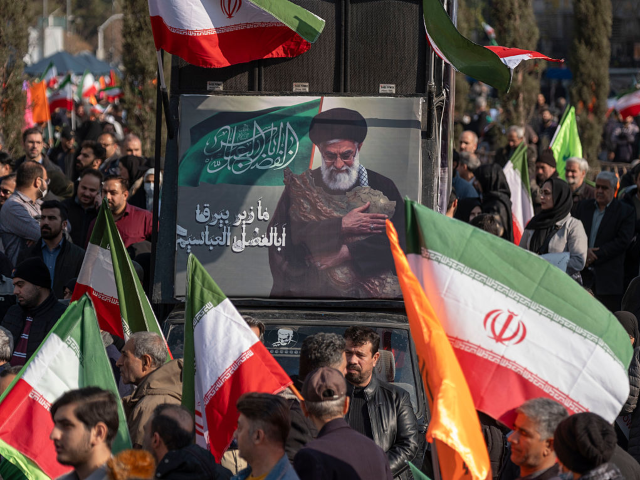
New polling conducted by J.L. Partners provided exclusively to Breitbart News ahead of its public release shows Americans, especially Republicans, by and large support toppling the regime in Iran but are unwilling to put any American lives at risk to do so.
The stunning new data shows that, yes, Americans do not like the regime in Iran and would love to see it wiped out. But it also has bright warning lights for the White House as the president considers his options because the data suggests that Americans broadly, and Republicans specifically, do not want to risk even a single American life to accomplish that.
J.L. Partners is one of the few pollsters to nail the outcome of the 2024 presidential race, correctly predicting that President Donald Trump would win the national popular vote against Democrat Kamala Harris.
Overall, the new poll obtained by Breitbart News exclusively shows, more Americans support the U.S. toppling the regime in Iran than oppose doing so, with 36 percent supporting such an action — 18 percent strongly supporting and 18 percent somewhat supporting — compared to just 21 percent opposing. Eleven percent strongly oppose and 10 percent somewhat oppose, with 24 percent of Americans indifferent offering neither support nor opposition.
Among Republicans specifically, support for the U.S. toppling the Iranian regime goes up even higher with 60 percent—36 percent strongly and 24 percent somewhat — supporting the move. Just 8 percent are opposed, 4 percent apiece somewhat and strongly, while 21 percent of Republicans are unsure.
While that seems strong on both accounts — among Americans broadly and among Republicans specifically — it’s in the follow-up questioning where things get dicey. Almost everyone who supports the U.S. toppling the Iranian regime only does so if zero American lives are at risk in so doing.
When asked how many American fatalities are an acceptable number to stomach for the U.S. to topple the regime in Tehran, a majority of all Americans and specifically Republicans said zero. Among all Americans, and among Republicans specifically, 51 percent of each group said they would tolerate no American casualties to achieve the mission. Among all Americans, an additional 5 percent said they would tolerate less than 10 American casualties and another 6 percent said they would tolerate less than 100 American fatalities.
Fourteen percent of all Americans added they would tolerate less than a thousand American fatalities, 13 percent said they would tolerate less than 10,000 American fatalities, and just 11 percent said they would tolerate more than 10,000 American fatalities to achieve the objective.
Among Republicans specifically, an additional 7 percent apiece said they would tolerate either less than 10 or less than 100 fatalities while 16 percent said less than a thousand is okay, 11 percent said less than 10,000 is okay, and just 7 percent said more than 10,000 is acceptable.
Accounting for these numbers on the follow-up questions, it suggests the real numbers for support among Americans for the U.S. toppling the Iranian regime is not 36 percent but really down around 14 percent — and among Republicans it is not really 60 percent but really down around 21 percent.
The survey of 1,003 registered American voters was conducted Jan. 21 to Jan. 23 and has a margin of error of 3.1 percent.
Interestingly, this polling data will almost certainly factor into any decisions the president makes in 2026 about whether or not the U.S. should get engaged in taking out the Ayatollah. Similar to the Venezuela operation that saw the capture of Nicolas Maduro this year or the previous U.S. strikes on Iran’s nuclear program last year in Operations Absolute Resolve and Midnight Hammer respectively, Americans love projecting U.S. strength — but are equally skeptical of costly military engagements especially if they risk American lives. Trump, surely, is going to be looking for some kind of optionality in his decision-making process and trying to find something that the U.S. can do that will not cost any American lives like he has done so far in other missions if the U.S. is to do anything at all here.
COMMENTS
Please let us know if you're having issues with commenting.