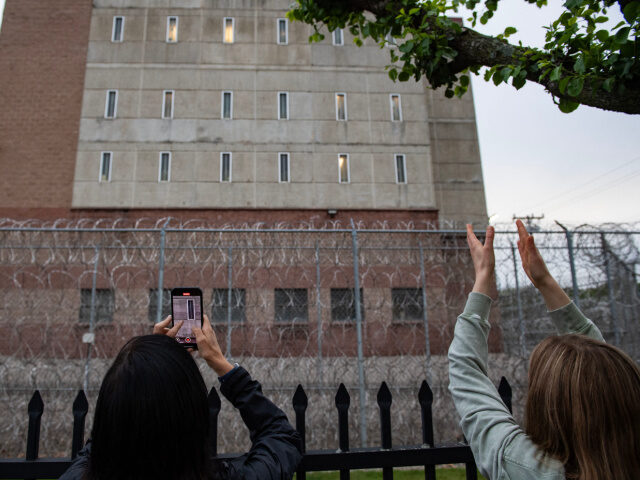

Three judges have endorsed the release of illegal migrants held in New York detention centers by the Immigration and Customs Enforcement agency.
“HUGE news,” declared Aaron Reichlin-Melnick, a pro-migration advocate at the American Immigration Council. He added:
Immigrants detained in New York, Vermont, and Connecticut must be given bond hearings [and likely release] unless they have a criminal record or are subject to some other ground of mandatory detention. This creates a circuit split, so the Supreme Court will likely hear the case next term.
The decision was made by three judges in the United States Court of Appeals for the Second Circuit, which oversees cases in Vermont, Connecticut, and New York. They wrote:
The government argues Petitioner is subject to mandatory detention under Section 1225(b)(2)(A). We disagree. The plain text of both Sections 1225(b)(2)(A) and 1226(a) make clear that only one applies to a noncitizenlike Petitioner: Section 1226(a).
The result is that illegals arrested in New York know they can usually ask for a bond hearing to be quickly released back onto the streets. This legal power gives them the ability to keep working — or to commit crimes — while they stretch out their deportation cases for many years.
But judges in the Texas-based Fifth Circuit and the Midwest-based Eighth Circuit earlier ruled for President Donald Trump’s deputies, that judges do not have to hold the courtroom “bond hearings” that enable the release of migrants before their cases are completed. This means that the many migrants detained in the Fifth and Eighth districts have a clear incentive to quickly give up their legal fight because every appeal they make keeps them in uncomfortable detention instead of being sent back home.
The result is a dramatic rise in the number of migrants who accept “voluntary deportations” while in detention. In turn, each departure frees a detention bed for another arrest.
The Supreme Court will likely try to resolve the conflict between the appeals courts in its next session, which starts in October 2026.
Progressives oppose deportations of migrants — even criminal migrants — because they dislike the national borders that allow ordinary Americans to govern their own society via laws, free markets, culture, and social norms.
That opposition has allowed at least 15 million illegal migrants into Americans’ neighborhoods, workplaces, schools, hospitals, and jails. The three judges in New York even used that huge failure to justify their curbs on Trump’s 2024 deportation mandate, saying:
Even if the government’s newfound interpretation of Section 1225(b)(2)(A) were plausible—and it is not—we would nonetheless reject it based on our obligation to construe these statutes in a manner that would avoid the serious constitutional questions attendant to what would be the broadest mass-detention-without-bond mandate in our Nation’s history for millions of noncitizens.
On April 16, Andrew Arthur at the Center for Immigration Studies criticized other judges’ rejection of the Trump policy, saying, “perhaps it’s better to say the Clinton, George W. Bush, Obama, Trump I, and Biden administrations ignored that detention mandate.”
The Democrats’ massive resistance to Trump’s deportations is also an indirect attack on Trump’s low-migration, high-productivity national economic strategy and his 2026 policy on affordability.
Under Trump’s low-migration, high-deportation reforms, Americans’ wages are up, housing costs are down, transport costs have shrunk, crime is dropping, and corporations are spending heavily to help Americans become more productive and to earn more wages for each working hour.
COMMENTS
Please let us know if you're having issues with commenting.