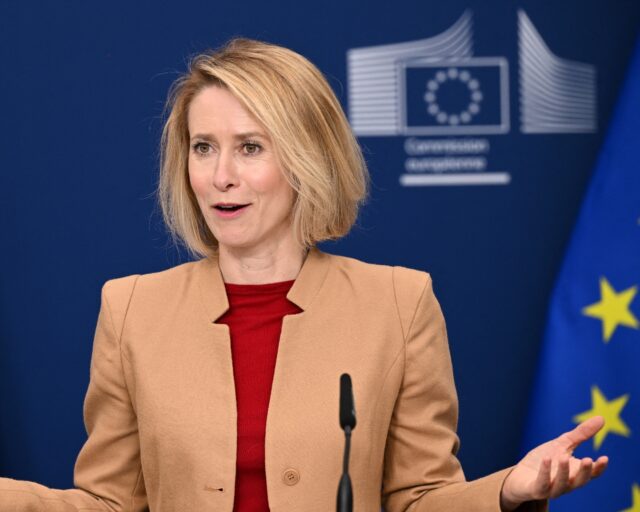

The European Union’s top diplomat, Kaja Kallas, claimed on Thursday that the E.U. should not “humiliate” itself by engaging in direct talks with Russia to end the war in Ukraine.
High Representative Kallas made the assertion to reporters at the end of a two-day meeting of the Nordic-Baltic Eight (NB8) group in Kuressaare, Estonia. The encounter focused on the Russian invasion of Ukraine, the ongoing conflict in the Middle East, and other security-related issues in Europe.
Asked by reporters if there is a risk of possible unfavorable terms for Europe and Nordic Baltic countries should others — such as the United States — engage in talks with Russia should Europe refuse to do so, Kallas answered that what the bloc has so far seen is that Russia “does not want to engage in any kind of dialogue” and thus, the European Union should not “humiliate” itself “by being the demandeurs” by saying, “please, we beg you to talk to us.”
She argued that, instead, the bloc should put Russia in a position where “they actually go from pretending to negotiate to actually negotiate.”
“And that is why we have planned to discuss with the foreign ministers of the European Union in Cyprus on what is the picture that we see, what are the requests that we have for Russia after this war is over, so that we can see that Russia does not pose a threat to any of these countries or Europe as a whole, because that has been the problem,” Kallas told reporters.
Kallas affirmed that the NB8 group— made up of Denmark, Estonia, Finland, Iceland, Latvia, Lithuania, Norway, and Sweden — are the “strongest supporters” of Ukraine and, according to the E.U. diplomat, the bloc’s support pushed Russia back to a stalemate. She further asserted that the European Union’s 90 billion euro loan to Ukraine and the 20th and most recent sanctions package against Russia will signal to Vladimir Putin that “his war leads to nowhere.”
“Ukraine is more important to us than it is to Russia,” Kallas proclaimed.
Asked by reporters for comments on President Donald Trump’s recent phone call with Putin and whether the Ukraine peace talks are “kind of at a dead end right now,” Kallas said that the Ukraine talks are really stalling and that “nothing” is happening in that regard.
“Of course, when we see these calls between President Trump and President Putin, always there are a lot of questions unanswered, considering that Russia is openly praising the heroic battle that Iran is having against America,” Kallas answered.
“Does it mean that there is actually also more pressure on Russia because they are helping Iran to fight a war against them? So, we would like to see also that pressure, and we did not see that in that call,” she continued.
On the war in Iran, Kallas asserted that there is likely no quick solution to the standoff at the Strait of Hormuz, and noted that the E.U. has agreed to expand sanctions on Iran over the blockade while affirming that E.U. naval operations can “play a greater role” in restoring maritime energy and trade flows.
“Tehran’s nuclear and missile programs, as well as its support to terrorist groups in the region and beyond, must be addressed. These issues cannot be put on backburner,” Kallas noted.
The NB8 meeting in Estonia concluded with all eight members — Denmark, Estonia, Finland, Iceland, Latvia, Lithuania, Norway, and Sweden — signing a joint statement affirming their support of Ukraine’s “irreversible” path towards full European Union and NATO memberships.
The bloc stressed that Russia remains the “most significant” threat to Euro-Atlantic security, and, in addition to sanctions and other measures, urged for determined and coordinated action to counter Russia. Additionally, the group called for further international isolation of Russia, including sports and culture.
COMMENTS
Please let us know if you're having issues with commenting.