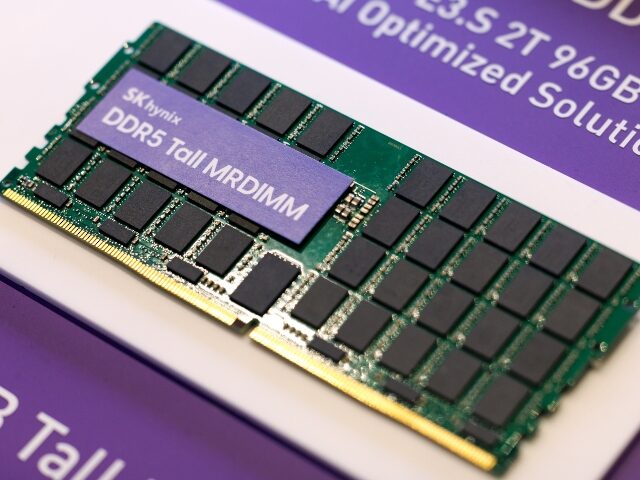

A shortage of memory chips has placed significant financial pressure on major technology hardware companies, forcing them to choose between reduced profit margins or increasing their prices for consumers.
Bloomberg reports that technology hardware manufacturers including Apple and HP are facing mounting challenges as soaring memory and storage component prices create what industry analysts are calling an unprecedented crisis for device makers. The shortage has transformed memory chip producers into some of the market’s strongest performers while simultaneously threatening the profitability of their customer companies.
Supply constraints have driven prices to levels that are forcing hardware companies into difficult strategic decisions about how to maintain profitability while remaining competitive in consumer markets.
Rob Thummel, senior portfolio manager at Tortoise Capital, which manages $9.1 billion in assets and operates an ETF focused on AI infrastructure, outlined the dilemma facing hardware manufacturers. According to Thummel, these companies face two unfavorable options: accepting reduced profit margins, which would likely trigger negative market reactions, or raising product prices to offset higher memory costs, potentially dampening consumer demand.
The impact on major technology stocks has been substantial. Apple shares increased only 8.6 percent during 2025, marking the company’s weakest annual performance since 2022. The stock has declined 4.2 percent in early 2026, placing it among the 20 poorest performers in the Nasdaq 100 Index. HP shares reached their lowest level since November 2020 on Wednesday after losing nearly one-third of their value in 2025 and falling another 6.8 percent in the opening days of 2026. Dell Technologies has dropped 28 percent since reaching an all-time high in October.
Memory and storage companies have experienced the opposite trajectory. Sandisk, Micron Technology, Western Digital, and Seagate Technology have all seen significant gains. Sandisk is leading the S&P 500 in early 2026 with gains exceeding 60 percent, while Western Digital and Micron rank among the index’s top 20 performers.
Breitbart News recently reported that Micron has predicted memory shortages due to the massive requirements of AI data centers:
However, this surge in demand for HBM technology, which uses three times the silicon wafers compared to standard DRAM, has led Micron to prioritize these lucrative deals over its consumer-facing business, Crucial. As a result, the company has recently shuttered Crucial, leaving fewer resources for the production of DRAM used in everyday products such as PCs, smartphones, smart TVs, and even cars. This shift in focus has already started to impact the prices of DDR5 RAM kits, with other devices expected to feel the effects soon.
During the earnings call, Mehrotra emphasized the severity of the situation, stating that “over the last few months, our customers’ AI data center build-out plans have driven a sharp increase in demand forecast for memory and storage.” He further added that “supply will remain substantially short of the demand for the foreseeable future,” indicating that the memory shortage is likely to persist for an extended period.
Read more at Bloomberg here.
Lucas Nolan is a reporter for Breitbart News covering issues of free speech and online censorship.
COMMENTS
Please let us know if you're having issues with commenting.