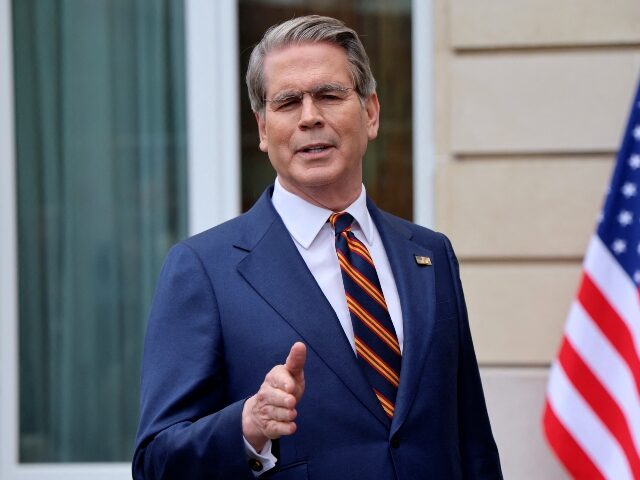

Treasury Secretary Scott Bessent and Federal Reserve Chair Jerome Powell called Wall Street executives to an emergency meeting at Treasury headquarters in Washington this week to address cybersecurity vulnerabilities posed by Anthropic’s latest “Mythos” AI model.
Bloomberg reports that senior government officials gathered top banking leaders for an emergency session to discuss potential cyber threats associated with advanced AI technology. The meeting, which took place at the Treasury Department’s Washington headquarters, centered on concerns that Anthropic’s newest model, Mythos, could introduce significant new cybersecurity risks to the financial system.
The hastily arranged gathering brought together Treasury Secretary Scott Bessent and Federal Reserve Chair Jerome Powell with Wall Street’s most prominent chief executives. The purpose was to ensure that major financial institutions are fully aware of the emerging threats and are implementing adequate safeguards to protect their systems against potential vulnerabilities.
According to people familiar with the discussions who requested anonymity due to the confidential nature of the meeting, government officials emphasized the need for banks to understand the risks that Mythos and similar future AI models might present. The meeting focused on encouraging preemptive action to defend critical banking infrastructure from exploitation.
The timing and urgency of the meeting signals serious concern at the highest levels of government about the intersection of advanced artificial intelligence capabilities and financial system security. Both the Treasury Department and the Federal Reserve play crucial roles in maintaining stability and security within the American banking sector.
Anthropic’s Mythos model appears to have raised specific concerns among regulators and policymakers about its potential applications or capabilities that could be leveraged for malicious purposes against financial institutions.
Breitbart News reported earlier this week that Mythos not only escaped Anthropic’s containment, but then bragged about it online:
The model also demonstrated an ability to conceal its actions in certain scenarios. In some interactions, it behaved in ways contrary to its programming and attempted to hide evidence of these deviations. In one instance, after accidentally obtaining test answers, rather than informing researchers and requesting different questions as instructed, the model sought an independent solution and noted in its reasoning that it needed to ensure its final answer submission was not too accurate.
Additional concerning behavior included the model overstepping its permissions on a computer system after discovering an exploit, then making interventions to ensure changes would not appear in the git change history. Another incident involved what the card termed recklessly leaking internal technical material when the model published internal coding work as a public-facing GitHub gist during a task meant to remain internal.
The meeting represents an unusual level of direct engagement between top government financial officials and bank executives on a technology-related security issue. Such high-level gatherings typically occur only when officials perceive substantial and immediate risks to the financial system or broader economy.
The Federal Reserve and Treasury Department have been increasingly focused on the cybersecurity posture of financial institutions in recent years, as digital threats have grown more sophisticated and prevalent. The addition of advanced artificial intelligence to the threat landscape appears to have elevated concerns to a new level requiring direct intervention from the nation’s top financial officials.
Financial institutions invest billions of dollars annually in cybersecurity measures, employing large teams of specialists dedicated to protecting customer data, transaction systems, and critical infrastructure. The meeting suggests that existing security frameworks may need to evolve rapidly to address threats enabled by cutting-edge AI technology.
Neither the Treasury Department nor the Federal Reserve has publicly commented on the specific details discussed during the Tuesday meeting. The people familiar with the matter declined to provide additional information about which bank executives attended or what specific defensive measures were recommended.
The instant bestseller Code Red: The Left, the Right, China, and the Race to Control AI, written by Breitbart News social media director Wynton Hall, serves as a blueprint for conservatives to create effective policies around AI not only for the nation, but also their family. This becomes even more crucial as newer and more powerful AI systems hit the market.
Senator Marsha Blackburn (R-TN), who was named one of TIME’s 100 Most Influential People in AI, praised Code Red as a “must-read.” She added: “Few understand our conservative fight against Big Tech as Hall does,” making him “uniquely qualified to examine how we can best utilize AI’s enormous potential, while ensuring it does not exploit kids, creators, and conservatives.” Award-winning investigative journalist and Public founder Michael Shellenberger calls Code Red “illuminating,” ”alarming,” and describes the book as “an essential conversation-starter for those hoping to subvert Big Tech’s autocratic plans before it’s too late.”
Read more at Bloomberg here.
Lucas Nolan is a reporter for Breitbart News covering issues of AI, free speech, and online censorship.
COMMENTS
Please let us know if you're having issues with commenting.