

At Al Sharpton’s National Action Network conference last week, President BarackObama’s Housing and Urban Development Secretary Shaun Donovan said thatObama “knows what it’s like to walk the streets of some of our poorest neighborhoodsbecause he’s lived there” and also knows “what it’s like to take a subway or a bus just tofind a fresh piece of fruit in a grocery store.”
What Donovan was referring to was so-called “food deserts,” defined by the Departmentof Agriculture as “urban neighborhoods and rural towns without ready access to fresh,healthy, and affordable food.”
Food deserts has been a chic term that liberals have thrown around to link obesity inthose “deserts” to a lack of access to healthy fruits and vegetables. This allowsliberals who believe in a social justice agenda to define obesity as a social injustice andgives them further license to meddle and thus right this injustice.
Except there is a huge methodological problem to these food desert designations.
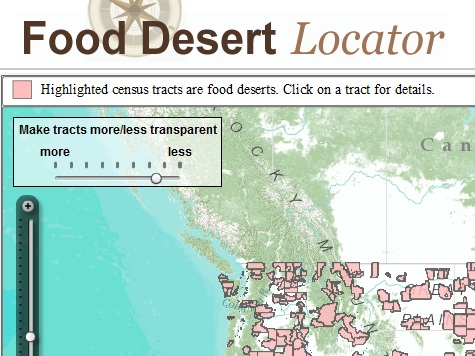
While the USDA comes up with snazzy “food desert locators,” those food desertshave been grossly misdefined and improperly characterized because in defining “fooddeserts,” the USDA only focused on the number of chain grocery stores in a given areaand completely ignored the host of small neighborhood corner stores where people inpoorer zip codes could get access to healthy food.
The USDA, on page 6 in a 2009 report titled “Access to Affordable and Nutritious Food:Measuring and Understanding Food Deserts and Their Consequences,” which wassubmitted to Congress, conceded that the study only took into account supermarketsand box stores in designating “food deserts,” ignoring the corner stores and bodegas inthe so-called “food deserts” where consumers can have access to vegetables and fruits.
Supermarkets are not the only sources of healthy and affordable foods.Many smaller-scale sources may be used by those who are underserved bysupermarkets. However, a complete assessment of the food environment ofevery area in the United States is an enormous task that is beyond the scopeof this study.
And this week, the New York Times published a story detailing two studies thatunexpectedly found that poorer neighborhoods which could be designated as “fooddeserts” not only have “more fast food restaurants and convenience stores than moreaffluent ones, but more grocery stores, supermarkets and full-service restaurants, too.”
Further, the studies cited by the New York Times found “no relationship betweenthe type of food being sold in a neighborhood and obesity among its children andadolescents.”
One study, done by the RAND Corporation, found that one could “get basically any typeof food” within “a couple of miles of almost any urban neighborhood.”
Another study, conducted by Helen Lee of the Public Policy Institute of California,found that poor neighborhoods “had nearly twice as many fast food restaurants andconvenience stores as wealthier ones, and they had more than three times as manycorner stores per square mile.” Further, Lee found that those neighborhoods “also hadnearly twice as many supermarkets and large-scale grocers per square mile.”
Simply put, there are a lot of healthy food oases in these government-designated “fooddeserts.”
But that won’t stop the left’s assault on this straw man. During this campaign season, expect Michelle Obama to repeat a variation of the “ifpeople want to buy a head of lettuce or salad or some fruit for their kid’s lunch, theyhave to take two or three buses, maybe pay for a taxicab, in order to do it” line topromote government intervention against so-called “food deserts” as part of Obama’sbroader social justice agenda.
COMMENTS
Please let us know if you're having issues with commenting.