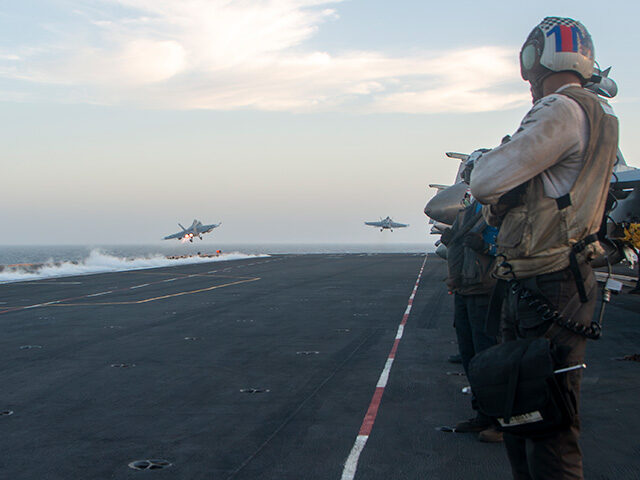
U.S. Africa Command (AFRICOM) announced its 100th airstrike of the year in Somalia on Saturday, a notable milestone for a high-tempo operation that has received little media coverage or political commentary.
The 100th airstrike targeted Islamic State jihadists near the Golis Mountains in northern Somalia. Most of the strikes in 2025 were against al-Shabaab, the al-Qaeda ally that perpetrates much of the terrorist violence in Somalia, but strikes against a resurgent ISIS increased dramatically.
According to AFRICOM, ISIS in Somalia grew from about 300 fighters in 2019 to 1,500 by mid-2025. About 60 percent of ISIS recruits were born outside Somalia. Security forces from Somalia’s state of Puntland have been fighting ISIS in the Golis Mountains for months, with only limited success until the U.S. began providing air support.
AFRICOM also supported a successful mission by Somali forces to eliminate a senior al-Shabaab commander named Hassan Siidow Hussein on Tuesday night. Hussein was targeted for organizing improvised explosive device (IED) attacks against both security forces and civilian targets in Somalia.
In addition to airstrikes, AFRICOM’s mission in Somalia includes training for military and police forces, including a Somali special forces unit known as the Danab Brigade or “Lightning Force.”
Stars & Stripes noted on Monday that the counter-terrorism mission in Somalia launches more airstrikes than the Trump administration’s more controversial and higher-profile drug interdiction effort in the Caribbean. There have been 28 strikes on Somali militants since early September, for example, versus 21 strikes against suspected drug traffickers in the Caribbean.
“The number of AFRICOM airstrikes in Somalia this year far exceeds that of all previous years and is on a pace to potentially double the previous one-year high of 63 carried out in 2019,” Stars & Stripes observed.
The African Union also has a peacekeeping force in Somalia, its third mission in less than 20 years. The current operation, which began in January 2025, is known as the African Union Support and Stabilization Mission in Somalia (AUSSOM). The African Union force was involved in Tuesday’s mission to eliminate the al-Shabaab commander.
Despite the prodigious amount of assistance rendered by the United States and African Union, Somalia’s weak and ineffective government never seems to make any permanent progress against either al-Shabaab or ISIS. Somali forces have an unfortunate history of giving ground in battles with terrorist fighters; some of the past year’s U.S. airstrikes have been “self-defense” operations to recover strategic positions captured by insurgent forces.
“Somalia remains the archetypal failed state, where borders are porous, the rule of law non-existent, and violent non-state actors fundraise, recruit, and radicalize new members with veritable impunity,” the Soufan Center complained in May.
“Further, al-Shabaab retains the ability to conduct cross-border strikes throughout the Horn of Africa, while also engaging in piracy operations along the Gulf of Aden and near the coast of Somalia,” the center added.
The Institute for Security Studies (ISS) noted in May that the Somali Security Forces (SSF) are slow to recruit and train operatives, and they do not integrate well with foreign troops like those from AUSSOM. Foreign partners are reluctant to pour more funding into the seemingly endless struggle against terrorist insurgents, while ISIS and al-Shabaab are noted for their fundraising ability. Al-Shabaab fundraising now includes millions fleeced from U.S. taxpayers by Somali welfare scam operations in Minnesota.
One reason the African Union keeps launching new peacekeeping missions is that Somali forces keep missing target dates for taking over full responsibility for counterterrorism operations. AUSSOM hoped to begin wrapping up its operations in 2028, but there are few signs the SSF will be able to take over by then — not even with the most intense U.S. air support campaign in the world behind them.
COMMENTS
Please let us know if you're having issues with commenting.