
The State Department said on Thursday that America is “comprehensively reviewing our relationship with the Government of Tanzania” due to concerns over the “ongoing repression of religious freedom and free speech.”
“Recent actions by the Government of Tanzania, however, raise grave concerns about the direction of our bilateral relationship and the reliability of the Tanzanian Government as a partner,” the State Department said.
“The Government of Tanzania’s ongoing repression of religious freedom and free speech, the presence of persistent obstacles to U.S. investment, and disturbing violence against civilians in the days leading up to and following Tanzania’s October 29 elections, required this reconsideration of our ties,” the statement explained.
“The United States cannot overlook actions that jeopardize the safety of our citizens, or the security and stability of the region. The future of our bilateral relationship with the Government of Tanzania will be based on its actions,” the State Department said.
Tanzania held a presidential election in late October that was disrupted by large protests and a violent crackdown by security forces. The protesters were angry that the major opposition party, Chadema, had been banned from the ballot after its leader, Tundu Lissu, was charged with treason.
Lissu was arrested in April because he allegedly said he and his party planned to “spoil” and “disrupt” the upcoming election, inspiring a “rebellion” because it was “the way to get change.”
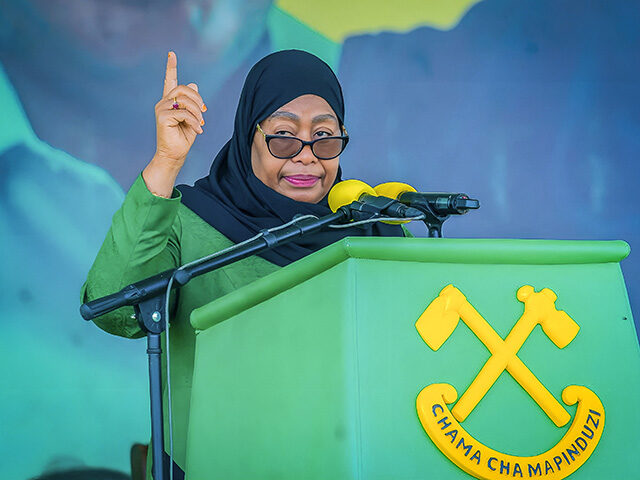
Incumbent President Samia Suluhu Hassan, elected in March 2021, was originally seen as less hostile to opposition politics than her predecessor, John Magufuli, who held the office from 2015 until his death in 2021.
Concerns began growing recently that Hassan was embracing some of Magufuli’s repressive tactics, including crackdowns on dissenting speech and lawfare against political opponents. Several prominent critics of Hassan’s government mysteriously disappeared before the election.
Lissu’s arrest and the banning of his party enraged the Tanzanian opposition, which filled the streets on October 29 to protest what many saw as a rigged election. Security forces opened fire on the protesters with guns and tear gas, a nationwide curfew was imposed, and Internet access was blocked across much of the country.
More demonstrations were held after Hassan was declared winner of the election with 98 percent of the vote, and more crackdowns followed, including the arrest of more Chadema leaders.
The United Nations Office of the High Commissioner for Human Rights (OHCHR) said on October 31 it was “alarmed by the deaths and injuries that have occurred in the ongoing election-related protests in Tanzania.”
“We call on the security forces to refrain from using unnecessary or disproportionate force, including lethal weapons, against protesters, and to make every effort to deescalate tensions. Protesters should demonstrate peacefully,” OHCHR said. The U.N. also called on Hassan’s government to “immediately and unconditionally release” all those held in “arbitrary detention.”
Hassan relented a little and said she would “show leniency” to the hundreds of people charged with “treason” for protesting, but the death toll reportedly ran into the hundreds, and more unexplained disappearances were reported.
A group of Western countries with embassies in Tanzania said on Friday there have been “credible reports” that the government is concealing the bodies of protesters killed by security forces.
OHCHR also said it has received “disturbing reports that security forces have been seen removing bodies from streets and hospitals and taking them to undisclosed locations in an apparent attempt to conceal evidence.” Chadema party officials said the death toll from Hassan’s crackdown could be over 1,000, with many of the bodies hidden in mass graves.
Senate Foreign Relations Committee Chairman Jim Risch (R-ID) and ranking member Jeanne Shaheen (D-NH) released a joint statement in November, denouncing Tanzania’s election as “marred by state-sponsored political repression, targeted abductions and manipulation.” The senators urged the State Department to conduct the type of review it announced on Thursday.
Risch also criticized Tanzania for oppressing Christian clergy who spoke out against “President Hassan’s brutal regime.”
“This crackdown is not only an assault on Christians and other citizens — it threatens Tanzania’s stability, undermines U.S. security and economic interests, and risks pushing the country further into China’s embrace,” Risch said in October.
Hassan was defiant in a televised national address on Tuesday, accusing the Chadema party and the protesters of being pawns of foreign “colonial powers” that want to overthrow her government.
“Do they still think they are our masters, our colonizers? Is it because of the little money that they give us, which isn’t even there anymore?” she complained.
“When they tell us that we used excessive force, what is reasonable force? Did they want us to just watch the violence until they fulfilled their goal of a revolution and overthrow the government from power?” she asked.
COMMENTS
Please let us know if you're having issues with commenting.