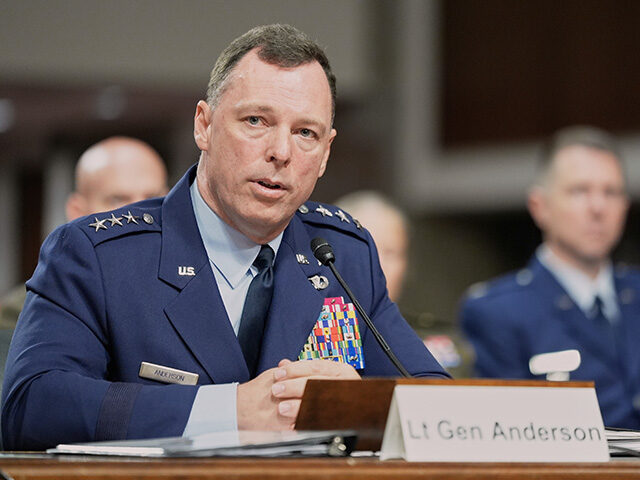
U.S. Africa Command (AFRICOM) said on Tuesday that a small number of American military officers have been deployed to Nigeria to assist with counter-terrorism efforts.
Gen. Dagvin R.M. Anderson, the commander of AFRICOM, said during a press briefing hosted by the State Department on Tuesday that the deployment was made after he met with Nigerian President Bola Tinubu at a summit in Rome in October.
The summit was part of the Aqaba Process, a counter-terrorism initiative launched by King Abdullah II of Jordan in 2015. The 2025 meeting in Rome was focused on terrorist threats in West Africa.
“At that meeting, I was able to meet President Tinubu. We were able to share some thoughts and agree that we needed to work together on a way forward in the region,” Gen. Anderson said on Tuesday.
“That has led to increased collaboration between our nations, to include a small U.S. team that brings some unique capabilities from the United States in order to augment what Nigeria has been doing for several years,” he said.
Anderson did not say exactly how large the U.S. team was, what missions it has undertaken, or when it arrived in Nigeria. He was pleased with the outcome, saying, “We’ve had some really good, positive movement there.”
“My deputy was just there with a high-level delegation from the State Department led by Allison Hooker, in order to look at how we can continue to move forward together,” he said.
Anderson dropped another hint later in the press conference, when he said the U.S. partnership with Nigeria was “a great example of a very willing and capable partner who requested the unique capabilities that only the U.S. can bring – with some of the ISR, some of the intelligence fusion – to bring that to bear together.”
ISR stands for Intelligence, Surveillance, and Reconnaissance. Anderson’s comments suggested the U.S. operators in Nigeria were helping local police and military units to locate and engage terrorist forces, something they have traditionally struggled with.
Nigeria’s “partnership” with the second Trump administration got off to something of a rocky start, as President Donald Trump accused the Nigerian government of not doing enough to protect its Christian citizens from constant attack by jihadis.
In October, not long after the Rome summit Gen. Anderson talked about, President Trump designated Nigeria as a “country of particular concern” for the persecution of Christians by radical Islamists.
The Trump administration cited research from watchdog groups like Open Doors, which ranked Nigeria as one of the most dangerous places in the world to be Christian for the eighth consecutive year in January 2026.
“In multiple instances, hundreds of Christians were killed or displaced because of attacks from Islamic militants,” Open Doors said in its annual World Watch report.
“Most of these attacks were carried out by militant Fulani herdsmen, who continue to target Christian communities, leading to the displacement of millions of Christians. Attacks are also carried out by Boko Haram and Islamic State West Africa Province, along with new extremist groups that are emerging,” the report said.
President Tinubu’s government denied there was any specific campaign of ethnic cleansing or genocide directed at Christians, offering the not-very-comforting defense that jihad and banditry are everywhere in Nigeria, and everyone has been victimized, including Christians and Muslims.
“There’s no religious persecution in Nigeria. It’s a lie from the pit of hell,” Tinubu insisted.
Nigeria’s tune began to change near the end of 2025, as Islamist groups launched savage attacks and kidnapping sprees across the northwestern region of the country. Tinubu came under increasing pressure at home to take more effective action against groups like Boko Haram and the Islamic State West Africa Province (ISWAP).
The Nigerian government became significantly more eager to enlist American counter-terrorist assistance, culminating in major U.S. airstrikes against Islamist militants in late December. The strikes targeted some lesser-known and elusive ISIS-aligned groups, including an Islamist gang called Lakurawa that got its start as a protection racket offering to defend villagers against bandits, before seizing control of rural communities.
On Wednesday, Nigerian Defense Minister Chrisopher Musa confirmed to the BBC that American troops were operating in his country to assist with “intelligence and training.” Musa did not offer any details on the size of the U.S. team, or when it arrived in Nigeria.
Also on Wednesday, local Nigerian officials said dozens of people were murdered by unarmed gunmen who attacked two villages in the western state of Kwara. A Red Cross official said there were at least 162 fatalities in the assault, which also left shops and homes in the villages of Nuku and Woro ablaze, forcing residents to flee.
COMMENTS
Please let us know if you're having issues with commenting.