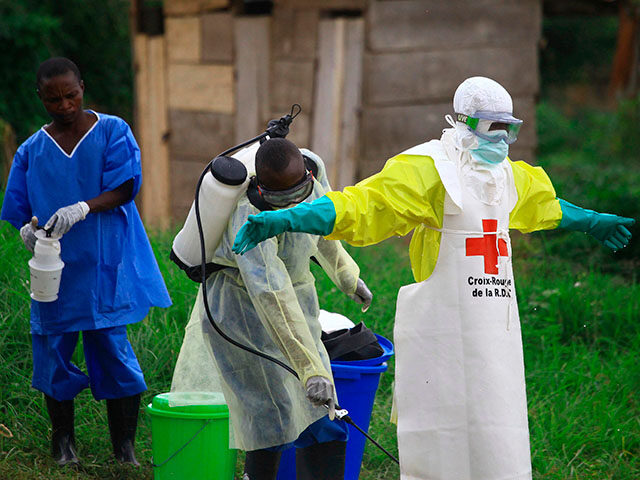

CBS News reported on Sunday that least six American citizens have been exposed to Ebola in the Democratic Republic of the Congo (DRC). Three of them encountered a “high-risk contact or exposure” and one is displaying symptoms of illness.
The CBS report was based on “sources with international aid organizations.” The sources said it was unclear if any of the Americans had been infected with Ebola. Even the symptomatic case might not be a confirmed infection, since Ebola shares early symptoms with other ailments, including muscle pains, skin rashes, fever, nosebleeds, and vomiting blood.
The U.S. Centers for Disease Control and Prevention (CDC) said in its latest bulletin that the “risk to the American public remains low” from the Congo outbreak. CDC advised Americans traveling to the Congo and neighboring regions of Uganda to “practice enhanced precautions,” including avoidance of people who display symptoms associated with Ebola.
CDC said it was “supporting interagency partners who are actively coordinating the safe withdrawal of a small number of Americans who are directly affected by this outbreak,” which would seem to confirm the basics of the CBS report, although CDC did not specify how many American citizens were involved.
At a press conference on Sunday, CDC Response Incident Manager Satish Pillai declined to confirm whether any Americans were exposed or infected. He added that he was unaware of any infected individuals boarding international flights and said screening procedures were in place at airports in the DRC and Uganda.
The U.S. State Department has issued a Level 4 “Do Not Travel” advisory for the DRC, upgraded from Level 3 on Sunday due to the “Ebola Bundibugyo Virus Disease outbreak in Ituri province.” The previous travel advisory was based largely on crime, violent unrest, and humanitarian crises in the eastern Congo.
The State Department noted that CDC issued a Level 2 “enhanced precautions” travel health notice for the DRC last week, due to the Ebola outbreak and the World Health Organization (W.H.O.) has declared the outbreak in the DRC and Uganda to be a “Public Health Emergency of International Concern.”
The U.K. Health Security Agency (UKHSA) said on Monday that there was a “low risk” to British citizens from the outbreak.
“Although the outbreak is serious, it is rare for Ebola cases to occur in returning travelers,” the agency noted.
Ugandan health officials on Monday insisted they have the outbreak under control, with only two confirmed cases so far. Both of the patients were said to be Congolese who traveled to Uganda, and one of them has died.
“We know Ebola. Life goes on with added vigilance,” the Ugandan government said, promising that all contacts of the two confirmed infections have been traced, and there has been “ZERO local infection” so far.
NBC News on Monday said there was nevertheless “mounting global alarm” over the outbreak, due in part to the exceptionally dangerous Bundibugyo strain involved. Bundibugyo Ebola has a fatality rate of 30 percent to 50 percent, spreads through bodily fluids, and has neither vaccines nor treatment at the present time.
W.H.O. and other international health officials are concerned that the outbreak appears to have been spreading for some time before it was detected and, while Ground Zero is the remote and violently unstable Ituri province, infections have now been detected as far away as the national capital of Kinshasa. The harsh realities of the Ituri province are making monitoring and treatment of the outbreak difficult.
Africa Centers for Disease Control (Africa CDC) experts said one reason for the spread of the disease is that community funerals are common practice in the eastern Congo and part of the ritual involves washing the bodies of the dead, which risks exposing people to infected bodily fluids. Africa CDC recommended immediately discontinuing such funeral practices in the outbreak area.
On Sunday, the W.H.O. regional office for Africa said that 35 experts from W.H.O. and the Congolese Health Ministry arrived in the Ituri provincial capital of Bunia, bringing 7 tons of emergency medical supplies and equipment with them.
The Doctors Without Borders (MSF) charity said it was also “preparing to rapidly scale up” its response to the outbreak.
“The number of cases and deaths we are seeing in such a short timeframe, combined with the spread across several health zones and now across the border, is extremely concerning,” said MSF emergency program manager Trish Newport.
On Sunday, Rwanda closed all of its border crossings with the DRC. The move was prompted by the discovery of Ebola cases in cities close to the Rwandan border, including the rebel-held city of Goma.
Rwandan officials said Congolese residents will no longer be allowed to cross the border, while Rwandans attempting to return from the DRC will be required to undergo mandatory Ebola testing and quarantine.
COMMENTS
Please let us know if you're having issues with commenting.