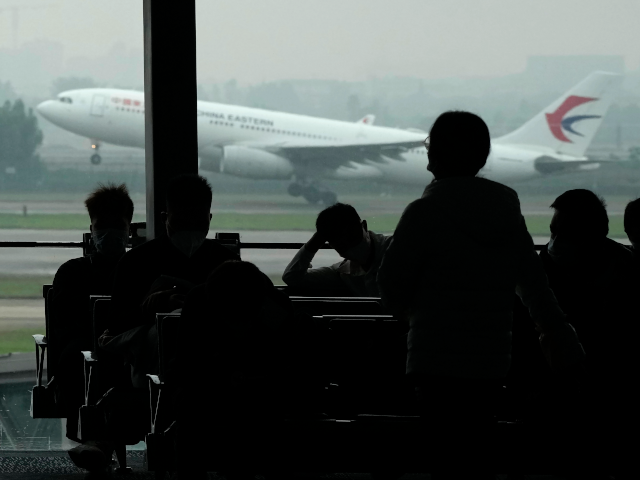

Data released this weekend by America’s National Transportation Safety Board (NTSB) in response to a Freedom of Information Act (FOIA) request suggest that someone on board China Eastern Airlines Flight MU5735 chose to cut off its fuel supply shortly before it nosedived and killed everyone onboard in 2022.
The MU5735 crash occurred in late March 2022 in Guangxi province, China, after the flight departed Kunming en route to Guangzhou. Chinese authorities reported that all 132 people on board died in the crash and have not, to this day, offered any conclusions regarding what happened for the plane to suddenly fall out of the sky. The crash has been the subject of intense debate for years given the otherwise stellar safety record of both China Eastern Airlines and of the plane model, a Boeing 737-800 NG. In addition to failing to offer any information regarding whether mechanical or human error — or deliberate action — was involved in the crash, the Chinese Communist Party moved to rapidly censor criticism of the handling of the disaster at the time.
According to the South China Morning Post, the NTSB published findings from its own investigation, aiding the Chinese government, on May 1. Its supplementary investigation found evidence that someone manually shut off the plane’s fuel supply by pulling a manual lever that controls how much fuel the engines receive.
“Engine speeds decreased after the fuel switch movement,” the report concluded. The plane is believed to have been flying at about 29,000 feet when the level was turned to stop feeding fuel to the engine. The NTSB reportedly arrived at these conclusions looking at flight recorders, the “black boxes” that monitor what happens on a plane. The American agency is involved in the investigation as the plane is made by Boeing, an American company.
“On a Boeing 737, the fuel switches are physical controls that regulate fuel flow to the engines. A pilot must pull the switch up before moving it from run to cutoff,” the flight industry publication Aerotime explained. “Both switches were shut off almost simultaneously, and on this aircraft type, both can be moved at once, even with one hand.”
David Soucie, an aviation analyst with CNN, explained that the new data suggests that someone not only chose to turn off the fuel supply, but did not make any attempt to restore it and keep the plane flying.
“This data clearly shows that the fuel switches were manually placed in the off position just prior to the crash,” Soucie concluded. “There is no indication the switches were placed back to the on position. That indicates there was no attempt to restart the engines. If the switches were turned off in error the pilots would have made an attempt to turn them back on.”
The ruling Chinese Communist Party has not at press time made any public statements on the new revelations. China is currently in a federal holiday period marking May Day, the international celebration of deadly communist ideology, with many of its public-facing offices, such as the Foreign Ministry, closed for vacations. CNN noted that it reached out to the Civil Aviation Administration of China (CAAC) and China Eastern Airlines this week, but did not receive a response to its requests by the time of the publication of its article on Monday.
The revelations this week prompted international headlines suggesting that the Chinese government could have deliberately hidden findings suggesting the pilot or co-pilot intentionally crashed the plane. Some outlets observed that the CAAC has complained in the past that any further transparency on the issue could result in “national security” complications, without elaborating. The U.K. Times explicitly concluded that “the Chinese authorities have known for four years that a pilot… deliberately crashed the aircraft.” The publication included the identity of the pilots:
Captain Yang Hongda, 32, Zhang Zhengping, the 59-year-old first officer, and Ni Gongtao, a 27-year-old second officer in training. Speculation in China has centred on Zhang, one of the airline’s most experienced pilots, who had recently been demoted from his captain’s rank.
The CAAC announced in April 2022, about a month into its investigations, that it had found “no abnormality” in the maintenance of the aircraft. Reports from the time indicated that the Chinese government had enthusiastically censored comments on regime-controlled social media complaining that the government was insufficiently maintaining planes and that mechanical error could have caused the mass death.
“The Civil Aviation Administration of China (CAAC) also said that the qualifications of the crew members and maintenance personnel on duty met the requirements, the plane’s airworthiness certificate was valid, and there were no abnormalities in navigation and surveillance equipment along the route or dangerous weather conditions,” the state-run Global Times reported in 2022. It added that no communications faults occurred before the crash. There did not appear to be any distress signals coming from the cockpit.
The Times acknowledged “online speculation” at the time that a co-pilot may have deliberately crashed the plane.
A year later, the Global Times cited the CAAC complaining that the investigation into what happened was “very complicated” and the agency still had no answers. Its “in-depth, detailed and rigorous technical investigation into the crash over the past year” did not yield any evidence that anything was wrong with the plane before it fell. This update notably did not include any mention of the potential mental health status of the pilot or co-pilot, or any speculation regarding potential motives in case of a deliberate crash.
COMMENTS
Please let us know if you're having issues with commenting.