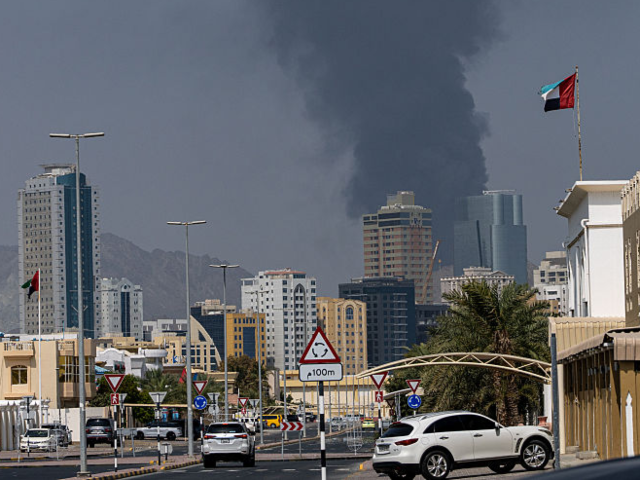

Iran ramped up its missile and drone attacks on the United Arab Emirates (UAE) on Monday night, setting a major oil port known as the Fujairah Oil Industry Zone ablaze.
Three Indian nationals were injured, prompting Indian Prime Minister Narendra Modi to denounce Iran’s actions.
Oil prices jumped about six percent on news of the fire at Fujairah, which was attacked by a dozen Iranian ballistic missiles, three cruise missiles, and four drones, according to Emirati defense officials. Iranian state media claimed the attack was a justified response to “U.S. military adventurism.”
Fujairah is one of the seven emirates that comprise the UAE, which was founded in 1971. The Fujairah Oil Industry Zone is located on the coast of the Gulf of Oman, about 80 miles from the Strait of Hormuz. The facility receives huge quantities of oil from a pipeline called the Abu Dhabi Crude Oil Pipeline (ADCOP), which runs about 235 miles to the gas fields in the south of another emirate, Abu Dhabi.
The port is also a significant hub for refueling ships, storing oil, and loading other forms of cargo. The Fujairah Anchorage Area is large enough to accommodate 174 ships and provide necessary services for their crews while they await new sailing orders.
The ADCOP pipeline is one of the major oil arteries of the Middle East, and it figures prominently in discussions of how global oil flows might be adjusted to reduce the importance of the Strait of Hormuz. This is probably why Iran attacked it, using a much more intensive bombardment than the offhanded drone strikes it launched at Fujairah during Operation Epic Fury in April.
Civil defense officials in Fujairah said the port fire was “under control” on Tuesday, but they would conduct a “cooling exercise” to prevent the fire from reigniting.
Three Indian citizens who worked in the Fujairah Oil Industry Zone were injured by Iran’s attack. The Indian embassy in the UAE said it was “in touch with local authorities for ensuring adequate medical care and welfare of the affected Indian nationals.”
Indian Prime Minister Narendra Modi condemned the Iranian attack on Tuesday, declaring that “targeting civilians and infrastructure is unacceptable.”
“India stands in firm solidarity with the UAE and reiterates its support for the peaceful resolution of all issues through dialogue and diplomacy,” Modi said. “Ensuring safe and unimpeded navigation through the Strait of Hormuz is vital for ensuring regional peace, stability, and global energy security.”
“The attack on Fujairah that resulted in injury to three Indian nationals is unacceptable,” added Indian Foreign Ministry spokesman Randhir Jaiswal. “We call for immediate cessation of these hostilities and the targeting of civilian infrastructure and innocent civilians.”
The attack on Fujairah was also condemned on Tuesday by Lebanese President Joseph Aoun, Pakistani Prime Minister Shehbaz Sharif, Jordan’s King Abdullah, Saudi Arabia, the Gulf Cooperation Council (GCC), the Arab League, several European powers, and Japan.
The Emirati foreign ministry “stressed the need for Iran to halt these unprovoked attacks, ensure its full commitment to an immediate cessation of all hostilities, and the complete and unconditional reopening of the Strait of Hormuz.”
UAE diplomatic adviser Anwar Gargash expressed his appreciation for “the messages of solidarity from the Gulf, Arab, and international communities with the UAE, which condemn and denounce the treacherous Iranian attacks.”
“These positions affirm that Iran is the aggressor party, responsible for exacerbating the crisis in the Arabian Gulf, and the source of danger and threat to its security and stability,” he said.
Gargash said Iran’s attacks on the UAE demonstrated the “moral bankruptcy” of a regime that has “chosen aggression as its approach to dealing with its neighbors.”
“The UAE’s firm and principled stance will not be intimidated by this escalation, nor will it allow it to shape the contours of future relations in the region,” he said.
“And once again, Iran has missed the mark,” he added.
Iran’s Islamic Revolutionary Guard Corps (IRGC), a designated terrorist organization, published a map over the weekend that showed Iran taking control of more territory beyond the Strait of Hormuz, including Fujairah and another Emirati port, Khorfakkan.
On Tuesday, Iranian state media announced the creation of a new “Strait Authority” that would issue “permits” for the Strait of Hormuz to ships that meet Tehran’s new “transit regulations.”
At a press conference on Tuesday, Chairman of the Joint Chiefs of Staff Gen. Dan Caine denounced Iran for “continuing to deliberately attack its neighbors.” He singled out the Fujairah attack, which he described as “successfully defeated.”
Caine said Iran’s attacks remained “below the threshold” of relaunching major combat operations,” but at the same press conference, Secretary of War Pete Hegseth warned that if Iran dares to “attack American troops or innocent commercial shipping,” it will “face overwhelming and devastating American firepower.”
Hegseth said the international waters of the Strait of Hormuz “belong to all nations, not to Iran to tax, toll, or control.”
“To our partners, allies, and the rest of the world: This is a temporary mission for us. The world needs this waterway a lot more than we do. We’re stabilizing the situation so commerce can flow again, but we expect the world to step up at the appropriate time, and soon we will hand responsibility back to you,” he said.
President Donald Trump said on Monday that Iran’s attacks on the UAE did not rise to the level of “heavy firing” that would shatter the uneasy ceasefire.
“Ships are moving. You know, we moved quite a few last night, big ones. There was no firing. I guess there has been some recently. I’m looking into it,” the president said.
The OPEC+ cartel on Sunday approved a small increase of 188,000 barrels per day (bpd) in oil output for June, its third effort to use production increases to blunt the effects of Iran’s attacks on shipping. The UAE, which withdrew from OPEC after more than five decades of membership on May 1, has been considering a much larger production increase. The OPEC+ statement on Sunday did not mention the UAE or its plans.
COMMENTS
Please let us know if you're having issues with commenting.