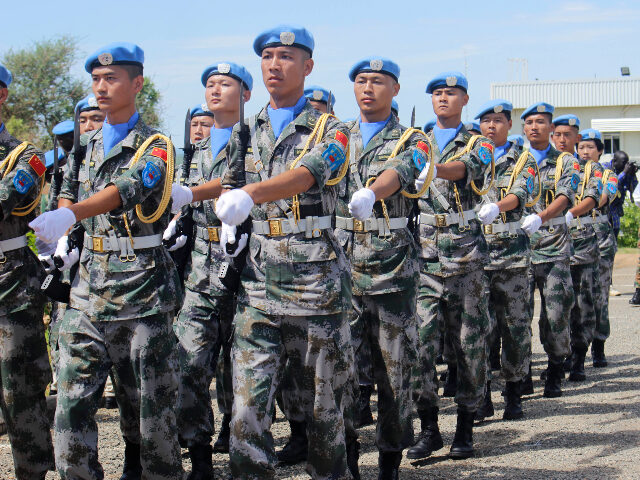

At a hearing of the House Foreign Affairs Committee on Wednesday, several lawmakers accused China of using United Nations peacekeeping missions as an opportunity for espionage.
“The Chinese peacekeeping department is concentrated in strategically sensitive regions, including areas along Belt and Road corridors, near ports, mineral resources, and existing or potential basing locations,” Rep. Sheri Biggs (R-SC) said.
“These are long-standing concerns about whether this designation is cover to advance military and intelligence objectives in regions where the U.S. has strategic interests,” she said.
“The Belt and Road Initiative countries shift their U.N. General Assembly voting patterns to align more closely with Beijing after the money arrives. This is a voting block that’s bought and paid for over time with these loans,” argued Rep. Scott Perry (R-PA).
The Belt and Road Initiative (BRI) is China’s massive international infrastructure program, which has been criticized for luring third-world nations into “debt traps” that eventually leave Beijing in control of their national assets. As Rep. Perry noted, BRI also spreads Chinese political influence in developing nations.
U.S. Ambassador to the United Nations Mike Waltz, formerly a congressman from Florida and onetime National Security Adviser (NSA) to President Donald Trump, told the hearing that Beijing’s peacekeepers often “serve a dual purpose as eyes and ears on the ground for the Chinese Communist Party.”
“In fairness to our Chinese colleagues on the Security Council, their contributions often are helpful. But again, they can serve a dual purpose, and we are very wide-eyed to that issue,” he said.
Waltz cautioned that full details could only be shared in closed-door briefings due to the sensitive nature of the intelligence.
India’s Firstpost argued that Waltz’s warnings were “hollow” because China is merely exploiting an opening created by the Trump administration’s cuts to the titanic amounts of money America was pouring into U.N. projects and other “development partnerships around the world.”
“Trump’s America First nationalist stance and retreat from the world stage have given China an opportunity to deepen its influence not only in these regions but also within multilateral institutions where the United States is reducing its engagement,” Firstpost huffed.
China launched BRI in 2013, during the second Obama administration, so it seems absurd to claim Beijing is taking advantage of U.S. spending cuts from 2025.
Also, as both Trump administrations have trenchantly noted, China gained an inordinate amount of influence over international bodies like the U.N. and World Health Organization (W.H.O.) during the very years when American foreign aid was running at all-time highs. The world learned this to its lasting sorrow during the Wuhan coronavirus pandemic and subsequent “investigations” of the outbreak that were transparently manipulated by China and its allies.
Complaints about the U.N. in general, and its peacekeeping missions in particular, offering extensive opportunities for espionage are hardly new. Canadian columnist Rachel Marsden was deeply suspicious of China’s billion-dollar pledge to the U.N. in 2015:
At the 2015 General Assembly, Chinese President Xi Jinping announced a $1 billion donation to the U.N. and offered 8,000 Chinese troops as a peacekeeping force. Xi also pledged $100 million to the African Union for security purposes. The donation was hardly a surprise, given China’s intense economic activity in Africa. That continent’s abundant mineral supply helps sustain China’s consumer technology manufacturing sector.
As for those “donated” 8,000 troops, they aren’t a sacrifice by China, but rather an opportunity to learn best practices from other countries’ soldiers and trainers who are also involved in U.N. deployments. According to the latest U.N. stats, there are more than 112,000 people serving in 16 peacekeeping operations around the world, 80,000 of whom are soldiers. Each of those peacekeeping missions provides precious ground truth: access to political and economic information under humanitarian pretext that would be difficult to obtain in another context.
Marsden made the point that peacekeeping missions, often dismissed as a thankless chore by member nations whose soldiers are not always on their best behavior, would be viewed by the People’s Liberation Army of China (PLA) as a valuable opportunity to observe foreign military operations up-close – including U.S. troops and forces that were trained by them.
COMMENTS
Please let us know if you're having issues with commenting.