Bringing Venezuela Under the ‘Donroe Doctrine’ Energy Umbrella
The commentary surrounding the recent capture of Nicolás Maduro has focused heavily on questions of legality—whether the operation violated U.S. or international law, the precedents it sets, and the diplomatic ramifications. But the narrow focus on legal authority and diplomatic reactions obscures a more fundamental economic story: the United States has quietly assembled something approaching energy dominance across the Western Hemisphere, and the economic implications are only beginning to come into view.
Consider the numbers. The United States, Canada, and Latin America now account for over one-third of global oil production—a figure that has been steadily rising and, by some estimates, approaches 40 percent, according to Bloomberg’s commodities and energy columnist Javier Blas. Between 2012 and 2022, the Western Hemisphere’s share of world oil output jumped from 27 percent to 34 percent, with all net growth in global supply during that period coming from the Americas. The shale revolution, Canadian oil sands, Brazilian offshore discoveries, and emerging producers like Guyana have fundamentally rebalanced global energy markets.
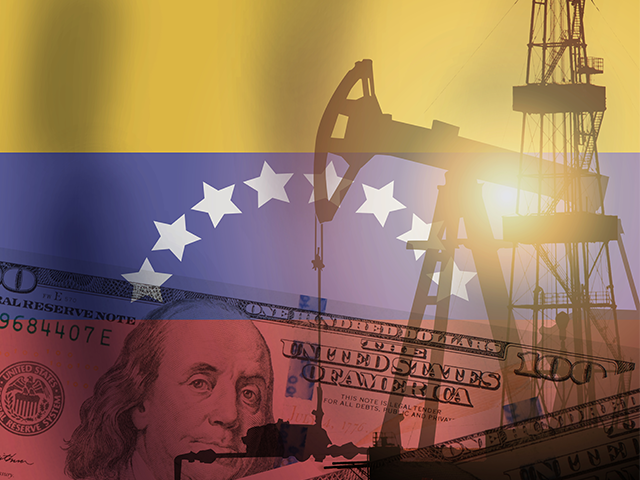
Venezuela represents the capstone of this shift. With the world’s largest proven oil reserves, the country once produced 3.7 million barrels per day at its 1970s peak before socialist mismanagement reduced output to barely ome million barrels today. Of course, restoring even a fraction of that capacity won’t happen quickly. Rebuilding Venezuela’s oil infrastructure after decades of neglect will take years, substantial capital, and a successful handoff of political power to less destabilizing forces than the Chavez-Maduro clique. But the strategic value lies not in immediate production gains but in what control of these reserves means for long-term energy security.
Leftist French economist Gabriel Zucman’s recent analysis of the intervention, while critical of U.S. motives, actually provides data that illustrates the extraordinary economic stakes involved and the potential benefits to the U.S. economy. In 1957, at the peak of U.S. oil investment in Venezuela, American oil companies earned profits there roughly equal to what all U.S. multinationals combined earned across all industries in the rest of Latin America and continental Europe. About 12 percent of Venezuela’s entire national income flowed to U.S. shareholders, according to Zucman.
“Venezuela’s economy was growing, but the gains overwhelmingly accrued to American investors and to well-paid U.S. expatriates,” Zucman writes. “By the early 1960s, Venezuela hosted the largest American expatriate community in the world, living in towns complete with modern hospitals and pristine baseball fields.”
This arrangement ended with nationalization in 1976, and production under state control eventually collapsed. Zucman estimates that if Venezuela could reach production and profitability levels comparable to Saudi Aramco—which reports $100-150 billion in annual profits—the economic stakes would be enormous.
Derisking the U.S. Economy Through Energy Abundance
Of course, real strategic value extends far beyond corporate profits. Energy security matters because nearly every major U.S. recession since 1973 has featured an oil shock as either the trigger or accelerant. The 1973 Arab embargo quadrupled prices and ushered in stagflation. The 1979 Iranian Revolution doubled oil costs within a year, precipitating another deep recession. The 1990 Gulf War spike coincided with economic contraction. The 2008 oil surge to $147 per barrel intensified the Great Recession. As recently as 2022, Russia’s invasion of Ukraine sent crude past $120, contributing to 40-year-high inflation that required aggressive Federal Reserve intervention.
In short, oil price volatility driven by geopolitical disruptions has consistently undermined economic stability. Research shows that a sudden 20 percent jump in oil prices can reduce U.S. manufacturing employment by roughly one percent within 18 months—tens of thousands of jobs lost as energy-intensive industries absorb higher costs for transportation, heating, and petroleum-based inputs like plastics and chemicals. Taking out the exogenous risk of far-away conflicts constraining the supply of oil paves a new path toward sustainable prosperity.
The COVID-19 pandemic provided another stark reminder of American vulnerability to exogenous shocks. Supply chain disruptions cascaded through the economy, revealing how dependent the United States remained on distant and unreliable sources for critical goods. The administration’s energy agenda—securing hemispheric oil through what some call the “Donroe Doctrine,” pursuing peace arrangements in the Middle East, and maximizing domestic production—suggests the Trump administration policymakers have learned this lesson and are working to make the U.S. economy less vulnerable to external disruptions.
The goal may be even more ambitious: to make America what Nassim Taleb calls “anti-fragile”—a system that doesn’t merely withstand shocks but actually strengthens from them. When geopolitical events stress energy production elsewhere in the world, the United States and Western Hemisphere would stand to benefit by becoming even more important to global supply. Future oil shocks wouldn’t just hit America less hard—they could accelerate the shift of production, investment, and strategic advantage toward the Americas.
America First, AI, and Energy Independence
It also could make the world a safer place—and therefore more prosperous—by securing more freedom for U.S. foreign policy. For decades, vulnerability to oil supply disruptions constrained American foreign policy. Major military action in or near oil-producing regions risked price spikes that could crater the domestic economy. That calculation has fundamentally changed. The United States now has the capacity to act without fearing that adversaries or cartels can weaponize energy supply against American interests. The examples are already visible: bombing Iranian nuclear facilities, enabling Ukrainian strikes on Russian refineries, and the Caracas operation itself would have been nearly unthinkable for previous administrations worried about triple-digit oil prices.
At the same time, we have more ability to avoid getting drawn into foreign disputes. Securing the Persian Gulf and balancing the powers around the Middle East’s oil supplies was central to U.S. policy for decades. It’s simply less important in a world where the Western Hemisphere has abundant energy. This is what an America First energy policy looks like. The left has long demanded a policy of “no blood for oil,” and Trump is delivering a world where that exchange is unnecessary.
The timing of this energy security breakthrough is particularly significant given an unexpected development: the American economy is becoming more energy-intensive, not less. For decades, analysts assumed we would move toward lower energy consumption per unit of GDP through efficiency gains and the shift to services. That assumption has been upended by artificial intelligence.
Large-scale AI systems require extraordinary amounts of electricity. Data centers running frontier AI models can consume as much power as small cities, and every indication suggests these demands will grow exponentially as models scale and deployment expands. Major technology companies are scrambling to secure power capacity. In an era of AI-driven competition, reliable and abundant energy becomes not just a nice-to-have but a core competitive advantage.
It’s hard to miss the irony that the technology sector, which largely embraced narratives about declining fossil fuel relevance, has created conditions where energy abundance and security matter more than ever. AI requires reliable electricity, much of which still comes from hydrocarbons and will still be mined and drilled from the earth for the foreseeable future.
This creates a striking asymmetry in strategic competition with China. While the United States enjoys unprecedented energy security through hemispheric production, China remains heavily dependent on imported oil and gas, much of it flowing from the Middle East and Russia through vulnerable sea lanes. In a prolonged competition centered on energy-intensive technologies like AI, this represents an enormous structural advantage.
What we’re witnessing in Venezuela is less about one country’s oil production and more about the completion of a shift toward Western Hemisphere energy independence and an embrace of the core reality of fossil fuel-driven global energy production. The economic implications are profound: from manufacturing resilience to reduced recession risk to advantages in technological competition. After 50 years of recurring oil shocks that constrained both economic growth and foreign policy flexibility, the United States has finally achieved something approaching energy security.
COMMENTS
Please let us know if you're having issues with commenting.