The Manufacturing Boom the Wall Street Journal Missed
A Wall Street Journal headline this week declared, “U.S. Manufacturing Is in Retreat and Trump’s Tariffs Aren’t Helping.” But the actual data released this week by the Federal Reserve and the Commerce Department tell a dramatically different story, one of rising output, climbing demand, and surging business investment.
Manufacturing is not in retreat. It’s booming. Industrial output hit an all-time high in November and then broke that record in December.
The disconnect between the WSJ’s narrative and the Fed’s numbers reveals a fundamental confusion about how to measure manufacturing health in a modern, productivity-driven economy.
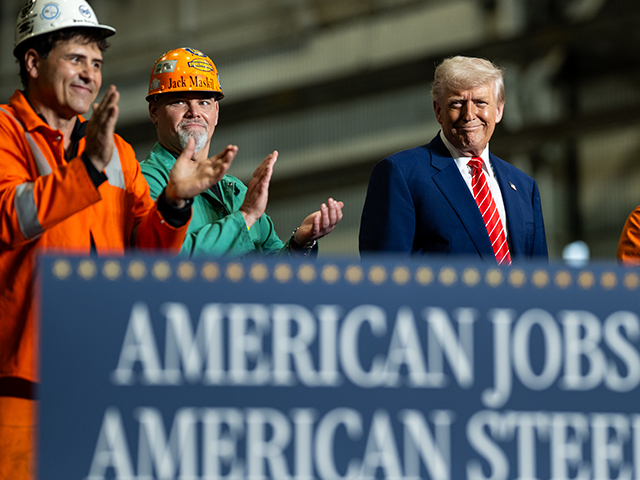
President Donald Trump delivers remarks at the U.S. Steel Corporation-Irvin Works in West Mifflin, Pennsylvania, on May 30, 2025. (Official White House Photo by Daniel Torok)Business Equipment Growth Hits 20-Year High
The Federal Reserve’s report on industrial production, published Wednesday, shows that manufacturing output has been advancing, not retreating. The manufacturing production index rose from 95.77 in January 2025 to 98.24 in January 2026, a year-over-year gain of 2.6 percent. January 2026 marks the highest level in the entire dataset.
Manufacturing output rose 0.6 percent in January alone. The Fed described this as “the largest [monthly increase] since February 2025” and emphasized the “widespread gains across industry groups,” noting that “durable manufacturing output increased 0.8 percent, with gains in nearly all component industries.”
Business equipment production, the key investment indicator, tells an even stronger story. Output surged 9.8 percent last year, the strongest increase in 20 years. In January, output rose another 0.9 percent, bringing output up to 9.3 percent above the prior year’s level.
Transit equipment production jumped 27 percent year-over-year, while information processing equipment rose five percent and industrial equipment gained 3.6 percent. This isn’t the profile of a sector in retreat.
Released the same day as the industrial production data, the Census Bureau’s report on durable goods orders reinforces the expansion narrative. Total durable goods orders rose 7.8 percent in 2025. Core capital goods orders, a proxy for business investment that excludes defense and aircraft, gained 3.5 percent. Machinery orders increased 5 percent, computers and electronic products rose 4.2 percent, and computers specifically surged 13.7 percent. Communications equipment orders jumped 9.1 percent while electrical equipment gained 5.1 percent.
This is very likely a reaction to Trump’s signature economic policies. Full expensing for capital investments, restored by the One Big Beautiful Bill, has incentivized companies to purchase machinery, computers, and equipment. Tariffs are bringing manufacturing processes back home and encouraging U.S. companies to order from domestic manufacturers. The restoration of immigration law and order has slowed workforce growth, encouraging companies to seek growth through productivity enhancing investment and innovation rather than simply adding to the headcount.
Production, Not Employment, Is the North Star for Economic Health
The WSJ article focuses heavily on jobs lost last year. But that emphasis betrays a myopia that undermines the argument. Trade analyst Alan Tonelson’s detailed analysis of the January jobs report and the Bureau of Labor Statistics’ annual benchmark revision reveals that even on the employment metric that the Journal emphasizes, Trump has stemmed the job losses brought about by Biden’s manufacturing-killing policies.
The benchmark revision, released with January’s jobs report, cut the number of manufacturing jobs created between March 2024 and March 2025 by 98,000, a period spanning mostly the Biden administration. This dramatically changed the comparative picture. Between February and December 2025, the first 11 months of Trump’s second term, manufacturing employment fell by 81,000. During the same calendar months in 2024 under Biden, manufacturing jobs declined by 179,000, more than twice Trump’s losses.
The comparison becomes even more striking when examining the period since Trump’s “Liberation Day” tariffs in April 2025. Between April and December 2025, manufacturing lost 72,000 jobs. During the same months in 2024 under Biden, before significant tariffs, the sector shed 160,000 positions, nearly 2.2 times as many. In January 2026, manufacturing then delivered its first monthly jobs gain, 5,000 positions, in more than a year.
If the Wall Street Journal is correct in its thesis that tariffs are harming manufacturing, we would expect to see employment performance worsen after the tariffs were implemented. Instead, the data shows the opposite: manufacturing employment losses during the Trump tariff period were less than half those recorded during the comparable pre-tariff Biden period. The trajectory improved, not deteriorated.
Wall Street Journal‘s framing reflects a common analytical error: treating employment surveys as the primary measure of manufacturing health rather than actual production data. In a labor-constrained economy, this approach systematically misdiagnoses the health of the economy.
Following the financial crisis, as the economy sputtered under President Barack Obama’s wrong-headed policies and the Federal Reserve’s misguided quantitative easing, the economy was starved for jobs, and unemployment remained high. During those years, it made sense to constantly look to job growth for a signal about the health of the economy. In a period of full employment, that’s no longer the north star for policy making.
The Journal doesn’t mention that manufacturing productivity rose 3.3 percent in Q3 2025, with output climbing 2.6 percent even as hours worked fell 0.7 percent. Over the past four quarters, productivity gained 2.3 percent, the strongest performance since 2021. This represents a fundamental reversal of the “mysterious slowdown” the New York Fed documented in July 2024, which showed manufacturing productivity declining from 2015 through 2022. Manufacturing productivity has now recovered 3.2 percent from its late 2022 trough.
The article also mentions that “manufacturing construction spending, which surged with Biden-era funding for chips and renewable energy, fell in each of Trump’s first nine months in office.” But that downturn was obviously just the inevitable pullback after Biden’s subsidies pulled forward construction that would have happened in subsequent years. Biden’s deficit spending not only borrowed dollars, but it also borrowed construction from the future.
The Productivity Recovery
The WSJ story explicitly blames tariffs for manufacturing’s supposed retreat. But the timing contradicts this narrative. Manufacturing output troughed in Q4 2024, before the 2025 tariff implementations. The recovery in productivity, output, wages, and capital investment has occurred during 2025, with all four metrics showing consistent improvement through three consecutive quarters. Job losses slowed from the Biden blood-letting era.
The better signals from February’s data releases show manufacturing production up, capital goods orders are surging, productivity is rising at its fastest pace in years, and wages are growing above four percent annually, faster than inflation. Business equipment production saw the biggest surge in two decades.
This is the profile of an economy undergoing a historic manufacturing expansion, not retreat.
COMMENTS
Please let us know if you're having issues with commenting.