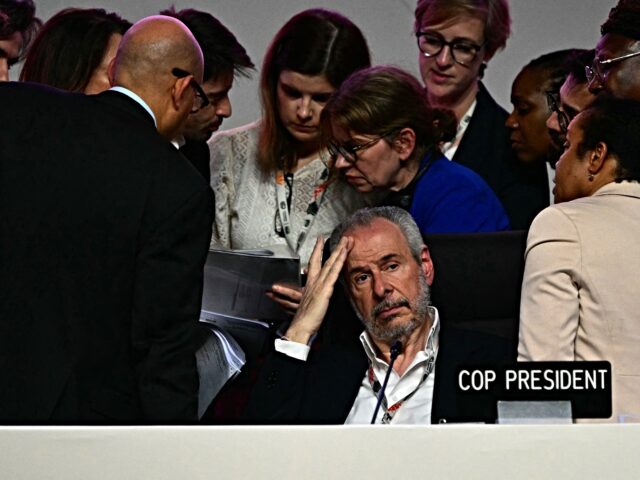
The United Nations COP30 climate summit ended this weekend with the publication of a declaration calling for a mutirão, or “collective effort,” to prevent climate disaster. Few specifics were offered on how exactly to do so.
The declaration suggested that the world’s nations should triple their spending on the “climate crisis” in the next decade, used suggested “voluntary indicators” to track their environmental progress, and participate in the launch of the “Global Implementation Accelerator,” intended to speed up the transition away from fossil fuels in unspecified ways.
Radical green activists lamented the failure to explicitly declare an ending deadline for the use of fossil fuels and mandate dramatic increases in governments’ expenses on climate activism, echoing the disappointment from senior United Nations officials, including Secretary-General Antonio Guterres.
Limiting the consequences of any statement out of the summit was the absence of the leaders of the world’s three most prolific polluters: China, India, and the United States.
COP30 is the 30th edition of the U.N.’s “Conference of the Parties to the United Nations Framework Convention on Climate Change (UNFCCC)” – in short, an annual meeting of parties to the Paris Climate Agreement. The objective of the summit is for participants to hash out concrete policy proposals to combat the alleged “climate crisis,” primarily pressuring the world’s richest countries to redistribute their wealth to more impoverished countries deemed to be on the “front lines” of the “climate crisis.” This year’s edition of the summit took place in Belém, Brazil, deep in the Amazon Rainforest, intended to highlight the prominence of that biome in the mystique of the climate movement.
This year’s edition was especially chaotic, as Belém did not boast sufficient and appropriate venues to house the tens of thousands of diplomats, activists, and fossil fuel lobbyists that attend the COP events.
The summit’s active days were sandwiched in between a security failure that allowed violent indigenous activists to access the “blue zone” for diplomats inside the summit on November 11 and a massive fire engulfing the “blue zone” on Thursday.
Fire Disrupts Global Climate Summit in Brazil, Sending Attendees Fleeing Through Smoke
In between those two events, Simon Stiell, executive secretary of the UN Framework Convention on Climate Change, reportedly sent a letter to Brazilian officials complaining that attendees were struggling with their health due to insufficient air conditioning, bathrooms lacked water, and frequent torrential rain was causing significant leaks through the venue’s light fixtures. Attendees complained the venues lack functioning toilets.
Despite the reports depicting a poor performance by host country Brazil, the government took a victory lap on Sunday, declaring the country capable of leading “an unprecedented global debate on the future of fossil fuels.” In an official press statement, the COP30 leadership claimed that leading those assembled to agree to any statement at all was a victory given the alleged “unprecedented geopolitical tensions” – a veiled reference to President Donald Trump’s refusal to partake in any climate alarmism activities.
“Despite the absence of consensus, with more than 80 countries supporting explicit language and over 80 opposing it, the Brazilian Presidency announced, on its own initiative, processes to develop two key roadmaps,” one to transition away from fossil fuels, and one to “halt and reverse deforestation.” Neither of these roadmaps includes any concrete commitments from parties involved.
The summit statement itself declared the beginning of a “Global Mutirão,” using a Portuguese and indigenous word for collective effort, which allegedly represented a new action against alleged climate change and is “calling on all actors to work together to significantly accelerate and scale up climate action worldwide.” The Mutirão calls for the establishment of voluntary progress markers on climate change to suggest to countries and the nebulous creation of “the Global Implementation Accelerator, as a cooperative, facilitative and voluntary initiative.”
The document also called on involved countries to increase spending on climate alarmism to threefold the current amount in the next decade and “reaffirm[ed] the call on all actors to work together to enable the scaling up of financing to developing country Parties for climate action from all public and private sources to at least USD 1.3 trillion per year by 2035.”
Other proposals in the document include “peer exchange workshops” and the adoption of a “gender and climate action plan.”
The document concludes with a warning that nothing in it should be construed to support state action to punish major polluters: “measures taken to combat climate change, including unilateral ones, should not constitute a means of arbitrary or unjustifiable discrimination or a disguised restriction on international trade.”
Guterres, the U.N. chief, was among the first to lament the results of the COP as insufficient.
“COPs are consensus-based – and in a period of geopolitical divides, consensus is ever harder to reach. I cannot pretend that COP30 has delivered everything that is needed,” Guterres said following the end of COP30, according to Al Jazeera. “The gap between where we are and what science demands remains dangerously wide.”
Stiell, the U.N.’s top climate official, also appeared to concede defeat in subsequent comments.
“Denial, division and geopolitics has dealt international cooperation some heavy blows this year,” he reportedly said at the end of the summit, according to The Guardian.
Environmentalist groups were among the most disappointed, highlighting the lack of action to contain the use of fossil fuels. The International Union for Conservation of Nature (IUCN) published a statement, for example, expressing “regret” that “more concrete results could not be achieved at COP30 on key issues that are central to addressing the climate crisis.”
“Although Parties had taken a historic decision at COP28 to transition away from fossil fuels in a just, orderly and equitable manner, no pathway was agreed to advance this commitment,” it noted, calling this a “matter of serious concern.”
Speaking to The Guardian, Greenpeace International deputy programme director Jasper Inventor, more pointedly dismissed the summit as a failure: “Cop30 started with a bang of ambition but ended with a whimper of disappointment. This was the moment to move from negotiations to implementation – and it slipped.”
Among the loudest to condemn COP30 was the president of neighboring Colombia, Gustavo Petro, a radical leftist and former member of a Marxist terrorist guerrilla.
“I do not accept that the COP30 declaration does not clearly state, as science does, that the cause of the climate crisis is the fossil fuels used by capital. If that is not stated, everything else is hypocrisy,” he wrote in a typically long-winded screed on Twitter. “Life on the planet, including our own, is only possible if we separate ourselves from oil, coal, and natural gas as energy sources; science has determined this, and I am not blind to science.”
Follow Frances Martel on Facebook and Twitter.
COMMENTS
Please let us know if you're having issues with commenting.