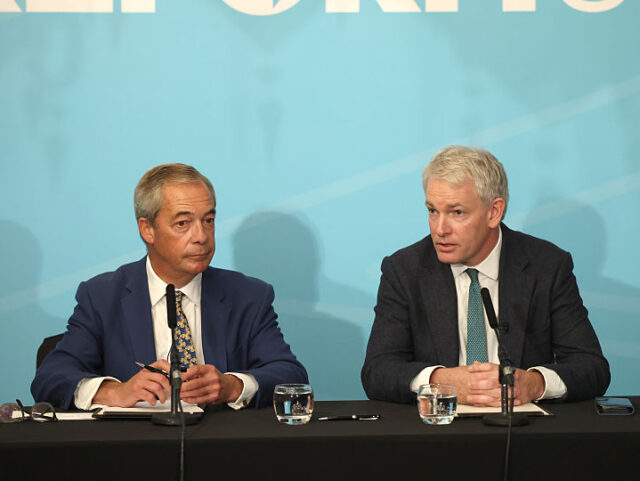

The UK needs “radical restoration” to drag it back to being a well governed and functioning country Danny Kruger, a sitting Member of Parliament said as he defected to Reform UK on Monday morning.
Brexit pioneer and Reform UK leader Nigel Farage welcomed erstwhile Tory Member of Parliament Danny Kruger, who represents East Wiltshire, to the party at a special press conference on Monday morning. Acknowledging that while his faction has brought new energy to British politics and has utterly dominated polling for over 100 polls in a row now, Mr Farage said its nature as a new political force with no record in government means it needs to learn how to manage the state before theoretically winning the next General Election.
To do this, Mr Farage said the party would be launching a new “department for preparing for government” to “find talent, find people with experience… and help us get ready for what will be a monumental task”. Announcing the leader of this unit, Mr Farage unveiled the defection of Mr Kruger to Reform UK.
Kruger is — or was — considered by Tory insiders to be a strong thinker and had a series of “big strategic roles” inside Downing Street over the course of the previous Conservative government, making him a valuable acquisition for Farage.
The defection of Kruger to Reform may also be perceived as opening something of a floodgate for others to move.
Kruger said he found the decision to cross the floor and join Reform “personally painful” because he has been a member of the Conservatives for 20 years and has many friends still in the party, yet said he couldn’t ignore that apart from a few highs, the party’s record in government has actually been one of failure. He called Mr Farage “the best hope we have, maybe our last hope, and I fervently hope our next Prime Minister” and said there is only space for one party on the right, and that now has to be Reform UK.
He said:
I was thrilled by Brexit… but those were exception to the rule. The rule of our time in office was failure. Bigger government, social decline, low wages, high taxes, and less of what ordinary people actually wanted. And now our country is entering the most profound set of crisis in my lifetime, under a government even worse than the one it replaced. Crisis in the economy, crisis at the border, crisis on our streets, crisis in our military, crisis for young people.
Yes we are still a great country and there are good reasons so many migrants want to come here, but there are also reasons so many entrepreneurs and young people want to leave. Britain is not broken, but it is badly damaged.
Mr Kruger said he had held onto hope that the Tories would have learnt the lesson from last year’s historic electoral defeat, that “the old ways don’t work, that centrism isn’t enough”, but said they hadn’t.
As for what needs to come now, Kruger called on government insiders including Civil Servants and even military officers to contact the party in secret to help it learn about what it happening on the inside and how to fix it. Kruger said:
It’s going to be difficult because we are planning change on a scale the system has not seen since the modern civil service was created in the 19th century. This work will be hard and it will be opposed by the system, and that’s why we need to be radical. Taking on the vested interests and the incumbents who always defend the status quo. Reform UK is a radical force but not a revolutionary one. Our mission is not just to overthrow the current system, but it is to restore the system we need. Limited government, accountable power, a strong society, a state that works in the interest of the people. Radical restoration, that is the reform the country needs.
Of working with those Civil Servants and military officers, Kruger said part of the purpose of his preparing for government brief was telegraphing to the permanent government well in advance the changes that are coming so they can get ready for them. He said:
…I think we’re going to encounter serious opposition, and part of the purpose of today and the work we’re going to be doing quite publicly in the years and months to come is to be signalling very clearly to the system what is coming, and we want to do that in a civil, constructive way.
We don’t want to pick fights where we don’t need to but it’s essential that the Whitehall Machine understands that if we win there will be change… I think there will be opposition but I am determined we do this in a way that’s constructive… but there are people, quiet people [in the Civil Service], often not in the most senior ranks, who recognise how broken the system is and who will want to help us. So I think it is very important that we signal to those people that we’re not out to get everybody and we want to work constructively with those parts of the machine that recognise that a system designed in the 19th century is no longer remotely fit for purpose.
We need a much leaner, much more efficient, much mor open central apparatus which is properly accountable to elected politicians so that when people vote for a change in government, they actually get a change, not just a change of ministers.
This story is developing, more follows
COMMENTS
Please let us know if you're having issues with commenting.