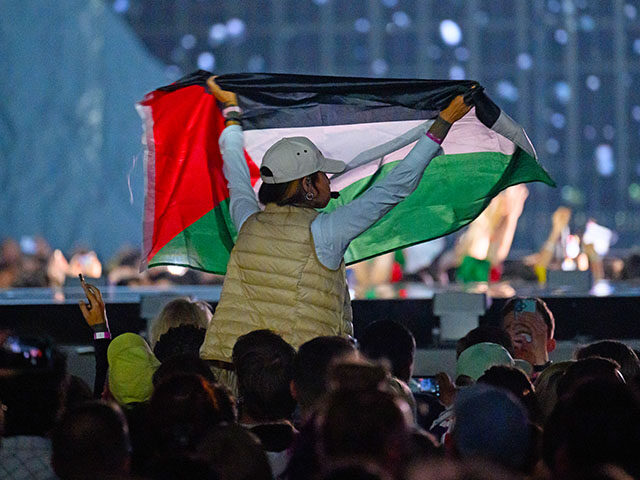
The national broadcaster responsible for hosting the 2026 Eurovision Song Contest announced on Wednesday that audience members will be allowed to bring “all official flags,” presumably including the Palestinian flag, and that booing will not be censored out of the live event, emboldening pro-Hamas protesters who have made the non-political event a major target.
The 70th iteration of the Eurovision Song Contest, a live musical event imagined as a way to bond European countries together after World War II, will take place in Vienna, Austria, in May. The contest has experienced significant internal and fan-based discord following the October 7, 2023, invasion of Israel by Hamas, a bloody genocidal act that killed over 1,000 people and featured widespread abductions, torture, and other atrocities. Israel has been a regular competitor in Eurovision since 1973, one of several non-European regulars at the event, and has won four times.
Following the Hamas attack, pro-Hamas protesters have dramatically escalated activism to force the European Broadcast Union (EBU), which manages Eurovision, to expel Israel in objection to the self-defense operations the Israeli government launched in Gaza after the attack. Pro-Hamas rioters have wreaked havoc on the last two editions of the contest, organizing mobs of thousands in 2024 host city Malmö, Sweden, and threatening Israeli contestant Yuval Raphael, an October 7 survivor, in the 2025 contest.
The organizers of the last contest in Basel, Switzerland, banned artists from displaying the flags of any country other than the one they are representing in the contest, outraging both pro-Palestinian activists who urged artists to wave the Palestinian flag and LGBTQIA2+ activists who lamented that the rainbow flag had been banned while being irrelevant to the controversy. They also extensively used “anti-booing” technology to silence the audience during the performances, in particular to prevent the audience from disrupting Raphael’s performance.
On Wednesday, Austrian broadcaster ORF vowed that its organizers will neither mute the audience nor ban fans from bringing flags, with some exceptions.
“We will allow all official flags that exist in the world, if they comply with the law and are in a certain form – size, security risks, etc,” executive producer Michael Kroen explained at a press conference.
Reports on the press conference do not clarify how the Austrian authorities will define “official” flags – whether they must represent a sovereign state, a state or territory, or simply a political movement, such as the rainbow flag. Also absent in explanations is whether the flags of countries explicitly banned from Eurovision, such as Russia and Belarus, will be allowed or not. Russia and Belarus were banned from the contest after years of participation in 2022 in protest of Russia’s invasion of another longtime competitor, Ukraine.
“We will not sugarcoat anything or avoid showing what is happening, because our task is to show things as they are,” Kreon reportedly added.
Another official, Director of Programming Stefanie Groiss-Horowitz, stated plainly, “We won’t play artificial applause over it at any point.”
“If there are large protests, then we will not hide this. But if there are smaller groups, then you don’t have to cut on every protester.” Groiss-Horowitz explained.
The policy represents a change from the past two years. In 2024, the first contest after the October 7 attacks, authorities in Sweden banned the waving of any flags not representing competing countries, including the Palestinian flag and rainbow flags. Malmö’s Eurovision hosting duties were marred by a mob of ten thousand people surrounding the show venue with pro-Palestinian flags and shouting pro-Hamas slogans; Malmö is home to one of Europe’s largest Muslim diaspora populations. Among those participating in the protests was climate alarmist Greta Thunberg, who has added anti-Israel activism to her roster of protest issues.
In Basel, Switzerland, the 2025 contest banned the contestants themselves from using flags outside of those representing their countries, but did not ban the public from bringing them, unless they were “flags with racist and/or discriminatory content, including symbols that incite hatred or violence; flags that may be considered offensive or defamatory; and flags with symbols of banned terrorist organizations.” The Palestinian flag was not deemed a symbol of inciting hatred of violence.
Basel also prominently featured the use of “anti-booing” audience volume control to affect the broadcast, preventing pro-Palestinian audience members from disrupting the Israeli performance. The audience muting problem became a problem for other acts whose songs involved significant audience participation, however. Eurovision fans in particular lamented that the audience controls damaged the performance of the act considered the frontrunner in the contest before the finals, Finnish-Swedish comedy band KAJ, and their sauna song “Bara Bada Bastu.” KAJ ended up in fourth place in the contest, finishing behind winner Austria and runners-up Israel and Estonia.
KAJ were among the acts greeted with large Palestinian flags on the “turquoise carpet” welcome event before the 2025 final.
The pre-final events in Basel also featured mobs of pro-Hamas protesters, included one recorded making a throat-slitting gesture at Israeli contestant Yuval Raphael.
Following Israel’s second-place finish in 2025 – and win with the popular vote – anti-Israel activists and leftist member nations of the EBU began demanding Israel be expelled from the contest. The EBU initially scheduled a vote on whether to keep Israel in the contest or not, but canceled it after President Donald Trump brokered a peace agreement in Gaza.
In early December, EBU members voted at a broader meeting to keep Israel in the contest, prompting five countries to boycott the event: Ireland, Spain, the Netherlands, Slovenia, and Iceland. Three countries – Bulgaria, Moldova, and Romania – have announced their return following the news of Israel’s continued presence.
Former Eurovision contestants have also continued to pressure the EBU to expel Israel. Nemo, the Swiss non-binary rapper who won the 2024 contest with his song “The Code,” dramatically announced last week that he would ship his winner’s trophy back to the EBU, relinquishing it in protest of Israel’s inclusion.
“Even though I’m immensely grateful for the community around this contest and everything that this experience has taught me both as a person and as an artist, today I no longer feel like this trophy belongs on my shelf,” Nemo asserted. “Eurovision says it stands for unity, for inclusion, and dignity for all people … Israel’s continued participation during what the UN’s Independent International Commission of Inquiry has concluded to be a genocide shows there’s a clear conflict between those ideals and the decisions the EBU is making.”
Follow Frances Martel on Facebook and Twitter.
COMMENTS
Please let us know if you're having issues with commenting.