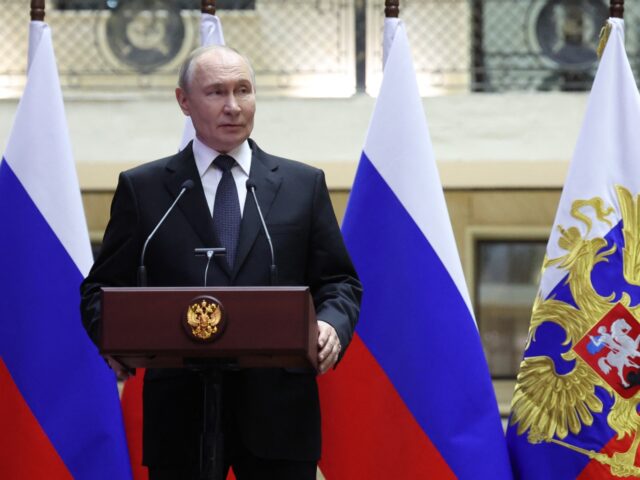

Russian strongman Vladimir Putin praised North Korean troops for fighting “valiantly and bravely” against Ukrainians in Kursk, a Russian region Ukraine counter-invaded last year, during a Defense Ministry meeting on Wednesday.
Putin’s effusive expressions of gratitude to communist North Korea for participating in his country’s invasion of Ukraine followed dictator Kim Jong-un staging an event this week to congratulate returning forces in Pyongyang, identifying them as engineers working to help clear mines and other dangers in the Russian border region. The public events indicate that Putin is satisfied with his growing relationship with the North Korean regime and may call on more military support from Pyongyang in the future – increasing North Korea’s military footprint in Europe.
The Russian news agency Tass, reporting on Putin’s comments on Wednesday, noted that the North Korean troops in Kursk were reportedly helping clear mines and other explosives, though Putin described them as being active in battle.
“By the decision of Comrade Chairman of the State Affairs of the DPRK Kim Jong Un, they were sent to participate in the liberation of the Kursk Region and fought valiantly and bravely with the enemy side by side with Russian soldiers,” Tass quoted Putin as saying. “They also took part in a large-scale and extremely difficult mine clearance operation in the liberated Kursk Region.”
Tass nonetheless described these forces as “combat engineers” who “took part in the difficult task of clearing the Kursk Region from explosive devices.”
The soldiers Putin mentioned appear to be the same ones for which Kim Jong-un held a welcome-back ceremony in their home countries this weekend. The North Korean regime presented the event as a celebratory affair and Kim delivered an extensive speech in which he claimed his soldiers were “courageous and responsible all the time” and performed “miracles” by removing explosives. Kim also used the event to condemn the “armed villains of the West” supporting Ukraine against the Russian invasion.”
“Early in August you, engineers of the regiment, left for the Kursk region of the Russian Federation, which your comrades-in-arms had retaken at the cost of their lives, and you achieved brilliant results in the course of performing your combat tasks there,” Kim remarked, according to North Korean state media.
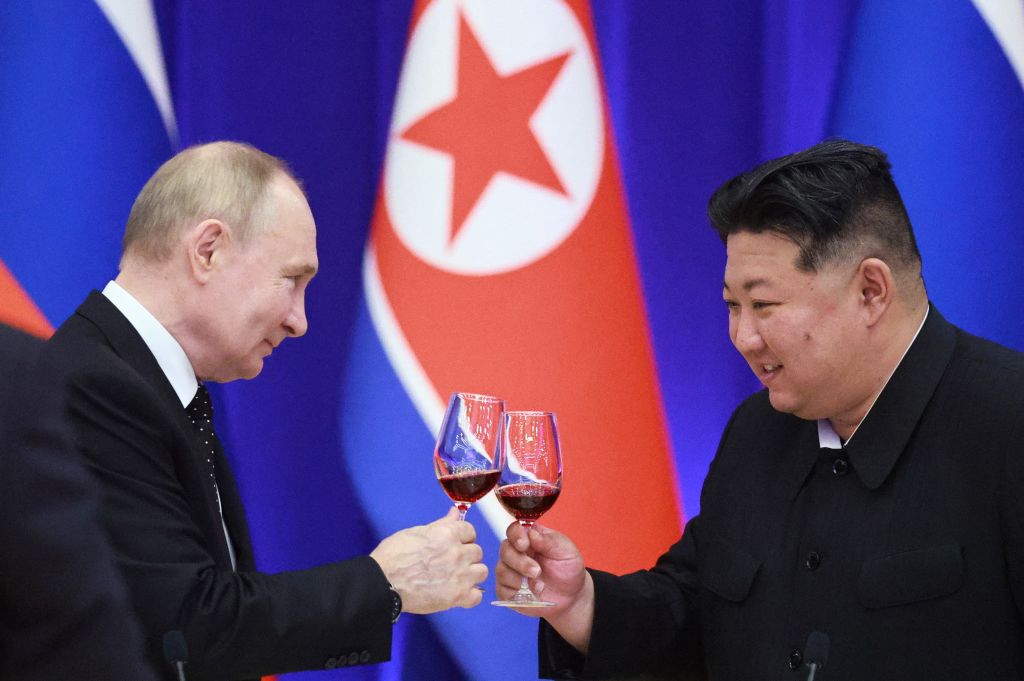
File/ In this pool photograph distributed by the Russian state agency Sputnik, Russian President Vladimir Putin and North Korean leader Kim Jong Un toast during a reception at the Mongnangwan Reception House in Pyongyang on June 19, 2024. (VLADIMIR SMIRNOV/POOL/AFP via Getty Images)
“As all of you, both officers and soldiers, displayed mass heroism overcoming unimaginable mental and physical burdens almost every day, you could work a miracle of turning a vast area of danger zone into a safe and secure one in a matter of less than three months,” he continued. “Except the heartrending loss of nine lives, all the officers and soldiers of the regiment have returned to the motherland, and I express my thanks to you for this.”
The Russian government first invaded Ukraine in 2014, colonizing its Crimean peninsula and maintaining a consistent presence in a decade of hostilities between pro-Russian “separatist” forces and the Ukrainian military in the Donbass region. In February 2022, Putin announced a “special military operation” to oust Ukrainian President Volodymyr Zelensky, who he declared a “Nazi.” Russia has since “annexed” the Donbass, as well as the regions of Kherson and Zaporizhzhia, and continues to conduct aerial bombings on Ukraine’s largest cities even as a U.S.-led peace negotiation is underway.
North Korea, one of the most repressive and violent communist regimes in the world, became embroiled in the affair following a reported rift between Kim Jong-un and his formerly most influential patrons, the government of China, after the eruption of the Wuhan coronavirus pandemic. Kim pivoted North Korea’s foreign policy closer to Russia, signing a mutual defense treaty with Putin in Pyongyang in June 2024. Shortly after the formalizing of that agreement, intelligence officials in South Korea and Ukraine began reporting the presence of North Korean troops in Europe to help Russia’s invasion.
“Today I can confirm that over 10,000 DPRK [North Korean] soldiers have been sent to eastern Russia, and most of them have moved to the far western Kursk Oblast where they have begun engaging in combat operations with Russian forces,” U.S. State Department spokesman Vedant Patel said in late 2024.
North Korea openly acknowledged its involvement in April 2025, after multiple international intelligence reports suggested that as many as 12,000 North Korean troops were fighting alongside the Russians. Kim declared the move necessary to “annihilate and wipe out the Ukrainian neo-Nazi occupiers and liberate the Kursk area in cooperation with the Russian armed forces.” At press time, the North Korean government has admitted only to sending troops into Kursk and other regions of Russia where Ukrainian forces are present, not Ukrainian territory.
In July, Kim Jong-un held an event at a theater in his nation’s capital in which attendees watched propaganda videos of Kim draping the coffins of North Koreans reportedly killed fighting against Ukraine with North Korean flags. State media showed Kim crying watching himself welcome back the bodies.
The governor of Kursk, Alexander Khinshtein, praised North Korean forces in October for their alleged work helping demine and otherwise secure areas where Ukrainian forces have been run out.
“Representatives of the Korean People’s Army have played a vital role in clearing the border area. Today, they are deeply engaged in demining efforts, which are crucial for the future reconstruction and security of the region,” Khinshtein said at the time, celebrating the “camaraderie between the Russian and Korean peoples.”
COMMENTS
Please let us know if you're having issues with commenting.