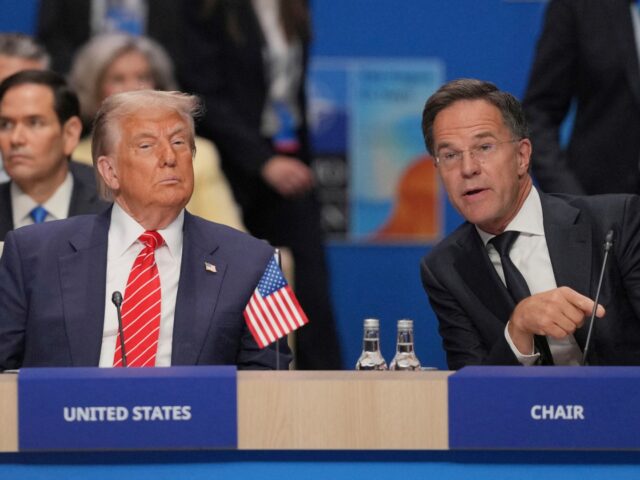

NATO Secretary General Mark Rutte has claimed that Europe has “gotten the message” from President Donald Trump, who has vowed consequences for the disloyalty displayed by supposed allies during the conflict with the Islamist Iranian regime.
Rutte, the former prime minister of the Netherlands, who has become one of President Trump’s loudest cheerleaders on the old continent after taking the helm of NATO, has once again found himself attempting to mediate a dispute between European capitals and Washington, Reuters reported.
On Friday, the Pentagon announced that America would draw down its forces from Germany by 5,000 over the next six months to a year. The following day, President Trump, without giving specifics, suggested that U.S. forces would be withdrawn at a much higher rate.
Mr Trump also suggested last week that U.S. forces could also be relocated from countries like Spain and Italy after Madrid denied America access to its military bases and Rome rejected some flights through its airspace amid the Iran conflict.
Although Berlin did not go so far as to deny access to its bases or airspace, German Chancellor Friedrich Merz — dogged by cratering support for his government among the German public — apparently saw fit to become the most vocal critic of the U.S. effort to degrade Tehran’s radical regime and its weapons programmes.
After initially proclaiming that the Iran conflict was “not our war”, Chancellor Merz accused the White House of not having a clear strategy for victory in Iran and said that the Mullahs in Tehran were “humiliating” the United States, despite having been militarily devastated during Operation Epic Fury.
However, it appears that Merz caved after President Trump threatened to cut troops and hike tariffs on European cars, a particular concern for the critical German automotive industry. On Sunday evening, the Chancellor wrote on X: “The United States is and will remain Germany’s most important partner in the North Atlantic Alliance… We share a common goal: Iran must not be allowed to acquire nuclear weapons.”
Responding to the spat between the United States and Europe, NATO Secretary General Mark Rutte said on Monday that Europeans have “gotten the message” from the White House.
“Yes, there has been some disappointment from the U.S. side, but Europeans have listened,” the NATO chief told reporters at a European Political Community summit in Armenia on Monday.
The former Dutch prime minister, who has taken to referring to President Trump as “daddy”, said that many countries in Europe are lining up to sign bi-lateral agreements with the United States to ensure access to their military bases in future conclifts.
He also noted that “more and more” European nations are getting ready to join the effort to keep the Strait of Hormuz open and prevent Iran from using the oil supply chain chokepoint to enrich itself, including by sending minseweaping boats to the Persian Gulf in preparation for the “next phase” of the conflict.
However, it is unlikely that Merz’s words or Rutte’s comments will halt the Pentagon from drawing down troops in Germany, which has been a longstanding aim of President Trump dating back to his first administration.
For over a decade, Mr Trump has criticised Berlin for failing to meet its NATO spending requirements, while demanding that the United States underwrite its protection, including against nations such as Russia, which Germany has long enriched by purchasing its oil and gas.
President Trump had previously called for the United States to draw down from Germany; however, this move was reversed by his predecessor, President Joe Biden.
The drawdown from Germany, which has been occupied by American forces to varying degrees since the end of the Second World War, could have significant consequences for Germany. According to public broadcaster DW, over 10,000 German jobs are directly tied to U.S. military bases, while an additional 70,000 jobs in Germany are indirectly dependent on the presence of the American forces. At present, approximately 36,000 U.S. troops are stationed at around 40 locations across Germany.
COMMENTS
Please let us know if you're having issues with commenting.