
The World Health Organization (W.H.O.) announced this week that the process to allow countries to sign onto its pandemic treaty would likely be stalled through 2027 after a negotiating team working on a “benefit sharing” system failed to reach consensus.
The pandemic treaty — which the W.H.O. refers to in generic terms as an “agreement” after years of debate on what kind of international legal document it actually is — has been a subject of intense controversy since it was proposed following the onset of the Wuhan coronavirus pandemic. W.H.O. authorities insisted that their catastrophic failure to address the pandemic indicated that it needed more authority to control global public health responses, claiming a lack of coordination among countries. Opponents of the agreement warned that expanding W.H.O. control over states’ responses to diseases could be a threat to sovereign rights, while W.H.O. leaders countered that opponents were spreading “misinformation.”
The W.H.O. ultimately passed a “final” draft of the agreement last year that still required debate and agreement on some of its provisions. While heralding this as a success, the passage did not allow the document to be open for member states to sign.
The Intergovernmental Working Group (IGWG) on the W.H.O. Pandemic Agreement concluded its meetings last week in anticipation of the World Health Assembly (WHA), the annual gathering of W.H.O. member states to discuss issues of mutual concern. The goal, as stated during last year’s Assembly, was for the working group to have completed negotiations on the creation of a “Pathogen Access and Benefit Sharing (PABS)” system. The PABS system, in theory, would effectively facilitate the sharing of information such as genetic analyses of new viruses and other pathogens and — more controversially — the sharing of pharmaceutical technology such as treatments and vaccines.
The WHA is expected to begin on May 18. Yet by May 1, the W.H.O. had confirmed that the Working Group asked for more time to debate how, exactly, countries who sign onto the pandemic treaty would be expected to share their medical expertise and scientific knowledge.
“Given the need for further negotiations, the Assembly will be asked to consider continuing IGWG’s work… and submit the outcome to the next Assembly in May 2027, or earlier by a special session of WHA in 2026,” the W.H.O. explained in a statement.
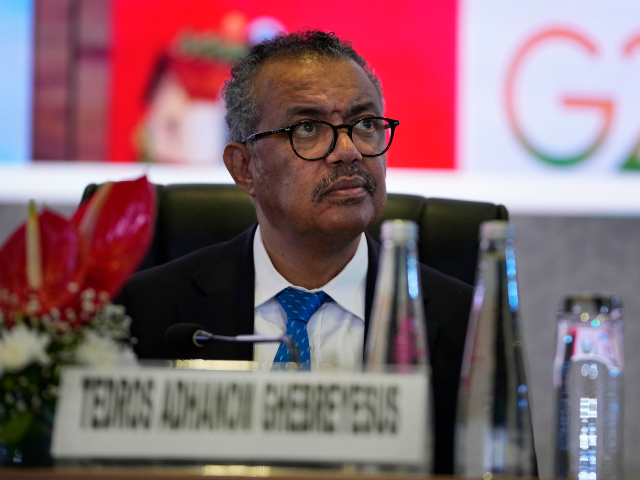
W.H.O. Director-General Tedros Adhanom Ghebreyesus, who was elected to a second term running the institution in an uncontested race in 2022 despite his disastrous handling of the Wuhan coronavirus pandemic, attempted to portray the delay positively.
“Real progress was made on the PABS annex and I am confident through continued negotiations differences will be overcome,” Tedros declared in an official W.H.O. statement. “Member States should continue approaching the outstanding issues with a sense of urgency because the next pandemic is a matter of when, not if.”
Tedros called the creation of the PABS system “the last piece of the puzzle” to push the pandemic agreement into reality.
The PABS issue was long one of the most controversial aspects of the pandemic agreement, pitting impoverished member states seeking free access to advanced medical technology against developed countries that argued that taking financial incentives away from pharmaceutical companies would hurt innovation. The leftist British newspaper The Guardian noted that the final passage of the agreement at the WHA last year happened because drafters succeeded in “pushing the thorny issue of Pabs into an annexe to the main treaty, subject to further negotiations.” The working group was established to resolve those issues within the next year, but failed to do so.
Reports from within the working group debate indicated that poorer countries expressed frustration with other member states defending their pharmaceutical industry from demands that they hand over any future vaccines or medications at little or no cost. The South African delegation, for example, complained that the proposals on the table did not place on “an equal footing… access and benefit sharing.”
“Approaches that risk decoupling these elements, or introducing fragmentation from the outset, are not sustainable foundations for the system we are tasked to build,” the South Africans asserted, “and may only legitimise the unfair status quo regarding access to essential health products.”
The delegation from Colombia reportedly argued that there would be no use in continuing to debate unless the entire negotiation system was upended and replaced by a piecemeal voting process.
“Why not introduce the concept of ‘progressive consensus’?” Colombian envoy Germán Velásquez asked. “Once a majority has been reached on specific points, a vote should be held if necessary, and negotiations should continue.”
The Independent Panel for Pandemic Preparedness and Response, a body created by the W.H.O., condemned the failure of the working group to present a complete PABS structure in a statement shortly after the news broke.
“It is deeply regrettable that the operational details of the Pathogen Access and Benefit Sharing (PABS) Annex could not be agreed in time for adoption at the next World Health Assembly later this month,” co-chairs Ellen Johnson Sirleaf and Helen Clark wrote in a statement. “Without agreement on the Annex, the Agreement as a whole cannot proceed towards ratification.”
“If a new pathogen emerged today, the world remains largely unprepared for it,” they claimed, demanding strengthening and enforcement of the already existing “International Health Regulations,” which the W.H.O. also attempted to use to expand its authority over countries during the pandemic.
The United States is not a member of the W.H.O. and is not participating in the current debate. It was a member during the presidency of Joe Biden and claimed to be “committed” to joining the pandemic treaty, suggesting that a future Democrat president may once again undo President Donald Trump’s policies to expand cooperation with the United Nations health agency.
COMMENTS
Please let us know if you're having issues with commenting.