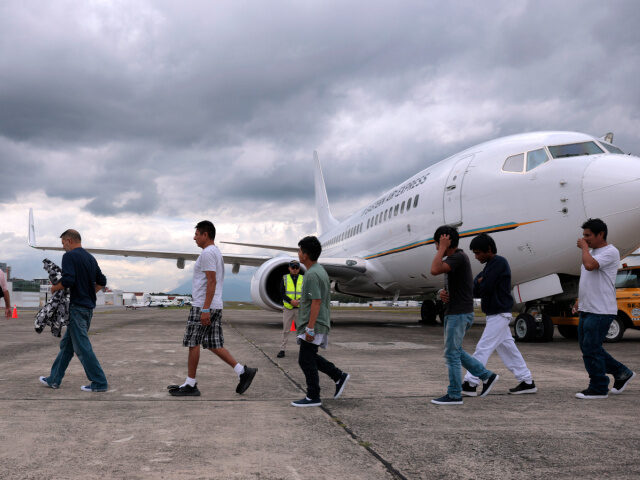

The U.S. government has inked deportation deals with 20 foreign countries to accept illegal migrants who cannot be sent back to their home countries, Secretary of State Marco Rubio told a cabinet meeting today.
Rubio said:
A part of securing our border is dealing with the people that are in this country unlawfully, many of whom do not want to go back to the country that they originally came from, for a variety of reasons, either we can’t send them there or some judge ties us up.
One of the key things we have achieved is now [that] 20 countries have signed third-country national agreements, meaning these are safe countries where individuals who refuse to go back to their country of origin can be sent to that country instead. We’ve got 20 countries now around the world who have signed agreements that allow us to deport people to those places.
The “Safe Third Country” deals also help ICE to accelerate many more deportations amid a myriad of lawsuits, Rubio noted:
What often happens when you go to the person who’s here unlawfully and say “We’re going to send you to this third country” is [that] all of a sudden they decide they’d rather go back to their home country instead. So it gives the ability to enforce all laws, and we work very closely with the Department of Homeland Security on that front.
In April, for example, ICE deported several Latin American migants to the Congo, after pro-migration lawyers had blocked their return home. This possibility has helped to dramatically expand the number of migrants who accept “voluntary deportations.”
From January to March, roughly 80,000 migrants accepted the “voluntary deportations” exit instead of risking a transfer to an unfamiliar country in Africa or Asia.
A number of migants have been dropped off in Panama, Ghana, Rwanda, South Sudan, and Uganda.
But there is a huge backlog of migrants from India, China, Laos, Vietnam, and other countries, whose home governments block their return.
Many are violent, career-criminal migants who have been released back into U.S. streets after serving years in jail. Others are job-seeking illegal migrants who provide a cheap pool of labor for shady enterprises and low-wage businesses.
The “Safe Third” countries have to show they will protect deported migrants, but they usually demand payments in exchange for accepting the illegals.
Rubio is also working to curb the inflow of India’s migrant workers — including truck drivers and H-1Bs — into the United States, much to the anger of the Indian government.
That anger was made clear when Indian government officials refused to meet Rubio at his recent arrival and departure from India.
COMMENTS
Please let us know if you're having issues with commenting.