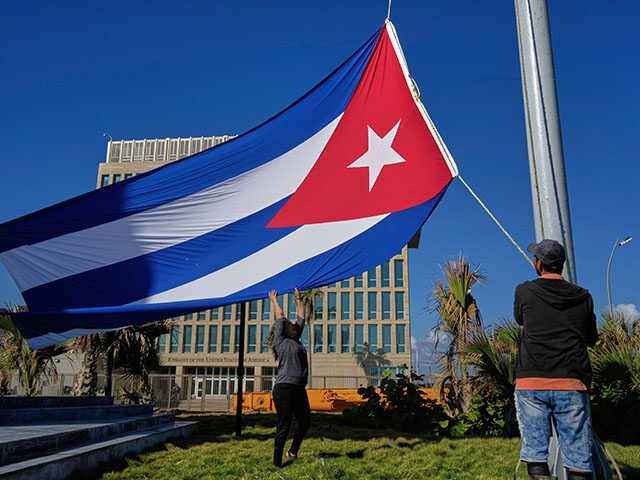

The Cuban Communist Party’s cable news network aired a commentary this week claiming that continued Castro regime control was a “guarantee for the national security of the United States” and attempting to remove it would create “instability” – ignoring the near-total collapse of Cuban health, energy, education, and political institutions and the incessant protests against the regime in that country.
The commentary, delivered by senior propagandist Jorge Legañoa, also included warnings to the Cuban population not to allow themselves to believe that the arrest of deposed Venezuelan dictator Nicolás Maduro, a puppet of the Castro regime, could lead to an end to communism in Cuba. Legañoa repeated the ominous catchphrase being popularized by the Venezuelan regime in the aftermath of Maduro’s fall: “Doubt is treason.”
Nicolás Maduro and wife, Cilia Flores, were arrested in a military-aided U.S. law enforcement operation in Caracas in the early morning hours of Saturday. They are facing a long list of criminal charges related to Maduro’s ties to narco-terrorist organizations in South America, most prominently the Venezuelan military operation known as the Cartel de los Soles (“Cartel of the Suns”).
An indictment published on Saturday accused Maduro and Flores of “narco-terrorism conspiracy, cocaine importation conspiracy, possession of machineguns and destructive devices, and conspiracy to possess machineguns and destructive devices against the United States,” among other crimes. The couple are expected to stand trial in the Southern District of New York and are being held in custody in Brooklyn.
The Cuban independent journalist Mag Jorge Castro shared part of the commentary from the Communist Party, addressing the United States, on social media following its broadcast on the propaganda network Canal Caribe on Tuesday night.
“Is it convenient for that White House, for that country, to have an unstable Cuba 90 miles from its coasts? No, Absolutely not,” the propagandist, Legañoa, declared, falsely suggesting that the current status quo in Cuba is “stable.”
“Our country, let me say it clearly, is a guarantee for the national security of the United States, it is protection of its waters, of its maritime frontiers, even if they try to ignore it,” Legañoa continued. “Cuba is neither a failed state nor a dictatorship, it is simply the old discourse of the economic blockade and the asphyxia of Cuba that they want to see as a revolutionary excuse to justify our inefficiencies.”
“We have internal problems to fix, that is true, social situations to address with urgency, phenomena to unearth, a lot of do, but not through American annexationism,” he continued, failing to address these situations with any specificity. “Let us not be deceived. They intend to fracture our revolutionary confidence and unity. One last fact: Trump’s national security advisor just said… that they are using their military power to assure their strategic interests in the Western Hemisphere and that they will not apologize. They will not apologize. So should we ask for forgiveness?”
He concluded the discussion with the phrase “doubt is treason,” popularized this week in Venezuela by the most dangerous Maduro henchman remaining, Interior Minister Diosdado Cabello. Cabello used the slogan while appearing in social media videos on the streets of Caracas at night, surrounded by armed thugs and threatening Venezuelan civilians to prevent public celebrations of Maduro’s arrest.
Prior to arguing to the United States that the Castro regime – which has murdered American citizens with impunity and regularly engages in sabotage and espionage activities – is a source of stability, Legañoa appeared to threaten the Cuban people out of considering an escalation in protests following the blow to Venezuela’s chavista regime.
“Cuba is for Cubans and the destiny of this country is decided by the people,” Legañoa declared. “There is only one nation and one serves it.”
The propagandist went on to imply that any attempt to undermine the Communist Party could result in indiscriminate bombing of the civilian population of Cuba.
“Bombs don’t have names, they do not discriminate, they kill revolutionaries and anti-[communists] just the same. It is not time for personal interests, to fight, to fracture unity,” he warned. “The revolution is won or lost on the street, it is sustained, pressured, or destroyed by the people.”
The commentary also appears to spuriously accuse Secretary Rubio of drug trafficking, referring to him as “Narco Rubio,” and claim that the Cartel of the Suns, contrary to substantial evidence, “does not exist.”
Legañoa is a longtime Communist Party loyalist who once served as an analyst for the Central Committee of the Communist Party of Cuba; the regime granted him the leadership of the propaganda outlet Prensa Latina in October.
The Cuban communist regime established friendly relations with Venezuela under late socialist dictator Nicolás Maduro, then enacted a full colonization of its security state after Maduro took over in 2013. Following Maduro’s arrest, Rubio noted during a press conference on Saturday that establishing a functional democratic regime in Venezuela would be a challenge because “one of the biggest problems Venezuela has is they have to declare independence from Cuba.”
“I don’t think it’s any mystery that we are not big fans of the Cuban regime, who, by the way, are the ones that were propping up Maduro,” Rubio explained in an appearance on NBC’s Meet the Press on Sunday. “His entire, like, internal security force, his internal security apparatus is entirely controlled by Cubans.”
That appeared to be corroborated by the Cuban communist regime confirming this week that at least 32 of the people killed in the operation to arrest Maduro were members of the Castro security forces.
COMMENTS
Please let us know if you're having issues with commenting.