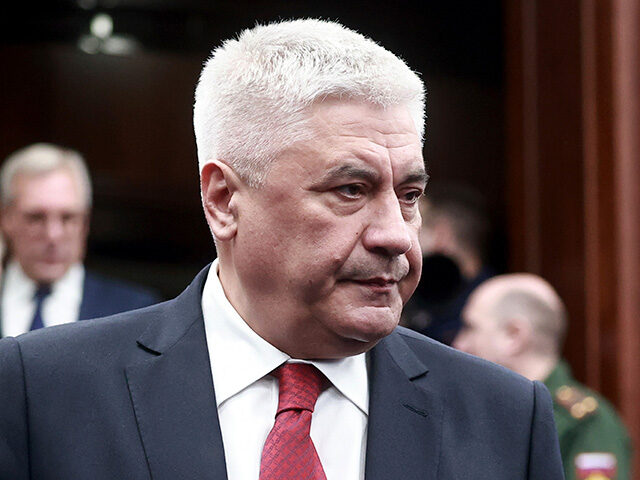

Russian Interior Minister Vladímir Kolokoltsev on Tuesday arrived in Havana, Cuba, for an official visit and encounters with officials of the communist Castro regime.
The visit marks the second time Kolokoltsev has visited Cuba in a little over two years, having last visited the island nation in November 2023. The Russian minister’s trip also marks the first high-level official visit from a Russian delegation to Cuba since the January 3, 2026, U.S. law enforcement operation in Caracas, Venezuela, that resulted in the arrests of socialist dictator Nicolás Maduro and his wife, Cilia Flores.
Russia, a key ally of both the Cuban and Venezuelan regimes, has offered no support to the Venezuelan socialist regime since the arrest of their leader beyond official messages of support through official statements and through remarks from official government spokespersons — despite Maduro using the purported Russian support to threaten the United States and deter any potential action against his narco-socialist regime.
Kolokoltsev met with the country’s 94-year-old dictator, Raúl Castro, on Tuesday afternoon. Granma, the official newspaper of the Communist Party of Cuba, reported that Castro and Kolokoltsev discussed the “excellent” bilateral relations between Russia and Cuba and a desire to strengthen their mutual ties. The nonagenarian dictator used the opportunity to extend his “warm greetings” to Russian strongman Vladimir Putin.
Kolokoltsev also met with the communist regime’s “figurehead” president, Miguel Díaz-Canel, who described the Russian official’s visit as “of enormous significance” due to “the moment in which it is taking place.”
In addition to the United States’ pressure against the Venezuelan regime and the successful arrest of Maduro, President Donald Trump has maintained an intense pressure campaign against Cuba, a state sponsor of terrorism, and has effectively cut off the Cuban communist regime’s access to Venezuelan oil, which the Cuban communists have consistently received under the auspices of their Venezuelan socialist allies for over two decades.
Recently, the Cuban regime announced that it intends to adopt measures towards a “State of War” but offered little information as to what it would actually entail.
“THERE WILL BE NO MORE OIL OR MONEY GOING TO CUBA – ZERO! I strongly suggest they make a deal, BEFORE IT IS TOO LATE. Thank you for your attention to this matter,” President Trump wrote in a Truth Social post last week.
Kolokoltsev, according to the Cuban presidency, expressed his “satisfaction at being back on the island, where he has close friends,” with Díaz-Canel asserting that the Russian official’s previous November 2023 visit occurred at a time when Cuba was allegedly facing the “intensification” of the “blockade” — a term the regime has used for decades to refer to the United States’ “embargo” on Cuba — as well as the purported intensification of a “widespread media smear campaign, and the impact of its inclusion on the spurious list of countries allegedly sponsoring terrorism.”
According to Díaz-Canel, all of the purported “campaigns” against Cuba remain in place, “but with greater complexity and a situation greatly impacted” by the events of the January 3, 2026, operation to capture Maduro.
The Cuban regime confirmed that 32 Cuban security officials were killed in Caracas protecting Maduro during the U.S. military operation to capture the now-deposed dictator — a revelation that confirmed nearly a quarter of a century worth of speculation over Cuban military presence and influence in Venezuela since the rule of late socialist dictator Hugo Chávez. The revelation also confirmed that Maduro did not trust his own people with his personal security.
The remains of the 32 dead soldiers arrived in Cuba last week in small boxes, raising questions as to what happened to them during the operation that left their bodies in such a state.
The Venezuelan socialist regime has not disclosed an exact number of Venezuelan casualties during the January 3 U.S. operation. On Tuesday, Venezuelan Attorney General Tarek William Saab claimed to the left-wing propaganda network Telesur that the operation left “between 100 and 120 dead.” Last week, Interior Minister and long-wanted, alleged drug lord Diosdado Cabello claimed, “When we don’t talk about the number of people who died or were killed, it’s because the explosions were so strong that, well, there are people we don’t know where they are.”
The state-owned Cuban News Agency (ACN) reported that Kolokoltsev laid a wreath in honor of the 32 dead Cuban soldiers at the Firefighters’ Mausoleum at the Colón cemetery in Havana in the company of his Cuban counterpart, Lázaro Alberto Álvarez Casas, and other officials. According to ACN, the remains of four of the 32 dead soldiers rest at the Colón cemetery in Havana.
Christian K. Caruzo is a Venezuelan writer and documents life under socialism. You can follow him on Twitter here.
COMMENTS
Please let us know if you're having issues with commenting.