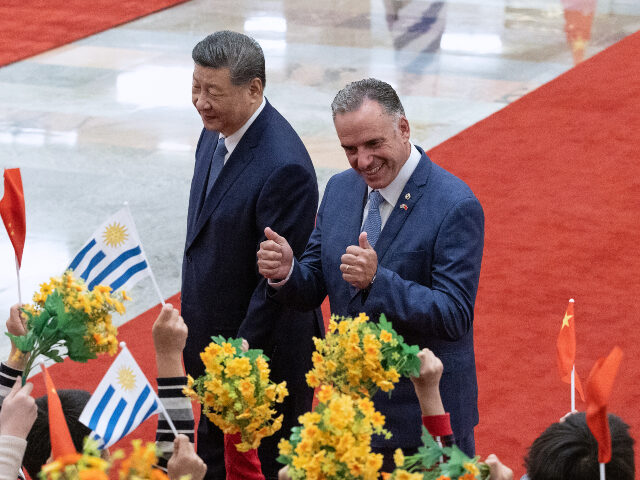
Leftist President of Uruguay Yamandú Orsi met with Chinese dictator Xi Jinping in Beijing Tuesday, pushing the South American nation closer to communist China through 19 different agreements signed between the two heads of state.
Orsi is currently halfway through a week-long official visit to China that started on Sunday, February 1, and will run through Saturday, February 7. Uruguayan Foreign Minster Mario Lubetkin detailed last week that about 150 individuals would form part of Orsi’s official delegation, including government officials and representatives of academia and trade unions as well as community chiefs. Lubetkin pointed out that since 2013 China is the topmost buyer of Uruguayan exports, netting the country some $3.49 billion in 2025.
Orsi participated in different cultural and protocolar events ahead of his Tuesday meeting with Xi at the Chinese capital. The Uruguayan presidency noted that Orsi is the first Latin American head of government to meet with Xi in 2026 and the fifth so far this year after the United Kingdom’s Keir Starmer, Finland’s Petteri Orpo, Canada’s Mark Carney, and Ireland’s Micheál Martin.
Orsi said, “My commitment was to make this visit happen in my first year in office, and we have kept our word.” The Uruguayan president took office in March 2025.
According to the Chinese state-owned news agency Xinhua, Xi called for the two countries to strengthen their alignment and deepen cooperation in economy, trade, finance, communications, and infrastructure, among other areas, asserting that both countries “share a natural affinity.” The meeting took place on the 38th anniversary of the start of Uruguay and China’s diplomatic relations.
“The world today is undergoing major changes unseen in a century,” Xi said, asserting that the international landscape is “marked by a mix of turbulence and transformation, while unilateral bullying is intensifying.”
Orsi, for his part, said that Uruguay wishes to continue efforts to support the development plans of both countries through “an intensification of trade in goods, above all, through diversification, and to focus much more strongly on trade, services, and investment, taking into account Uruguay’s stability in our region and our role in South America and Latin America.”
“Our comprehensive strategic partnership is at its best and it should be our responsibility in this audience to commit ourselves to raising it to a new level,” he said.
The Uruguayan and Chinese delegations signed 19 agreements, including deals in investment and industrial cooperation, environment, fishing and poultry, trade, “Global Development,” intellectual property, communications, and an agreement for the “joint promotion of cooperation and dissemination among media outlets and think tanks in the Global South,” among others.
Other agreements boost the collaboration between Uruguay’s National Audiovisual Communication Service and Xinhua for the exchange of news and include a memorandum of understanding between the Uruguayan service and Chinese media groups on cooperation.
The Uruguayan presidency published the Spanish version of its 32-point joint statement in which the two countries agreed to broaden their “pragmatic” cooperation and intensify their collaboration at international organizations and multilateral mechanisms to “continuously demonstrate the strategic value” and nature of their relations.
Uruguay reaffirmed its adherence to the Chinese regime’s “One-China Principle,” which falsely claims the sovereign nation of Taiwan is a province of China. Uruguay asserted in the statement that “any form of ‘Taiwan independence’ is contrary to this principle and therefore opposes, and supports the efforts of the Chinese Government to achieve national reunification.”
Both countries also agreed to deepen the implementation of China’s Belt and Road Initiative (BRI) debt-trap program, which Uruguay formally joined in 2018. Uruguay acknowledged Chinese company involvement in the constructing of its 5G network and its joint willingness with China to lead efforts towards a prospective Free Trade Agreement (FTA) between China and the Mercosur regional trade bloc.
The two countries emphasized their need to establish “greater cooperation and mutual support in the area of Peacekeeping Operations, including training exchanges in international peacekeeping in accordance with the strengths of each Party and based on a shared commitment to the United Nations peacekeeping system.”
Days before Orsi departed for China, the Uruguayan magazine Búsqueda, citing an unnamed official from the U.S. embassy in Montevideo, reported that the United States is “closely following” Orsi’s trip to China.
“We are closely following the Uruguayan government’s upcoming trip to China. Our friendship with Uruguay involves working together on numerous issues and matters and constantly seeking ways to help each other,” the official said, expressing concern on issues related to security, labor and human rights practices, and trade between China and Uruguay.
“We are concerned about China’s trade practices. The Asian country subsidizes its manufacturing sector and floods Uruguay with goods at artificially low prices,” the official detailed. “As an example, the Uruguayan Association of Toy Manufacturers reported that, in 2025, these practices led to the loss of 150 jobs in Uruguay.”
Christian K. Caruzo is a Venezuelan writer and documents life under socialism. You can follow him on Twitter here.
COMMENTS
Please let us know if you're having issues with commenting.