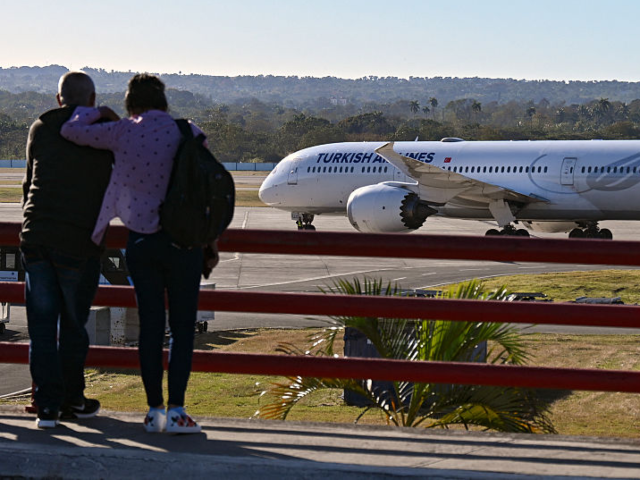

The Communist Party of Cuba warned airlines operating in the country that it would soon run out of jet fuel, reports revealed on Monday, potentially lasting through the middle of March.
The general population of the impoverished communist country has suffered significant shortages of many basic goods for decades as a result of 67 years of repressive and incompetent Party rule. For much of the 21st Century, however, its elites and tourists from various European countries and Canada have been able to enjoy the island in luxury in part due to the allied socialist government of Venezuela providing free or heavily subsidized oil. That supply was abruptly cut off after the January 3 arrest of Venezuelan dictator Nicolás Maduro; successor Delcy Rodríguez has not resumed supplying the country, instead working with the United States to sell the oil at a profit.
While reports indicated that the Party desperately sought alternative fuel sources for the first few weeks from countries in Africa and its supporters in Mexico, those potential supplies never materialized following the passage of an executive order by President Donald Trump that allowed for the imposition of tariffs on third party states that sold or gifted fuel to Cuba.
According to multiple reports citing EFE news agency, the Cuban state’s aviation authority issued a warning reading, “JET A1 FUEL NOT AVBL,” visible in the Federal Aviation Administration’s (FAA) global database. The warning reportedly indicates that the complete fuel shortage began on Monday and airlines were allegedly warned to expect jet fuel not to be available through March 11. EFE noted that no airlines have publicly confirmed that they are essentially grounded in Cuba but, given the usual traffic into and out of the country, most affected airlines are based in America, Panama, Spain, and Mexico.
Multiple reports attributed the shortage in jet fuel in particular to Trump’s executive order in late January declaring the Cuban Communist Party a national security threat to the United States.
“The President is addressing the depredations of the communist Cuban regime by taking decisive action to hold the Cuban regime accountable for its support of hostile actors, terrorism, and regional instability that endanger American security and foreign policy,” the order read, creating an opportunity to impose tariffs on nations that “directly or indirectly” provide oil to Cuba.
Prior to signing the order, Trump declared in a social media post: “THERE WILL BE NO MORE OIL OR MONEY GOING TO CUBA — ZERO! I strongly suggest they make a deal, BEFORE IT IS TOO LATE.”
The Argentine news network Infobae observed in its coverage of the airport crisis that Cuba is currently believed to only be covering about 40 percent of its energy needs, including supplies that used to come from Venezuela and Mexico. With those absent, Cuba is struggling to meet its energy needs in nearly every sector. The Castro regime has received words of support from its wealthiest allies, China and Russia, but little else, including fossil fuels from the latter. The Pentagon announced on Monday, however, that it had intercepted an oil tanker in the Indian Ocean allegedly operating in violation of “quarantine of sanctioned vessels in the Caribbean,” potentially a Russian ship. The Russian news agency Tass did not identify the origin of the ship, citing a lack of clarity from the Pentagon.
According to Infobae, Cuba has not received Venezuelan oil since January and Mexico is believed to have halted its supplies in late January.
The Castro regime launched strict restrictions on the use of oil, including banning the sale of diesel to civilians, last week. It has not publicly announced a plan to replace the missing supplies at press time. In addition to the airport crisis, reports from the independent outlet Cubanet suggest that Cuba’s notoriously dirty and poorly stocked hospitals are preparing to reduce their services to bare essentials.
“There is no availability for food for the workers and appointments will be reduced,” a source at a hospital in Havana told Cubanet. “They are considering suspending those [appointments] that are not priorities, at least until the fuel shortage improves.”
On Sunday, the official newspaper of the Communist Party of Cuba, Granma, announced that a ship had left Mexico to Cuba — but only carrying humanitarian aid. According to Granma, Mexico is sending a shipment of “liquid and powdered milk, meat products, beans, rice, tuna in water, sardines, crackers, vegetable oil, and personal hygiene items.”
The United States has also been delivering a flood of humanitarian aid items to help the impoverished Cuban people, using connections with the Catholic Church to ensure the Communist Party does not steal the goods. Last week, the State Department announced that it would provide $6 million in food, medicine, and other humanitarian aid goods. American restrictions on doing business with the Castro regime, commonly known as the “embargo,” do not prevent Americans from offering medicine, food, and other critical aid to the island nation’s captive residents.
COMMENTS
Please let us know if you're having issues with commenting.