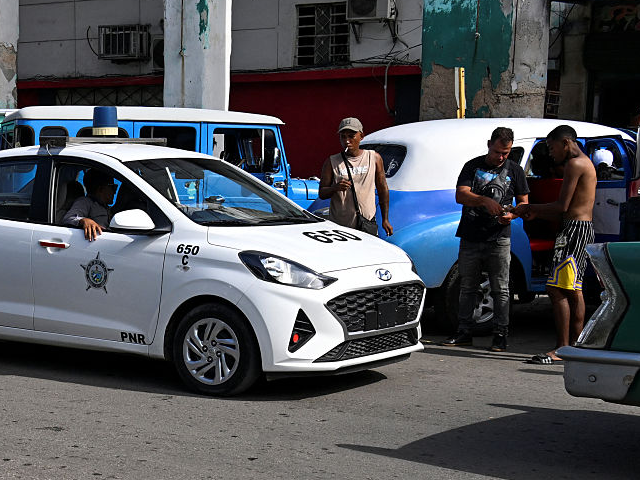

The human rights organization Prisoners Defenders published a report this week revealing that the Communist Party of Cuba is systematically imprisoning, harassing, and otherwise intimidating citizens to prevent them from organizing events to mark the fifth anniversary of the July 11, 2021, anti-communist protests.
On that day, an estimated 187,000 people took the streets in nearly every city and town in the country to demand an end to the brutal Castro family communist regime and the restoration of a free republic. Protesters clearly chanted “freedom!” and called for the end of the 67-year-old dictatorship, eliciting a violent response from those in power. Figurehead “president” Miguel Díaz-Canel appeared on national television issuing an “order of combat” to communists to physically attack anyone they suspected of opposing the regime. The government reportedly bussed in communists into the capital from other provinces and deployed its repressive “black berets” to conduct door-to-door searches for suspected protesters, on some occasions opening fire inside their targets’ homes.
The July 2021 protests were widely considered to be the most expansive in modern Cuban history. While Cubans have consistently organized acts of dissent and protest for decades, rarely did the protests erupt simultaneously throughout the country as they did in 2021. Authorities, Prisoners Defenders observed, are thus working to prevent a repeat of such civil unrest, particularly given that quality of life in Cuba, already dire under communism, has collapsed in the past five years as a result of the failing power grid, the absence of free oil from Venezuela, and expanded sanctions imposed by President Donald Trump on the regime.
Prisoners Defenders described an “intense campaign of harassment and preventive repression” against known activists and other prominent individuals, including some with no overt political profile who had merely developed a following as a popular personality through art, journalism, or otherwise irreverent media.
“The authorities’ response included surveillance operations, house searches, arbitrary detentions, threats, physical assaults, police summonses, and forced transfers to remote locations to prevent their participation in a strictly diplomatic event,” Prisoners Defenders noted in its report this week, as the regime intended to “ prevent… any attempt at mobilization ahead of the anniversary of 11J.”
Among those recently arrested were the hosts of an increasingly popular YouTube channel with no overtly political content: Eduardo Ceballos Pérez (Eddy Jones) and Christian Rodríguez Riverón, who publish content under the name “Despingovery Channel” (the name is a pun using a Cuban slang phrase roughly translating to a big mess or disaster). The men use their videos to highlight abandoned, dilapidated, or destroyed infrastructure in the country. In their latest episode — the one that got them arrested — the pair visited an abandoned Soviet-era military site, highlighting how unprepared and poorly armed the Cuban Revolutionary Armed Forces (FAR) are for battle. The video was published in the aftermath of the embarrassing arrest of Venezuelan dictator Nicolás Maduro by American forces in Caracas in January in which 32 Cuban officers were killed and returned home in small shoebox-sized containers.
Prisoners Defenders also highlighted the arrests of “journalists, digital content creators, a rapper, an evangelical pastor, opposition leaders, a doctor, former political prisoners from 11J, and, in addition, a particularly high number of minors,” emphasizing that the current repressive wave is targeting people with audiences.
Mass arrests of prisoners of conscience have continued in the past month, the humanitarian organization observed, documenting that it had confirmed 1,306 individuals currently in Cuban prisons for political reasons as of this week. This number is likely a significant underrepresentation of the true population of political prisoners in Cuba, as the communist regime often disappears suspected or known political dissidents and fails to properly process them in the criminal system. Prisoners Defenders noted that it is still in the process of verifying the status of 21 other people believed to have been imprisoned for their values.
Of those verified as political prisoners, Prisoners Defenders shared that 40 of them are children, six of them between the ages of 15 and 17 arrested in June. Another four of those arrested in the past month were identified as adolescents between the ages of 19 and 21. Of the total, 16 children are reportedly in prison after being convicted of “sedition” for participating in the July 11, 2021, protests.
The Prisoners Defenders findings align with those of other human rights groups. On Wednesday, the Cuban Observatory of Human Rights (OCDH) announced that it had documented 1,949 repressive actions — including but not limited to the arrests of political dissidents — in the first half of 2026, the situation worsening as the July 11 anniversary nears.
“Almost five years after the the massive July 11 protests in Cuba, we denounce the grave repressive situation in the country and especially the brutality against political prisoners: they are killing them slowly,” the OCDH warned. “The Cuban regime persists in the repression against the population and have no intention of implementing changes in politics or human rights.”
COMMENTS
Please let us know if you're having issues with commenting.