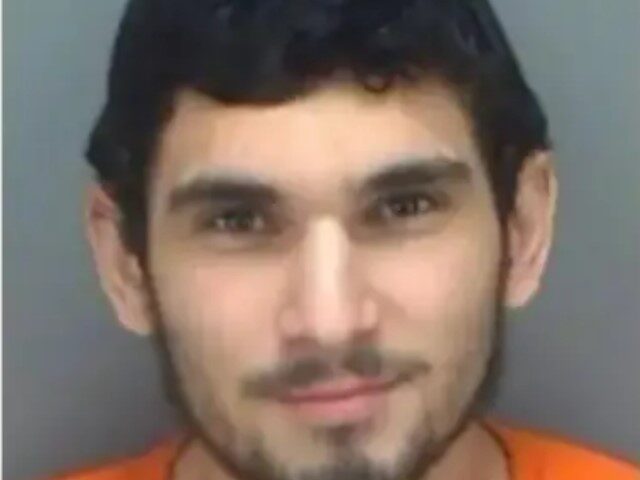

Muhammed Momtaz al-Azhari, a 26-year-old U.S. citizen born in California who lately resided in Tampa, Florida, pleaded guilty last week to attempting to provide material support to the Islamic State.
Al-Azhari’s case was controversial among some privacy advocates because of the heavy surveillance employed by the FBI to monitor him for several years before finally taking him into custody in May 2020.
Al-Azhari is described by the U.S. Department of Justice (DOJ) as “a United States citizen who spent most of his life abroad and came to embrace dogmatic, Islamist/Salafist beliefs.” His travels took him to Saudi Arabia, where he was arrested for vocally supporting one of the Islamist militias fighting in Syria.
The group Al-Azhari was incarcerated in Saudi Arabia for supporting was Jaysh al-Islam (“The Islam Army”), a group fighting against the regime of Syrian dictator Bashar Assad that was also nominally opposed to ISIS. After Al-Azhari completed his three-year prison sentence in Saudi Arabia and returned to the United States in 2018, he became a huge fan of ISIS and began rabidly consuming its propaganda. He was evidently determined to become one of the “lone wolf jihadis” ISIS was encouraging to “rise up” and perpetrate mass casualty attacks in the Western world.
According to the FBI’s charging documents, Al-Azhari settled in Tampa during the summer of 2019 and “acquired at least three firearms,” even though his felony conviction in Saudi Arabia should have prevented him from buying guns.
The FBI evidently had him under heavy surveillance from soon after he returned to the United States because it was immediately aware that he was buying gun kits on eBay. Agents took over the account of an eBay seller with that individual’s permission and began stringing Al-Azhari along, exploring his interest in acquiring guns with extended magazines and silencers, and his eventual desire to buy heavier weapons like an AK-47.
Over the course of the next two years, the FBI kept a close eye on Al-Azhari while he accumulated an arsenal that included an Uzi submachine gun and a bulletproof vest. Agents watched as he scouted locations for a mass-casualty attack, including FBI headquarters in Tampa, the Honeymoon Island beach resort, and even the Pulse nightclub in Orlando – the site of jihadi Omar Mateen’s deadly rampage in June 2016. Al-Azhari was a great admirer of Mateen and even tried to learn where he was buried so he could pay respects at his grave.
The FBI charging document is over 80 pages long and contains an exhaustive list of Al-Azhari’s activities, which were monitored with numerous physical and electronic techniques. This heavy surveillance was brought up in court by defense lawyers after his 2020 arrest. The lawyers noted the FBI was following Al-Azhari with a “secret spy plane surveillance program” that produced over 900 video clips of his daily actions. The defense argued this level of surveillance was an unreasonable violation of their client’s privacy.
One detail of Al-Azhari’s surveillance that puzzled digital privacy advocates was the FBI’s seeming ability to determine his real-world location when he accessed jihadi websites, even though he was using Tor, a browser designed to keep users and their Internet IP addresses anonymous.
Defense lawyers also argued Al-Azhari’s eventual arrest was improper. The suspect was almost comically obvious as a jihad wannabe, frequently attempting to convert his co-workers at a Tampa Home Depot to militant Islam and remarking that Americans “got what they deserved” on September 11. He also pestered his co-workers to sell him guns, freaked out when he saw police cars and spoke of his desire to become involved in a “bloody” event. One of his co-workers claimed that he pulled a gun during an argument at work.
Home Depot managers eventually decided Al-Azhari needed some time off to seek counseling. His store took the precaution of hiring an off-duty police officer for extra security during his two-week administrative leave. Tampa police sent out a bulletin that Al-Azhari should be considered “armed and dangerous” if he approached any Home Depot, and when he did exactly that, an off-duty cop arrested him and found a very small .22 revolver on his person. Defense lawyers unsuccessfully argued the gun was too small to be truly dangerous to a human being.
Terrorism charges were leveled after the FBI obtained warrants to search al-Azhari’s residence and electronic devices. They accumulated a huge trove of disturbing information, from ISIS propaganda videos to PDF files with titles like “Four Easy Ways to Make a Suicide Belt.”
Some of the evidence gathered by the FBI was deemed worthy of classification on a national security basis but was later turned over to defense lawyers at their request. Al-Azhari tried to enlist his sister Muna to wipe out much of the evidence at his home before it could be searched, unaware that the FBI had already recruited her as an informant.
Al-Azahri told other informants that he wanted to “die in a shootout with disbelievers,” just like the Pulse nightclub shooting.
“I don’t want to take four or five. I want to take at least 50, like brother Omar Mateen in Orlando did,” he said.
In May 2020, electronic surveillance picked up Al-Azhari reciting what sounded like a jihadi suicide message at about 3:45 in the morning: “Hello, America. Today is your emergency. Today we kill from you like you kill from us. Know, America, today is your emergency, today we fight you in your own country.”
The defense argued that Al-Azhari was mentally ill and incapable of standing trial, in part because he was allegedly imprisoned and tortured in Saudi Arabia when he was a teenager and was forever afterward plagued by hallucinations and bouts of paranoia. A psychologist hired by the defense diagnosed him with schizophrenia, autism, depression, and anxiety disorders.
Al-Azhari underwent treatment while in custody at a federal medical center in North Carolina, after which a judge ruled that his mental competence to face trial had been restored.
Al-Azhari pleaded guilty to attempting to provide material support to a foreign terrorist organization on February 24, accepting a sentence of 18 years in federal prison plus forfeiture of “certain assets that are traceable to proceeds of the offense, as well as various items of property, including gear involved in, or intended to be used to commit the offense.”
COMMENTS
Please let us know if you're having issues with commenting.