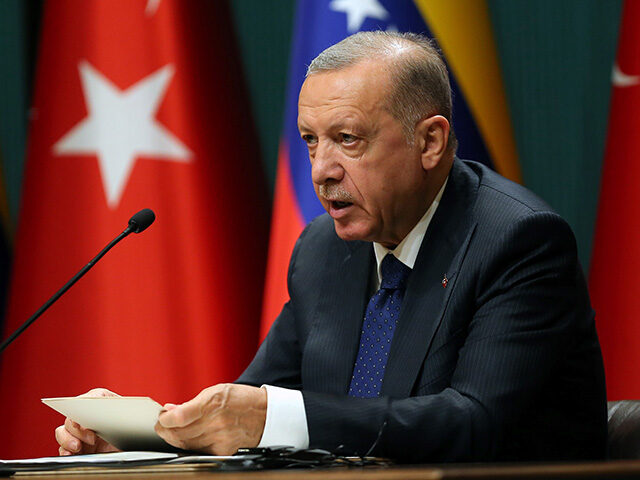

President Donald Trump discussed the conflict in northeastern Syria with Turkish President Recep Tayyip Erdogan during a phone call on Tuesday.
The Kurdish-led Syrian Democratic Forces (SDF) has been fighting with forces loyal to Syria’s interim president Ahmed al-Sharaa and the Kurds have accused Sharaa’s troops of using extreme brutality to seize control of territory that has long been held by the semi-autonomous SDF.
Turkey borders on the conflict zone and, while both Turkey and the U.S. are supportive of Sharaa’s government in Damascus, Turkey is exceptionally hostile to the Kurds. The SDF was a vital U.S. ally during the war on the Islamic State, but Turkey views all armed Kurdish groups in Syria as a security threat, accusing them of being allied with – or part of – the banned separatist Kurdistan Workers Party (PKK) in Turkey.
The SDF has been reluctant to fully assimilate with the new government in Damascus, which took power after Sharaa’s coalition of insurgent and jihadi groups deposed dictator Bashar Assad in December 2024, abruptly ending the 14-year Syrian civil war. Among other issues, the Kurds are deeply suspicious of the jihadi groups who have been folded into the Syrian national army by Sharaa, who is himself a former al-Qaeda officer.
Sharaa has been insistent that the Kurdish region must be fully brought into Syria’s national government, and the SDF must be brought under the control of the Syrian army. This conflict of visions erupted into violence last month, beginning in the Kurdish districts of the city of Aleppo.
The situation soon deteriorated into a state of warfare between the Syrian army and SDF. The United States helped to broker a ceasefire that did not hold. A second ceasefire agreement was reached on Tuesday, giving the SDF four days to accept an integration deal that would forfeit many of their long-held demands.
The Kurds have consistently accused Sharaa’s forces of committing atrocities throughout the conflict, including beheadings reminiscent of the Islamic State and assaults on civilians, possibly including sexual assaults.
According to Erdogan’s office, the Turkish president told Trump that he is “closely following developments in Syria,” and that “Syria’s unity, harmony and territorial integrity were important for Turkey.”
The Turkish presidential office also said that Erdogan and Trump discussed fighting a resurgent Islamic State, a topic of immediate concern because the SDF has been forced to withdraw from the prisons for ISIS fighters and their families it has long supervised. This led to a prison break by dozens of ISIS terrorists at one of the detention camps on Monday.
“A peaceful Syria, free from terrorism and developing in all aspects, would contribute to the stability of the region,” Erdogan reportedly told Trump.
Trump commented only that he had a “very good call” with Erdogan. Later on Tuesday, Trump said he “likes” the Kurds, and hopes to defend them from abuse.
“Kurds were paid tremendous amounts of money – we have given oil and other things. So, they were doing that for themselves, more so they were doing it for us,” Trump said of the U.S. relationship with the SDF during the Syrian civil war.
“But we get along with the Kurds and we are trying to protect the Kurds,” he added.
Trump’s envoy to Syria and ambassador to Turkey, Tom Barrack, said on Tuesday that the “greatest opportunity for the Kurds in Syria right now” was to join the “post-Assad transition under the new government led by President Ahmed al-Sharaa.”
“This moment offers a pathway to full integration into a unified Syrian state with citizenship rights, cultural protections, and political participation— long denied under Bashar al-Assad’s regime, where many Kurds faced statelessness, language restrictions, and systemic discrimination,” he contended.
Barrack said the Trump administration is “pushing for safeguards on Kurdish rights and counter-ISIS cooperation,” but he strongly urged the SDF to pursue integration with Damascus, because “prolonged separation could invite instability or ISIS resurgence.”
Erdogan said on Wednesday that his foreign minister, Hakan Fidan, would represent Turkey on Trump’s “Board of Peace” for resolving conflicts in the Middle East.
Erdogan offhandedly made the announcement when a reporter asked if Erdogan himself would take a seat on the board, which will feature Trump as its chairman. On the same day Erdogan made his announcement, Israeli Prime Minister Benjamin Netanyahu said he would personally represent his country on the board.
Some of Erdogan’s political allies in Turkey have suggested he should be the chairman, ostensibly because he is so widely respected across the Middle East.
Erdogan and Sharaa are doubtless eager to resolve the conflict with the SDF before the Board of Peace sits down to its first meeting. On Tuesday, Syria’s state-run SANA news agency reported that Damascus has reached a “mutual understanding” with the SDF “on a number of issues concerning the future of Hasaka province,” the province where much of the Syrian Kurdish population lives.
“It was agreed to grant the SDF a period of four days for consultations to develop a detailed plan for the practical mechanism of integrating the areas,” SANA said. “If an agreement is reached, Syrian forces will not enter the centers of Hasaka and Qamishli, and will remain on their outskirts.”
Sharaa’s office reportedly promised that his forces would “not enter Kurdish villages,” and those villages would remain protected by “local security forces from the area.”
Turkey’s major pro-Kurdish political party, the People’s Equality and Democracy Party (DEM), said on Tuesday that continued violence against the Syrian Kurds could undermine Turkey’s delicate reconciliation talks with the PKK.
“At a time when we are talking about internal peace and calm, can there really be peace if Kurds are being massacred in Syria and the feelings of Kurds in Turkey are ignored?” said DEM co-chair Tulay Hatimogullari.
DEM party supporters held protests against the “massacre” of the Syrian Kurds, and Erdogan’s role in facilitating it, along the Turkey-Syria border on Monday. The protests grew rowdy, Turkish police deployed water cannons and paper spray, and Erdogan’s officials accused the demonstrators of sedition for burning a Turkish flag.
“With this attack in question, it is evident that dark forces aiming to sabotage the goal of a terror-free Turkey have once again come into play. These attempts will neither weaken the determination of our state nor harm the unity and solidarity of our nation,” Erdogan’s communications director Burhanettin Duran said in an ominous social media post linking the pro-SDF demonstrations to PKK terrorism.
COMMENTS
Please let us know if you're having issues with commenting.