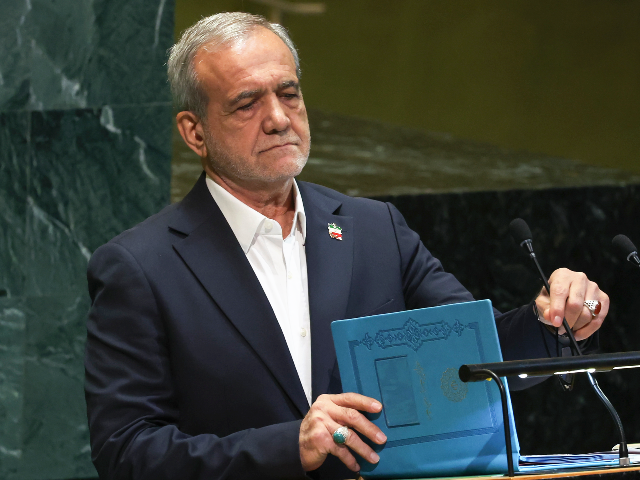

Iranian President Masoud Pezeshkian declared in conversation with Japanese Prime Minister Takaichi Sanae on Thursday that his country is ready for new negotiations to end hostilities with the United States — provided Washington drops its priority issues.
The president described America’s demands — the most prominent of which is an agreement that ensures the Islamic terror state will never possess a nuclear weapon — as “maximalist” and unreasonable, reportedly attempting to present Tehran as the rational action in conversation with Takaichi, a prominent conservative American ally. Pezeshkian’s remarks were published in part by the state-run Iranian Islamic Republic News Agency (IRNA).
“Iran is ready to continue diplomacy if US maximalist approach stops,” he reportedly told Takaichi, accusing America and Israel, which is also involved in the current conflict, of “war crimes” for targeting Iranian terror leaders. The president, who is subservient to “supreme leader” Mojtaba Khamenei, demanded an end to American “provocative actions” and suggested that the ongoing American blockade on Iranian ships in the Strait of Hormuz would “further escalate the situation in the region.”
Iran itself is maintaining a blockage of commercial traffic in the Strait of Hormuz, threatening to attack random civilian vessels as a way to pressure the world into ending American operations against it. The American blockade against strictly Iran-linked vessels was a response to this initial belligerent act by Iran.
Contrary to Pezeshkian, however, Foreign Ministry spokesman Esmail Baqaei said on television on Thursday that Iran is dismissing further talks with America as Washington’s demands are “not serious.”
“He underlined that the U.S. is not serious about lifting sanctions and has not learned from past mistakes,” according to IRNA.
“There is deep mistrust between the two countries, rooted in a long history of mistrust dating back even before the Islamic Revolution, the spokesperson said,” according the report, “adding that the U.S. expects its maximum demands to be accepted, while Iran has always put forward its proposals based on ending the war and establishing a ceasefire.”
Pezeshkian’s attempt at a conciliatory tone was also significantly undermined by Iranian senior clerics demanding no negotiations with America during Friday prayers. The independent news organization Iran International translated some such remarks that made clear the theocratic wing of the regime did not support a negotiated end to war under any circumstances.
“Negotiating with America means surrender,” Mashhad Friday Prayer Imam Ahmad Alamolhoda was quoted as saying. Another cleric insisted that free Iranian operations in the Strait of Hormuz were “no longer negotiable.”
The mixed messaging follows several public comments by President Donald Trump dismissing the possibility of talks for now, citing disorganization within the Iranian government.
The Pentagon launched a military attack on Iran on February 28 known as Operation Epic Fury intended to primarily degrade Iran’s missile and drone capabilities, to defend America and its allies. The operation also consisted of eliminating senior Iranian officials who posed a threat to America, most prominently “supreme leader” Ali Khamenei. His son Mojtaba was announced as the new “supreme leader” some weeks later, but he has yet to make any public appearances or visibly exercise power in any way, leading to rumors he is incapable of managing the country. Dozens of other senior officials have been killed since February, leaving unclear who exactly is running the country and pitting the civilian wing of the regime, led by Pezeshkian, against the military leaders of the terrorist Islamic Revolutionary Guard Corps (IRGC).
President Trump announced in late April that he would no longer send his negotiating team to Islamabad, Pakistan, to meet for in-person talks with the Iranians, citing the lack of coherence on the Iranian side.
“Too much time wasted on traveling, too much work! Besides which, there is tremendous infighting and confusion within their ‘leadership,'” he revealed. “Nobody knows who is in charge, including them. Also, we have all the cards, they have none! If they want to talk, all they have to do is call!!!”
President Trump has on several other occasions cited Iranian infighting as an obstacle in further talks, rather than any specific action on the American side.
“Iran has just informed us that they are in a ‘State of Collapse,’” the president wrote on his website, Truth Social, last week. “They want us to ‘Open the Hormuz Strait,’ as soon as possible, as they try to figure out their leadership situation (Which I believe they will be able to do!).”
Adding to this impression was a report published by Iran International on Thursday that Pezeshkian is struggling to keep the Foreign Ministry on his side and considering firing Foreign Minister Abbas Araghchi.
“President Masoud Pezeshkian and [Parliament] Speaker Mohammad Bagher Ghalibaf believe Araghchi has in recent weeks acted less as a cabinet minister tasked with implementing government policy and more as an aide to Ahmad Vahidi, the commander of the Revolutionary Guards,” anonymous sources allegedly told the outlet.
COMMENTS
Please let us know if you're having issues with commenting.