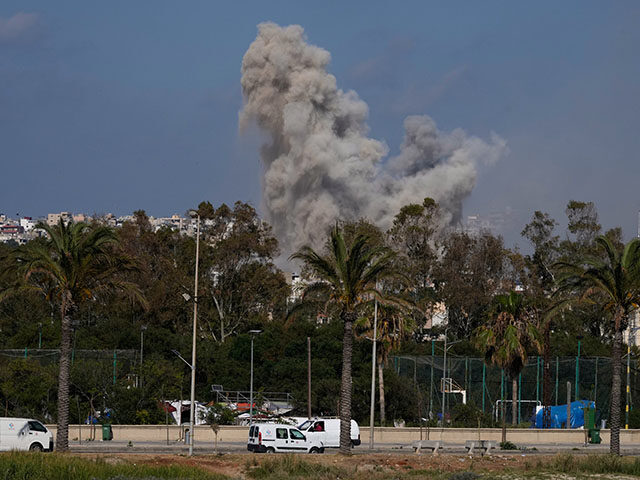

President Donald Trump said on Monday that he brokered a new ceasefire agreement between Israel and the Iran-backed Hezbollah terrorists of Lebanon, but both sides continued to launch attacks on Tuesday and the Israel Defense Forces (IDF) are still issuing evacuation orders for Lebanese communities where strikes against Hezbollah are imminent.
“I had a conversation with Bibi Netanyahu today, asking him not to go into a major raid of Beirut, Lebanon. He turned his Troops around. Thank you Bibi!” Trump wrote in a Truth Social post on Monday evening.
“I also had a conversation with Representatives of the Leaders of Hezbollah, and they agreed to stop shooting at Israel, and its soldiers. Likewise, Israel agreed to stop shooting at them. Let’s see how long that lasts — Hopefully it will be for ETERNITY!” Trump continued.
In another Truth Social post, Trump said he had a “very productive call” with Israeli Prime Minister Benjamin Netanyahu, during which Netanyahu ostensibly agreed “there will be no troops going to Beirut, and any troops that are on their way have already been turned back.”
In a phone interview with ABC News on Monday, Trump described the escalating conflict in Lebanon as a “glitch” in his negotiations with Iran, but the talks were otherwise “looking good.”
“There was a little glitch today, but I turned that one around very quickly, as you probably noticed earlier,” Trump said.
The Times of Israel (TOI) reported on Tuesday that Netanyahu and Israeli Defense Minister Israel Katz had been planning strikes on Hezbollah-dominated areas of Beirut, a step they both said they were prepared to take on Monday after Hezbollah intensified its attacks on both Israeli troops and civilians.
According to TOI, the Israeli government agreed to postpone strikes against Beirut at Trump’s urging, but it was not clear if those plans ever included ground forces. Israel has moved its forces across the Litani River – the strategic boundary between north and south Lebanon – for the first time in decades, but Netanyahu and Katz seemingly had airstrikes in mind when they spoke of attacking the Hezbollah strongholds in Beirut.
An Israeli official cited by TOI suggested that Netanyahu and Katz had announced strikes against Beirut specifically to pressure Hezbollah into accepting a ceasefire, in a gambit coordinated with Washington.
Lebanese officials, including some with ties to Hezbollah, eagerly pushed the idea of a ceasefire, although they wanted a broader deal and more permanent end to hostilities than partial ceasefire envisioned by U.S. officials. It was not clear if these Lebanese officials could actually get Hezbollah to end its attacks on Israel.
For their part, the Israelis clearly feel their security objectives have not been accomplished yet, as witnessed by Hezbollah’s continuing attacks across the Israel-Lebanon border.
“I spoke this evening with President Trump and told him that if Hezbollah does not stop attacking our cities and civilians, Israel will strike terrorist targets in Beirut. This position remains unchanged. At the same time, the IDF will continue operating in southern Lebanon as planned,” Netanyahu said on Monday night in response to Trump’s Truth Social posts.
The Lebanese embassy to the United States issued a statement on Monday that claimed Hezbollah was agreeable to the U.S. proposal for a limited ceasefire that could expand to cover all of Lebanon, if it holds.
The embassy said Hezbollah got on board after a telephone call between Lebanese President Joseph Aoun and U.S. Secretary of State Marco Rubio. Trump subsequently told Lebanese Ambassador Nada Maawad that Netanyahu signaled his approval of the deal during their phone call on Monday.
“Under the proposed arrangement, Israeli strikes on Beirut’s southern suburbs would cease in exchange for Hezbollah refraining from carrying out attacks against Israel, with the ceasefire framework to be expanded to encompass all Lebanese territories,” the Lebanese embassy said.
“The scheduled negotiation meetings on Tuesday and Wednesday are set to convene to discuss this progress and build upon it,” the statement added.
Despite these hopeful signals, Hezbollah continued launching attacks, including a rocket strike against the Israeli border community of Metula on Monday night, and a rocket attack against the city of Safed in Upper Galilee on Tuesday. The IDF said it was able to intercept the rockets fired at Safed, and no injuries were reported.
Hezbollah also reportedly attacked an Israeli military position near the Lebanese border with a drone on Tuesday. Hezbollah claimed its fighters attacked Israeli armor in the towns of Haddatha and Bayada using missiles and artillery, and its fighters were able to drive Israeli troops out of several Lebanese towns after engaging them with rockets and artillery.
The IDF responded with strikes against several Hezbollah positions in southern Lebanon. Lebanese health officials said at least nine people were killed by the strikes, including several civilians and children, plus two Lebanese soldiers. One of the strikes reportedly damaged a hospital in Tyre, the largest city in southern Lebanon.
According to Lebanon’s independent L’Orient Today, Israeli artillery struck the outskirts of Nabatieh, a strategic city on the north side of the Litani River. The IDF has reportedly encircled Nabatieh and taken control of the historic Beaufort Castle located near the city.
The IDF issued a new forced displacement order on Monday for Dahieh, a Hezbollah stronghold located south of Beirut. Local media reported a large number of residents panicked and fled toward central Beirut, causing traffic jams.
L’Orient Today saw the “murky deal announced by Trump” as a product of desperate Lebanese officials pushing for a ceasefire before the focus of the Israel-Hezbollah battle shifts to Lebanon, coupled with the Trump administration’s desire to keep Iran from bolting negotiations again, as it has threatened to do unless Israel pulls out of Lebanon.
TOI suggested that while some reports have exaggerated the tensions between Trump and Netanyahu, there could be a serious disagreement between the U.S. and Israel over including Lebanon in negotiations with Iran.
The Israelis are determined to neutralize the Hezbollah threat by severely degrading Hezbollah’s capabilities and creating a security buffer zone in southern Lebanon. Iran, meanwhile, is seeking to protect its proxy in Lebanon by exploiting anxieties in Washington, and international circles, that Israel has responded to Hezbollah attacks with excessive force.
Iranian state media on Monday conveyed threats from the Islamic Revolutionary Guard Corps (IRGC) to not only keep the Strait of Hormuz blocked, but “activate other fronts, including the Bab el-Mandep Strait,” if Israel does not pull back from Lebanon.
The Bab el-Mandeb Strait links the Red Sea with the Gulf of Aden and Indian Ocean. Iran has been threatening to use its Houthi proxies in Yemen to shut down the Bab el-Mandeb Strait with terrorist tactics.
COMMENTS
Please let us know if you're having issues with commenting.