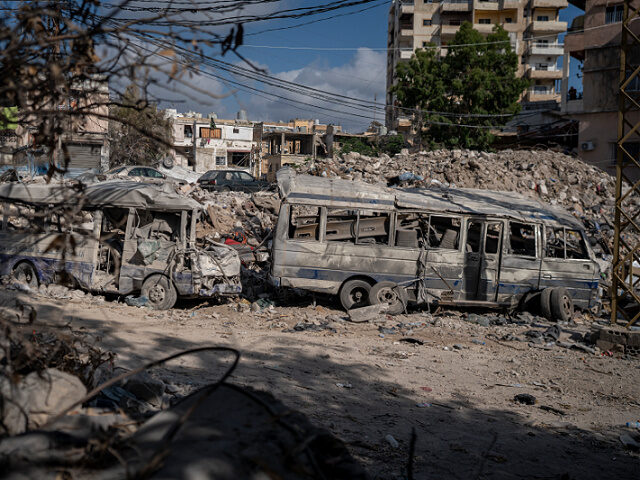

Lebanese officials complained on Monday that Israeli forces were still conducting operations on Lebanese soil, despite the peace deal ostensibly calling for all hostilities between Israel and Hezbollah to cease.
On Sunday, the Israel Defense Forces (IDF) demolished a massive Hezbollah underground complex beneath the Lebanese town of Majdal Zoun.
Israeli Prime Minister Benjamin Netanyahu and Defense Minister Israel Katz announced the demolition project on Sunday, stating that U.S. officials were duly informed in advance.
“The tunnel, which was over 200 meters long and more than 25 meters deep, contained hundreds of weapons and several launch silos intended to target the territory of the State of Israel and its citizens,” said Netanyahu and Katz in their joint statement.
“IDF commanders and fighters will remain in the security zone in southern Lebanon and will continue to destroy terrorist infrastructure, remove threats to northern communities, and safeguard the security of Israel’s citizens,” they said.
The tunnel beneath Majdal Zoun was originally scheduled to be demolished last week, along with several Hezbollah “infrastructures” near the historic Beaufort Castle in Lebanon, which Israeli forces captured in early June. At least 20 Hezbollah operatives were killed in the battle to seize the Majdal Zoun tunnel.
The IDF postponed the demolitions under pressure from the United States, as part of the U.S. peace deal with Iran. Israeli forces also halted their effort to capture a major Hezbollah “nerve center” of tunnels beneath the Ali Taher ridge.
The demolition proceeded on Sunday, conducted by forces from Israel’s 551st Brigade and the Yahalom Combat Engineers. Combat engineers said the tunnel was buried too deeply to be destroyed with airstrikes. At least one other detonation was reportedly carried out near Beaufort Castle on Monday.
Hezbollah on Monday complained about Israeli “violations” of the ceasefire, including airstrikes, drone strikes, the Majdal Zoun demolition, and “the dropping of suspicious objects” over two districts. Heavy activity by Israeli drones was reported over the southern Lebanese cities of Sidon and Nabatieh and nearby villages.
“The Islamic Resistance reiterates that the enemy’s actions constitute a blatant violation of the ceasefire to which it has adhered thus far,” the Hezbollah statement said.
Hezbollah said it is “monitoring and documenting these violations and reserves its right to defend its homeland and people.”
Lebanese officials said on Monday that about 400,000 of the roughly one million people displaced by Israel’s military operation in southern Lebanon have returned home. The government has accordingly shut down 213 of the 692 “reception centers” that housed the refugees.
A great deal of attention is now focused on the latest of many promises by the Lebanese government that it will disarm Hezbollah and prevent future attacks on Israeli civilians.
Writing at the Foundation for Defense of Democracies (FDD) on Monday, research fellow Hussain Abdul-Hussain argued that Lebanon has finally made a “deal with teeth,” because Israel will hold on to much of southern Lebanon as a “security buffer” if Beirut does not neutralize the Hezbollah threat.
“Past ceasefires bought Hezbollah time to rebuild. This agreement makes the recovery of Lebanese territory contingent on results, leaving Lebanon with a binary and inescapable choice,” Abdul-Hussain noted — that choice being to either collect Hezbollah’s weapons and dismantle its military sites or kiss southern Lebanon goodbye.
Abdul-Hussain said one of the best signs that this disarmament agreement is better than all of its predecessors is that Hezbollah opposes this one strongly and is boiling with fury at the government in Beirut for signing it. The Iran-backed terrorists are essentially demanding that Lebanon formally become a satrapy of Tehran to gain its “protection,” an arrangement that most Lebanese who are not Shiite Muslims will not find appealing.
“Hezbollah’s moves are not the actions of a confident movement. They are the response of a militia that understands a sovereign Lebanese government negotiating peace threatens its Iranian project more than battlefield losses do,” Abdul-Hussain contended.
On the other hand, some leaders in vulnerable Israeli territory see signs that Hezbollah is once again using the respite of a ceasefire to rearm and replenish its numbers.
“We’re in a kind of euphoria right now. I feel people are getting carried away and aren’t reading the situation correctly. I don’t think this agreement brings any real breakthrough, and I don’t know how it improves our security,” Eitan Davidi, chairman of the Margaliot moshav (collective farm), told Ynet News on Monday.
Davidi praised the peace deal for achieving official Lebanese recognition of Israel and validating the IDF’s “legitimacy” to remain in the buffer zone until the Hezbollah threat is neutralized, but he was not enthusiastic that the new deal would do a better job of eliminating Hezbollah weapons than the entirely ineffective bargain Israel struck with Beirut in November 2024.
“It’s not that I don’t believe the Lebanese don’t want to do it. They very much want to, but they can’t. In effect, we’ve signed an agreement with a government that’s incapable of delivering results and cannot disarm Hezbollah,” he said.
IDF officials told Haaretz on Monday that Israel’s deal with Lebanon commits the IDF only to “redeployment” and “repositioning,” not outright “withdrawal,” and the IDF does not expect to be redeploying completely out of Lebanon any time soon.
“As of this moment, the IDF is not withdrawing from anywhere. Despite the understandings, it is not clear when and how the withdrawal will actually be carried out, and this depends on the guarantees that we see from the political echelon,” said an Israeli military source.
Haaretz said the IDF is still “uneasy” about U.S. negotiations with Iran, but feels much more optimistic about Israel’s deal with Lebanon, which could establish a highly desirable level of coordination between the IDF and the Lebanese Army.
The next round of Israeli demolitions could put that newfound coordination to the test because the IDF has mapped out a large underground complex around Beaufort Castle. At least one of those underground structures is reportedly a four-story underground bunker constructed for Hezbollah by Iran. Another tunnel appears to have “dozens of Hezbollah operatives” trapped inside, and the IDF is not inclined to let them leave without surrendering.
COMMENTS
Please let us know if you're having issues with commenting.