The governments of both Japan and China claimed on Tuesday to have menaced each other’s ships out of the waters surrounding the Japanese-controlled Senkaku Islands, accusing each other of violating their respective sovereign territory.
The Chinese Coast Guard (CCG) issued a statement claiming that a Japanese fishing boat had “illegally entered the territorial waters” of China and, in response, the Coast Guard “took necessary law enforcement measures,” forcing it to leave.
The Chinese state propaganda outlet Global Times relayed a message from a Coast Guard spokesman who said “the Diaoyu Dao [Senkaku Islands] and its affiliated islets are China’s inherent territory and urged the Japanese side to immediately stop all acts of infringement and provocation in these waters.”
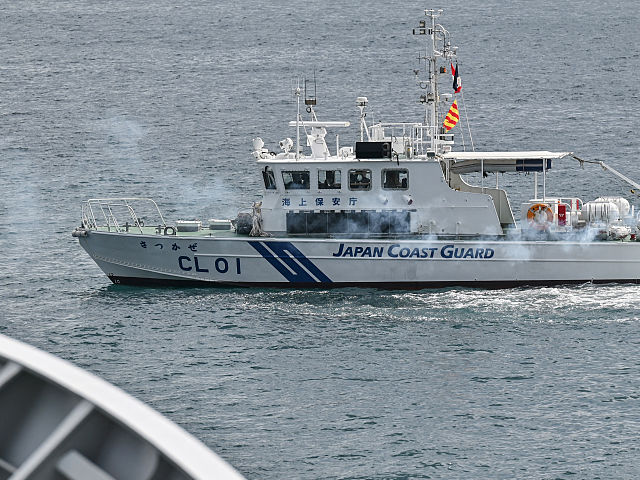
The Japanese Coast Guard issued a separate statement claiming that it, not the Chinese government, had expelled illegally present ships from the Senkaku waters. According to Tokyo, two Chinese government ships illegally crossed into Japanese waters and were expelled.
“The coast guard says both vessels sailed in Japanese waters for about three hours then left. It adds that they were equipped with cannons,” the Japanese network NHK reported. “Coast guard patrollers are continuing to monitor the ships and warning them not to enter Japan’s waters.”
While NHK did not mention any shipping vessel, the report comparing the Chinese and Japanese accounts in the BBC indicated that the Japanese Coast Guard did mention that a fishing boat was caught in the dispute, but Japanese authorities “ensured the fishing boat’s safety until the CCG left the territory a few hours later.”
The Senkaku Islands, which China refers to by the name “Diaoyu,” are a small group of uninhabited islands in the East China Sea. While the islands themselves have no population, they are considered resource-rich for both mineral and fishing wealth. China and Japan had initially agreed to a resource-sharing deal in 2008, but that has since given way to increasing tensions over the territory. Japan has formally controlled the islands since 2012 and claims them as historically Japanese territory, while communist China has more recently escalated its harassment of Japanese vessels in the waters around the islands, claiming them as Chinese.
China declared the imposition of an Air Defense Identification Zone (ADIZ) over the islands in 2013 which would force Japanese aircraft to identify themselves to the Chinese government while flying in Japanese airspace, but Beijing has not actively pursued enforcement after multiple American presidencies affirmed the United States would defend Japan in the event of a Chinese invasion of the islands.
China’s dispute with Japan over the Senkaku Islands is separate from its frivolous claims over most of the South China Sea, including the Paracel and Spratly Islands which overlap with the sovereign territories of Brunei, Vietnam, the Philippines, Malaysia, and Taiwan. China lost a case before the Permanent Court of Arbitration at the Hague brought by the Philippines over its claims in the South China Sea in 2016. The court has not similarly addressed the East China Sea dispute.
The latest exchange in the East China Sea is the most recent since November 16 and occurs in the greater context of increasing tensions between China and Japan. The Chinese government, which regularly threatens to invade and colonize Taiwan, has threatened violence and made complaints at international venues against Japanese Prime Minister Takaichi Sanae for comments in which she hinted that Japan would defend Taiwan in the event of a Chinese invasion. Speaking to the Japanese parliament, the Diet, on November 7, Takaichi described a hypothetical Chinese invasion of Taiwan as a “worst-case scenario” and a “situation threatening Japan’s survival.” The use of terminology describing a Taiwan invasion as an existential threat to Japan reflected language found in Japanese law, which strictly curtails military action unless a threat emerges that threatens the existence of the country.
The Chinese Communist Party took the remarks to be a military challenge to China. The Chinese consul general in Osaka, Xue Jian, published a now-deleted message on Twitter in which he threatened to behead Takaichi.
“We have no choice but to cut off that dirty neck that has lunged at us without a moment’s hesitation. Are you ready?” he wrote.
The Senkaku Islands dispute elicited concern from Takaichi separately from the situation around Taiwan. On November 1, Takaichi met with genocidal Chinese dictator Xi Jinping and reportedly raised the issue of increasingly bold Chinese incursions into Japanese waters. Even before Takaichi became prime minister in late October — a month prior — the Japanese outlet Kyodo News published an analysis article warning of the growing and aggressive Chinese presence in Japanese waters.
“Chinese coast guard vessels have become a near-permanent fixture near the Senkaku Islands, a group of uninhabited islets administered by Japan but claimed by China as Diaoyu,” Kyodo observed. “For 286 consecutive days — through storms and squalls — the ships have patrolled the fringes of Japanese territorial waters in an unmistakable show of force.”
The outlet spoke to fishermen in Okinawa who noted that the Chinese fleet was more robust that it had been in the past, allowing it to withstand storms to harass them.
“As of the end of August, Chinese vessels have stayed near the islands for 286 straight days, much longer than the previous mark of 215,” Kyodo reported. “They were spotted on 355 days in 2024 alone, the highest since Japan brought the islets under state control in 2012.”
COMMENTS
Please let us know if you're having issues with commenting.