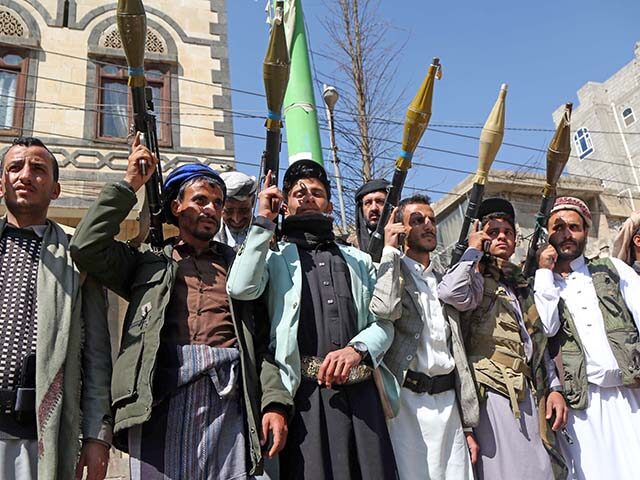
The Southern Transitional Council (STC), the Yemeni separatist movement that abruptly abandoned its alliance with the deposed national government last month and began snapping up oil-rich territory in southern Yemen, is urging the United States to support them against the Iran-backed Houthi extremists who control the northern half of the country.
The STC is a pseudo-government that has always insisted on remaining distinct from the Presidential Leadership Council (PLC), the internationally recognized national government that fled to the port city of Aden after the Houthis captured the national capital, Sanaa, in 2014.
The STC began reminding everyone of just how distinct it was by taking control of two strategic southern provinces in early December. On Wednesday, the group added a third province to its conquests and said it was gearing up for a major offensive against the Houthis to dislodge them from Sanaa. The STC is refusing demands from both the PLC and the United Nations to withdraw from the territory it has occupied.
Some STC spokesmen have justified their territorial conquests by saying the PLC government is too weak and passive to fight the Houthis, so it was time for the more energetic STC to take the wheel. Ahmed Atef, the STC’s representative to the United Nations, made a version in an interview on Wednesday.
Atef said the STC’s swift conquest of the oil-rich southern provinces was a “major success” that proved the separatists have the willpower and capability to defeat the Houthis.
“They have this slogan of ‘death to America, death to Israel,’ which is really very unacceptable,” he said. The Houthi slogan, in full, is “Allahu Akbar, death to the United States, death to Israel, curse the Jews, victory for Islam.”
Atef warned that if the Houthis retained control of Sanaa and northern Yemen, they will “continue threatening maritime traffic in the Red Sea, continue threatening us in the South and Saudi Arabia, and continue threatening the UAE and the Gulf region.”
Atef stressed that the ultimate goal of the STC remains independence for southern Yemen, which he billed as a more stable and secure nation that would be friendly to the Western world.
“Once we have got this front against the Houthis strengthened and emboldened with the support of the international community and the United States, that is going to help us very much on the ground to continue our fight and bring stability and peace to the region,” he said.
The unified Republic of Yemen has only existed for 35 years. Before that, southern Yemen was a dire Marxist “people’s republic” that fell apart when subsidies from the collapsing Soviet Union dried up, and before that it was a British protectorate centered around Aden. North Yemen, on the other hand, was a property of the Ottoman Empire until the empire disintegrated after World War I.
Yemen could break into more than two pieces if the STC gets its way, given the multitude of armed factions that have gained strength in the country since the Houthi insurgency, although Atef and other STC spokesmen claim they have the strength to keep all the southern and eastern factions in line.
The PLC, on the other hand, appears to have little influence or military strength. Some of its leaders fled from Aden to Saudi Arabia when the STC began conquering provinces. The highest-ranking member of the PLC government remaining in Yemen is probably Vice President Aidarous al-Zubaidi – who also happens to be the leader of the STC.
Saudi forces are massing along the border of Yemen and have even launched some artillery strikes against targets in the border region. The STC is strongly backed by the Saudis’ Gulf allies, the United Arab Emirates (UAE), but the Saudis support the PLC and might even be willing to use airstrikes to force the STC to relinquish control of the provinces it has taken. The STC has already refused at least one public demand from the Saudis to withdraw from the oil province of Hadramaut.
“So far Saudi Arabia has tried strategic patience, but I do not think that will last. It does not mean it will necessarily go into a direct war with the UAE in Yemen. But Yemen is a poor country with too many young fighters and too many proxies. Both sides are putting all their cards on the table,” Chatham House researcher Farea al-Muslimi told the UK Guardian on Thursday.
“While much of what that has happened is not surprising for Yemen observers, the optics is too humiliating for Saudi Arabia. This is playing out on its borders, not those of the UAE,” al-Muslimi added.
COMMENTS
Please let us know if you're having issues with commenting.