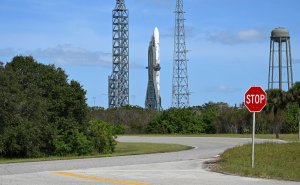
Nov. 13 (UPI) — Blue Origin’s New Glenn booster rocket successfully launched its second-ever trip into space on Thursday to deploy two NASA satellites that are bound for Mars.
The unmanned New Glenn rocket successfully lifted off shortly after 4 p.m. EST from Cape Canaveral Space Force Station’s Launch Complex 36, carrying a payload of two satellites.
Following its initial separation, the reusable booster rocket returned to Earth and landed on a drone.
The booster rocket reached a top speed of about 4,700 mph before its engines shut off ahead of the second-stage separation as its payload continued further into space.
The New Glenn rocket also reached an altitude of nearly 330,000 feet before returning to Earth and landing on the drone ship following the second stage separation three minutes and 15 seconds after launch.
The New Glenn rocket landed on the drone vessel in the Atlantic Ocean about nine minutes and 20 seconds after launch.
Thursday’s mission launch originally was scheduled on Sunday, but local weather scrubbed that attempt, as did space weather caused by solar flares on Wednesday.
Thursday’s launch was scheduled for between 2:57 p.m. EST and 4:25 and was preceded by loading the booster rocket with propellant from 11 a.m. to 1 p.m., according to the Orlando Sentinel.
The local weather offered better than a 95% chance of a launch on Thursday, but space weather remained a concern.
The mission, dubbed NG-2, launched amid cheers from spectators at Cherie Down Park and Jetty Park near the launch site.
The successful launch enabled NASA to initiate its Escape and Plasma Acceleration and Dynamics Explorers probes that are part of the space agency’s Small Innovative Missions for Planetary Exploration program.
The ESCAPADE mission seeks to help determine how Mars’ atmosphere might have changed over billions of years and its potential impact on future manned or robotic missions to the planet.
Rocket Lab built the two probes, which will record observations of plasma and magnetic fields around Mars to learn how atoms are removed from the planet’s upper atmosphere and its magnetosphere.
Scientists hope the observational data will help explain whyMars has a very thin atmosphere.
NASA budgeted $75 million for the mission, including $20 million to pay Blue Origin for the use of its New Glenn rocket.
The successful mission firmly establishes Jeff Bezos-owned Blue Origin as a competitor to Elon Musk’s SpaceX in the commercial space industry.
COMMENTS
Please let us know if you're having issues with commenting.